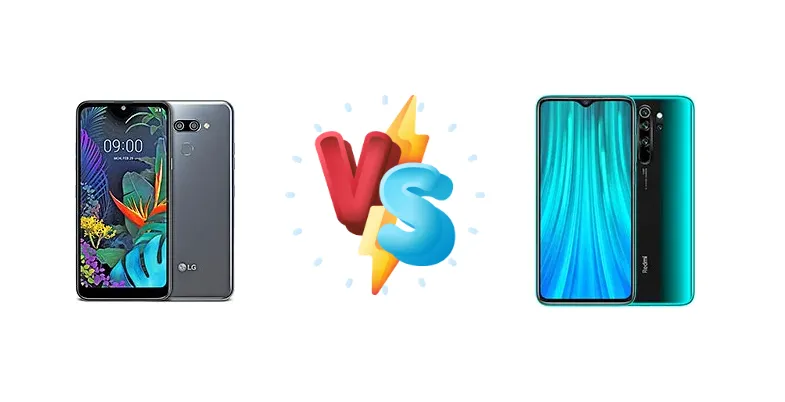
The LG K50 and Xiaomi Redmi Note 8 Pro represent distinct approaches to the budget smartphone market. The K50 aims for affordability, while the Redmi Note 8 Pro attempts to pack in features typically found in higher-priced devices. This comparison dissects their key differences, focusing on performance, display quality, and camera capabilities to help you determine which phone best suits your needs.
🏆 Quick Verdict
For the average user, the Xiaomi Redmi Note 8 Pro is the clear winner. Its significantly more powerful Helio G90T chipset and brighter display provide a superior experience for gaming and media consumption, justifying the potential price difference. The LG K50 remains a viable option for basic tasks, but struggles to compete in demanding scenarios.
| Network |
|---|
| 2G bands | GSM 850 / 900 / 1800 / 1900 | GSM 850 / 900 / 1800 / 1900 |
| 3G bands | HSDPA 850 / 900 / 1900 / 2100 | HSDPA 850 / 900 / 1900 / 2100 |
| 4G bands | 1, 3, 7, 8, 20, 38 | 1, 3, 5, 7, 8, 40, 41 |
| Speed | HSPA 42.2/5.76 Mbps, LTE (2CA) Cat6 300/75 Mbps | HSPA, LTE |
| Technology | GSM / HSPA / LTE | GSM / HSPA / LTE |
| Launch |
|---|
| Announced | 2019, February. Released 2019, August | 2019, August 29. Released 2019, September 24 |
| Status | Discontinued | Discontinued |
| Body |
|---|
| Build | - | Glass front (Gorilla Glass 5), glass back (Gorilla Glass 5), plastic frame |
| Dimensions | 161.3 x 77 x 8.7 mm (6.35 x 3.03 x 0.34 in) | 161.4 x 76.4 x 8.8 mm (6.35 x 3.01 x 0.35 in) |
| SIM | · Nano-SIM· Nano-SIM + Nano-SIM | Nano-SIM + Nano-SIM |
| Weight | 170 g (6.00 oz) | 200 g (7.05 oz) |
| | MIL-STD-810G compliant*
*does not guarantee ruggedness or use in extreme conditions | - |
| Display |
|---|
| Protection | - | Corning Gorilla Glass 5 |
| Resolution | 720 x 1520 pixels, 19:9 ratio (~269 ppi density) | 1080 x 2340 pixels, 19.5:9 ratio (~395 ppi density) |
| Size | 6.26 inches, 97.8 cm2 (~78.8% screen-to-body ratio) | 6.53 inches, 104.7 cm2 (~84.9% screen-to-body ratio) |
| Type | IPS LCD | IPS LCD, HDR, 500 nits (typ) |
| Platform |
|---|
| CPU | Octa-core 2.0 GHz Cortex-A53 | Octa-core (2x2.05 GHz Cortex-A76 & 6x2.0 GHz Cortex-A55) |
| Chipset | Mediatek MT6762 Helio P22 (12 nm) | Mediatek MT6785V/CC Helio G90T (12 nm) |
| GPU | PowerVR GE8320 | Mali-G76 MC4 |
| OS | Android 9.0 (Pie) | Android 9.0 (Pie), upgradable to Android 11, MIUI 12.5 |
| Memory |
|---|
| Card slot | microSDXC (dedicated slot) | microSDXC (uses shared SIM slot) |
| Internal | 32GB 3GB RAM | 64GB 4GB RAM, 64GB 6GB RAM, 128GB 4GB RAM, 128GB 6GB RAM, 128GB 8GB RAM, 256GB 8GB RAM |
| | eMMC 5.1 | UFS 2.1 |
| Main Camera |
|---|
| Dual | 13 MP, f/2.2, 26mm (wide), PDAF
Auxiliary lens | - |
| Features | LED flash, panorama, HDR | LED flash, HDR, panorama |
| Quad | - | 64 MP, f/1.9, 26mm (wide), 1/1.72", 0.8µm, PDAF
8 MP, f/2.2, 13mm (ultrawide), 1/4.0", 1.12µm
2 MP (macro)
Auxiliary lens |
| Video | 1080p@30fps | 4K@30fps, 1080p@30/60/120fps, 720p@960fps, gyro-EIS |
| Selfie camera |
|---|
| Features | - | HDR, panorama |
| Single | 13 MP, f/2.0, 1/3.1", 1.12µm | 20 MP, f/2.0, (wide), 1/3", 0.9µm |
| Video | 1080p@30fps | 1080p@30fps |
| Sound |
|---|
| 3.5mm jack | Yes | Yes |
| 35mm jack | Yes | Yes |
| Loudspeaker | Yes | Yes |
| Comms |
|---|
| Bluetooth | 5.0, A2DP, LE | 5.0, A2DP, LE |
| Infrared port | - | Yes |
| NFC | Yes (market/region dependent) | Yes |
| Positioning | GPS, GLONASS | GPS, GLONASS, GALILEO, BDS |
| Radio | No | FM radio, recording |
| USB | microUSB 2.0, OTG | USB Type-C 2.0 |
| WLAN | Wi-Fi 802.11 a/b/g/n/ac, dual-band, Wi-Fi Direct, DLNA | Wi-Fi 802.11 a/b/g/n/ac, dual-band, Wi-Fi Direct |
| Features |
|---|
| Sensors | Fingerprint (rear-mounted), accelerometer, proximity | Fingerprint (rear-mounted), accelerometer, gyro, proximity, compass |
| Battery |
|---|
| Charging | - | 18W wired |
| Type | Li-Po 3500 mAh, non-removable | Li-Po 4500 mAh, non-removable |
| Misc |
|---|
| Colors | Aurora Black, Moroccan Blue, Platinum Gray | Black, Red, Blue, White, Deep Sea Blue, Midnight Blue, Electric Blue, Twilight Orange |
| Models | LMX520BMW, LMX520EMW, LM-X520, 802LG | 2015105, M1906G7I, M1906G7G |
| Price | About 180 EUR | About 220 EUR |
| SAR | - | 1.15 W/kg (head) 1.18 W/kg (body) |
| SAR EU | - | 1.00 W/kg (head) 1.47 W/kg (body) |
| Tests |
|---|
| Audio quality | - |
Noise -93.6dB / Crosstalk -91.9dB |
| Battery life | - | Endurance rating 114h |
| Camera | - |
Photo / Video |
| Display | - |
Contrast ratio: 1326:1 (nominal) |
| Loudspeaker | - |
Voice 64dB / Noise 71dB / Ring 82dB |
| Performance | - |
AnTuTu: 224759 (v7), 279355 (v8)
GeekBench: 6999 (v4.4), 1622 (v5.1)
GFXBench: 14fps (ES 3.1 onscreen) |
LG K50
- Extremely affordable price point
- Decent battery life for basic usage
- Simple and user-friendly interface
- Weak processor struggles with demanding tasks
- Likely lower display brightness and quality
- Limited camera capabilities
Xiaomi Redmi Note 8 Pro
- Powerful Helio G90T processor for gaming and multitasking
- Bright and vibrant display
- Faster 18W charging
- Potentially higher price than the LG K50
- May have more bloatware
- Larger size and weight compared to the K50
Display Comparison
The Redmi Note 8 Pro boasts a significantly more appealing display experience. While both phones share a 1326:1 contrast ratio, the Redmi Note 8 Pro’s measured peak brightness of 640 nits far exceeds what we’d expect from the K50, resulting in better visibility outdoors. The K50’s display specifications are not provided, suggesting a lower brightness level. This difference is crucial for users who frequently use their phones in sunlight. While both displays share the same contrast ratio, the Redmi Note 8 Pro’s higher brightness translates to a more vibrant and engaging visual experience.
Camera Comparison
Both phones are listed as having Photo/Video capabilities, but the details are sparse. Without specific sensor information, it’s difficult to make a definitive judgment. However, given the Redmi Note 8 Pro’s positioning as a feature-rich device, it’s likely to have a more advanced camera system. The G90T’s image signal processor (ISP) is also more capable than the P22’s, allowing for better image processing and potentially superior low-light performance. The LG K50’s camera is likely focused on providing basic functionality, while the Redmi Note 8 Pro aims for a more comprehensive photographic experience.
Performance
The performance gap between these two devices is substantial. The Xiaomi Redmi Note 8 Pro’s Mediatek Helio G90T (12 nm) features a combination of Cortex-A76 and Cortex-A55 cores, offering a significant architectural advantage over the LG K50’s Helio P22 (12 nm) and its all-Cortex-A53 configuration. The G90T’s A76 cores deliver considerably higher single-core performance, while the combination of both core types provides a more balanced multi-core experience. This translates to smoother multitasking, faster app loading times, and a much more enjoyable gaming experience on the Redmi Note 8 Pro. The K50’s P22 is adequate for basic tasks, but will struggle with demanding applications and games.
Battery Life
Both devices share an endurance rating of 114 hours, suggesting comparable battery life under similar usage conditions. However, the Redmi Note 8 Pro’s 18W wired charging capability provides a significant advantage over the K50, which lacks fast charging specifications. This means the Redmi Note 8 Pro can be topped up much more quickly, minimizing downtime. While both phones offer all-day battery life for moderate users, the Redmi Note 8 Pro’s faster charging is a valuable convenience feature.
Buying Guide
Buy the LG K50 if you prioritize extreme affordability and only need a phone for basic communication, light web browsing, and social media. It's a good choice for first-time smartphone users or those on a very tight budget. Buy the Xiaomi Redmi Note 8 Pro if you value performance, a better display for media, and a more capable camera system. It's ideal for mobile gamers, content creators, and anyone who wants a more versatile smartphone experience.
Frequently Asked Questions
❓ Is the Redmi Note 8 Pro's Helio G90T chipset capable of running demanding games like PUBG Mobile at high settings?
Yes, the Helio G90T is specifically designed for gaming. It can comfortably run PUBG Mobile at high settings with smooth frame rates. The combination of Cortex-A76 and Cortex-A55 cores, along with a capable GPU, provides the necessary processing power for a good gaming experience.
❓ How much faster is the 18W charging on the Redmi Note 8 Pro compared to a standard 10W charger?
The 18W charging on the Redmi Note 8 Pro significantly reduces charging time. While exact times vary depending on battery level and usage, you can expect a full charge to take approximately 2-2.5 hours with the 18W charger, compared to 3.5-4 hours with a standard 10W charger. This is a substantial time saving for users who need to quickly top up their battery.
❓ Will the LG K50 struggle with modern social media apps like TikTok and Instagram?
The LG K50's Helio P22 processor may exhibit some lag and slowdown when running demanding social media apps like TikTok and Instagram, especially when multitasking. While it can run these apps, the experience won't be as smooth or responsive as on the Redmi Note 8 Pro.