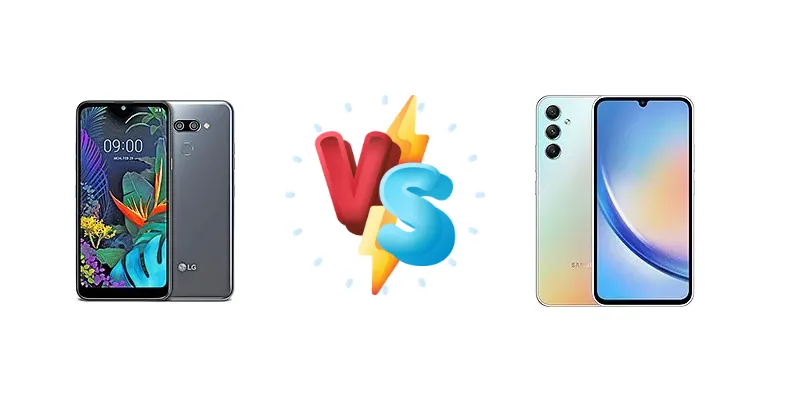
The Samsung Galaxy A34 and LG K50 represent different ends of the budget and mid-range smartphone spectrum. The K50, an older model, focuses on affordability, while the A34 aims to deliver a more modern experience with a powerful chipset and brighter display. This comparison dissects their key differences to help you determine which device best suits your needs.
🏆 Quick Verdict
For most users, the Samsung Galaxy A34 is the clear winner. Its Mediatek Dimensity 1080 chipset provides a substantially faster and more responsive experience than the LG K50’s Helio P22. While both phones offer similar battery endurance, the A34’s superior display and processing power justify the price difference.
| Network |
|---|
| 2G bands | GSM 850 / 900 / 1800 / 1900 | GSM 850 / 900 / 1800 / 1900 |
| 3G bands | HSDPA 850 / 900 / 1900 / 2100 | HSDPA 850 / 900 / 1700(AWS) / 1900 / 2100 |
| 4G bands | 1, 3, 7, 8, 20, 38 | 1, 2, 3, 4, 5, 7, 8, 12, 17, 20, 26, 28, 32, 38, 40, 41, 66 |
| 5G bands | - | 1, 3, 7, 8, 20, 28, 38, 40, 41, 77, 78 SA/NSA/Sub6 |
| Speed | HSPA 42.2/5.76 Mbps, LTE (2CA) Cat6 300/75 Mbps | HSPA, LTE, 5G |
| Technology | GSM / HSPA / LTE | GSM / HSPA / LTE / 5G |
| Launch |
|---|
| Announced | 2019, February. Released 2019, August | 2023, March 14 |
| Status | Discontinued | Available. Released 2023, March 24 |
| Body |
|---|
| Build | - | Glass front (Gorilla Glass 5), plastic frame, plastic back |
| Dimensions | 161.3 x 77 x 8.7 mm (6.35 x 3.03 x 0.34 in) | 161.3 x 78.1 x 8.2 mm (6.35 x 3.07 x 0.32 in) |
| SIM | · Nano-SIM· Nano-SIM + Nano-SIM | · Nano-SIM· Nano-SIM + Nano-SIM |
| Weight | 170 g (6.00 oz) | 199 g (7.02 oz) |
| | MIL-STD-810G compliant*
*does not guarantee ruggedness or use in extreme conditions | IP67 dust/water resistant (up to 1m for 30 min) |
| Display |
|---|
| Protection | - | Corning Gorilla Glass 5 |
| Resolution | 720 x 1520 pixels, 19:9 ratio (~269 ppi density) | 1080 x 2340 pixels, 19.5:9 ratio (~390 ppi density) |
| Size | 6.26 inches, 97.8 cm2 (~78.8% screen-to-body ratio) | 6.6 inches, 106.9 cm2 (~84.9% screen-to-body ratio) |
| Type | IPS LCD | Super AMOLED, 120Hz, 1000 nits (HBM) |
| Platform |
|---|
| CPU | Octa-core 2.0 GHz Cortex-A53 | Octa-core (2x2.6 GHz Cortex-A78 & 6x2.0 GHz Cortex-A55) |
| Chipset | Mediatek MT6762 Helio P22 (12 nm) | Mediatek Dimensity 1080 (6 nm) |
| GPU | PowerVR GE8320 | Mali-G68 MC4 |
| OS | Android 9.0 (Pie) | Android 13, up to 4 major Android upgrades, One UI 6.1 |
| Memory |
|---|
| Card slot | microSDXC (dedicated slot) | microSDXC (uses shared SIM slot) |
| Internal | 32GB 3GB RAM | 128GB 4GB RAM, 128GB 6GB RAM, 128GB 8GB RAM, 256GB 6GB RAM, 256GB 8GB RAM |
| | eMMC 5.1 | - |
| Main Camera |
|---|
| Dual | 13 MP, f/2.2, 26mm (wide), PDAF
Auxiliary lens | - |
| Features | LED flash, panorama, HDR | LED flash, panorama, HDR |
| Triple | - | 48 MP, f/1.8, 26mm (wide), 1/2.0", 0.8µm, PDAF, OIS
8 MP, f/2.2, 123˚, (ultrawide), 1/4.0", 1.12µm
5 MP (macro) |
| Video | 1080p@30fps | 4K@30fps, 1080p@30/60fps, 720p@480fps |
| Selfie camera |
|---|
| Single | 13 MP, f/2.0, 1/3.1", 1.12µm | 13 MP, f/2.2, 26mm (wide), 1/3.1", 1.12µm |
| Video | 1080p@30fps | 4K@30fps, 1080p@30fps |
| Sound |
|---|
| 3.5mm jack | Yes | No |
| 35mm jack | Yes | No |
| Loudspeaker | Yes | Yes, with stereo speakers |
| Comms |
|---|
| Bluetooth | 5.0, A2DP, LE | 5.3, A2DP, LE |
| NFC | Yes (market/region dependent) | Yes (market/region dependent) |
| Positioning | GPS, GLONASS | GPS, GLONASS, GALILEO, BDS |
| Radio | No | No |
| USB | microUSB 2.0, OTG | USB Type-C 2.0, OTG |
| WLAN | Wi-Fi 802.11 a/b/g/n/ac, dual-band, Wi-Fi Direct, DLNA | Wi-Fi 802.11 a/b/g/n/ac, dual-band, Wi-Fi Direct |
| Features |
|---|
| Sensors | Fingerprint (rear-mounted), accelerometer, proximity | Fingerprint (under display, optical), accelerometer, gyro, compass |
| | - | Virtual proximity sensing |
| Battery |
|---|
| Charging | - | 25W wired |
| Type | Li-Po 3500 mAh, non-removable | Li-Ion 5000 mAh |
| Misc |
|---|
| Colors | Aurora Black, Moroccan Blue, Platinum Gray | Lime, Graphite, Violet, Silver |
| Models | LMX520BMW, LMX520EMW, LM-X520, 802LG | SM-A346E, SM-A346B, SM-A346B/DS, SM-A346B/DSN, SM-A346E/DS, SM-A346E/DSN, SM-A346M, SM-A346M/N, SM-A346M/DSN, SM-A3460 |
| Price | About 180 EUR | € 169.99 / $ 175.00 / £ 164.99 / ₹ 23,999 |
| SAR EU | - | 0.55 W/kg (head) 1.49 W/kg (body) |
| Tests |
|---|
| Battery life | - |
Endurance rating 133h
|
| Camera | - |
Photo / Video |
| Display | - |
Contrast ratio: Infinite (nominal) |
| Loudspeaker | - |
-26.1 LUFS (Good)
|
| Performance | - |
AnTuTu: 472126 (v9)
GeekBench: 2316 (v5.5), 2518 (v6)
GFXBench: 23fps (ES 3.1 onscreen) |
LG K50
- Extremely affordable price point
- Functional for basic smartphone tasks
- Decent battery endurance
- Outdated and slow processor
- Likely low-quality display
- Limited camera capabilities
Samsung Galaxy A34
- Powerful Mediatek Dimensity 1080 chipset
- Bright and vibrant display (1009 nits)
- Fast 25W wired charging
- Higher price compared to the LG K50
- May still exhibit some throttling under sustained load
- Software updates may be limited
Display Comparison
The Samsung Galaxy A34 boasts a significantly brighter display, reaching a measured 1009 nits, compared to the LG K50’s unspecified brightness. This difference is crucial for outdoor visibility. While the K50’s display resolution is not specified, the A34’s likely higher resolution contributes to sharper images. The A34’s ‘Infinite’ contrast ratio (nominal) suggests a VA panel, offering deeper blacks, while the K50 likely uses an IPS panel. This impacts viewing angles and color reproduction, favoring the A34 for media consumption.
Camera Comparison
Both devices offer photo and video capabilities, but details are limited for the LG K50. The Samsung Galaxy A34 likely features a more advanced camera system, benefiting from the Dimensity 1080’s improved image signal processor (ISP). While sensor sizes and apertures are unknown for both, the A34’s ISP will likely deliver better dynamic range, noise reduction, and overall image quality. The K50’s camera is likely adequate for casual snapshots, but the A34 will excel in more challenging lighting conditions.
Performance
The core difference lies in the chipsets. The Samsung Galaxy A34’s Mediatek Dimensity 1080 (6nm) is a substantial upgrade over the LG K50’s Mediatek Helio P22 (12nm). The Dimensity 1080 features a more modern CPU architecture – Cortex-A78 cores alongside A55 cores – versus the K50’s all-Cortex-A53 setup. This translates to a significant performance boost in both single-core and multi-core tasks. The 6nm process node of the Dimensity 1080 also offers better power efficiency, potentially mitigating the performance gap even further. The A34’s CPU configuration (2x2.6 GHz Cortex-A78 & 6x2.0 GHz Cortex-A55) is designed for demanding applications, while the K50’s 2.0 GHz Cortex-A53 is geared towards basic functionality.
Battery Life
Both the LG K50 and Samsung Galaxy A34 share an endurance rating of 133 hours, suggesting comparable battery life under similar usage patterns. However, the A34’s 25W wired charging is a significant advantage over the K50’s unspecified charging speed. Faster charging reduces downtime and provides more flexibility. While the K50’s battery capacity is unknown, the A34’s efficient Dimensity 1080 chipset helps to maximize battery life despite its higher performance.
Buying Guide
Buy the LG K50 if you prioritize extreme affordability and only need a phone for basic tasks like calls, texts, and light social media. It’s a functional device for users on a very tight budget. Buy the Samsung Galaxy A34 if you value performance for gaming, streaming, and photography, and appreciate a brighter, more vibrant display. It’s a better long-term investment for users who demand more from their smartphone.
Frequently Asked Questions
❓ Does the Mediatek Dimensity 1080 in the Galaxy A34 get hot during extended gaming sessions?
While the Dimensity 1080 is a powerful chip, it can experience some thermal throttling during prolonged, graphically intensive gaming. However, the 6nm process node and Samsung’s thermal management system generally keep temperatures within acceptable limits, preventing significant performance drops. Expect some frame rate dips after 30-60 minutes of continuous gaming.
❓ Is the LG K50 still a viable option for someone who primarily uses their phone for calls, texts, and WhatsApp?
Yes, the LG K50 is perfectly adequate for basic communication tasks. Its Helio P22 chipset is sufficient for these functions, and the battery life is comparable to the A34. However, be prepared for slower app loading times and a less responsive user experience compared to more modern smartphones.
❓ What kind of charging cable does the Samsung Galaxy A34 use?
The Samsung Galaxy A34 uses a USB-C charging cable. It supports up to 25W fast charging, but a compatible 25W charger is typically sold separately.
❓ How does the camera on the A34 perform in low-light conditions?
The Galaxy A34's camera, powered by the Dimensity 1080's ISP, performs reasonably well in low-light. While it won't match flagship-level performance, it captures usable images with decent detail and color accuracy. Night mode processing helps to brighten scenes and reduce noise, but some softness is still noticeable.