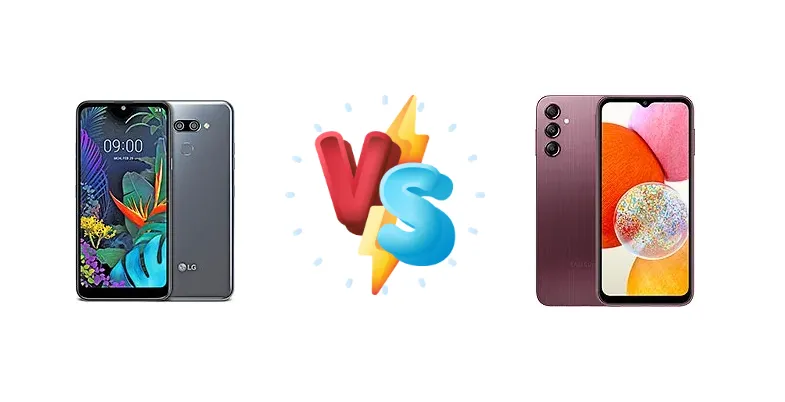
The LG K50 and Samsung Galaxy A14 represent two approaches to the budget smartphone market. The K50, an older model, aims for affordability, while the A14 offers a more modern chipset and features. This comparison dissects their key differences to determine which device delivers the best value for your money.
🏆 Quick Verdict
For most users, the Samsung Galaxy A14 is the superior choice. Its Mediatek Helio G80 chipset (or Exynos 850 variant) provides a significant performance boost over the LG K50’s Helio P22, translating to smoother multitasking and gaming. While the K50 may be cheaper, the A14’s improved processing power justifies the price difference.
| Network |
|---|
| 2G bands | GSM 850 / 900 / 1800 / 1900 | GSM 850 / 900 / 1800 / 1900 |
| 3G bands | HSDPA 850 / 900 / 1900 / 2100 | HSDPA 850 / 900 / 2100 |
| 4G bands | 1, 3, 7, 8, 20, 38 | 1, 3, 5, 7, 8, 20, 28, 38, 40, 41 |
| Speed | HSPA 42.2/5.76 Mbps, LTE (2CA) Cat6 300/75 Mbps | HSPA, LTE |
| Technology | GSM / HSPA / LTE | GSM / HSPA / LTE |
| Launch |
|---|
| Announced | 2019, February. Released 2019, August | 2023, February 28 |
| Status | Discontinued | Available. Released 2023, March 27 |
| Body |
|---|
| Build | - | Glass front, plastic back, plastic frame |
| Dimensions | 161.3 x 77 x 8.7 mm (6.35 x 3.03 x 0.34 in) | 167.7 x 78 x 9.1 mm (6.60 x 3.07 x 0.36 in) |
| SIM | · Nano-SIM· Nano-SIM + Nano-SIM | · Nano-SIM· Nano-SIM + Nano-SIM |
| Weight | 170 g (6.00 oz) | 201 g (7.09 oz) |
| | MIL-STD-810G compliant*
*does not guarantee ruggedness or use in extreme conditions | - |
| Display |
|---|
| Resolution | 720 x 1520 pixels, 19:9 ratio (~269 ppi density) | 1080 x 2408 pixels, 20:9 ratio (~400 ppi density) |
| Size | 6.26 inches, 97.8 cm2 (~78.8% screen-to-body ratio) | 6.6 inches, 104.9 cm2 (~80.2% screen-to-body ratio) |
| Type | IPS LCD | PLS LCD |
| Platform |
|---|
| CPU | Octa-core 2.0 GHz Cortex-A53 | Octa-core (2x2.0 GHz Cortex-A75 & 6x1.8 GHz Cortex-A55) - Version AOcta-core (4x2.0 GHz Cortex-A55 & 4x2.0 GHz Cortex-A55) - Version B |
| Chipset | Mediatek MT6762 Helio P22 (12 nm) | Mediatek MT6769 Helio G80 (12 nm) - Version AExynos 850 (8 nm) - Version B |
| GPU | PowerVR GE8320 | Mali-G52 MC2 |
| OS | Android 9.0 (Pie) | Android 13, upgradable to Android 15, One UI 7 |
| Memory |
|---|
| Card slot | microSDXC (dedicated slot) | microSDXC (dedicated slot) |
| Internal | 32GB 3GB RAM | 64GB 4GB RAM, 128GB 4GB RAM, 128GB 6GB RAM |
| | eMMC 5.1 | - |
| Main Camera |
|---|
| Dual | 13 MP, f/2.2, 26mm (wide), PDAF
Auxiliary lens | - |
| Features | LED flash, panorama, HDR | LED flash, panorama, HDR |
| Single | - | 13 MP, f/2.0, (wide) |
| Triple | - | 50 MP, f/1.8, 26mm (wide), 1/2.75", 0.64µm, PDAF
5 MP, f/2.2, 17mm (ultrawide), 1/5.0", 1.12µm
2 MP (macro) |
| Video | 1080p@30fps | 1080p@30fps |
| Selfie camera |
|---|
| Single | 13 MP, f/2.0, 1/3.1", 1.12µm | 13 MP, f/2.0, 26mm (wide), 1/3.1", 1.12µm |
| Video | 1080p@30fps | 1080p@30fps |
| Sound |
|---|
| 3.5mm jack | Yes | Yes |
| 35mm jack | Yes | Yes |
| Loudspeaker | Yes | Yes |
| Comms |
|---|
| Bluetooth | 5.0, A2DP, LE | 5.1 or 5.3, A2DP, LE |
| NFC | Yes (market/region dependent) | Yes (market/region dependent) |
| Positioning | GPS, GLONASS | GPS, GALILEO, GLONASS, BDS, QZSS |
| Radio | No | Unspecified |
| USB | microUSB 2.0, OTG | USB Type-C 2.0 |
| WLAN | Wi-Fi 802.11 a/b/g/n/ac, dual-band, Wi-Fi Direct, DLNA | Wi-Fi 802.11 a/b/g/n/ac, dual-band, Wi-Fi Direct |
| Features |
|---|
| Sensors | Fingerprint (rear-mounted), accelerometer, proximity | Fingerprint (side-mounted), accelerometer, proximity, compass |
| Battery |
|---|
| Charging | - | 15W wired |
| Type | Li-Po 3500 mAh, non-removable | Li-Po 5000 mAh |
| Misc |
|---|
| Colors | Aurora Black, Moroccan Blue, Platinum Gray | Black, Dark Red, Silver, Green |
| Models | LMX520BMW, LMX520EMW, LM-X520, 802LG | SM-A145F, SM-A145F/DSN, SM-A145M, SM-A145M/DS, SM-A145P, SM-A145R |
| Price | About 180 EUR | € 85.76 / $ 147.60 / £ 79.95 |
| SAR EU | - | 0.46 W/kg (head) 1.37 W/kg (body) |
LG K50
- Potentially lower price point
- Functional for basic smartphone tasks
- Simple and straightforward user experience
- Outdated processor
- Limited performance for demanding apps
- Likely slower software updates
Samsung Galaxy A14
- Significantly better performance (Helio G80 or Exynos 850)
- Faster 15W charging
- More modern features and software support
- Slightly higher price
- May include less useful 2MP macro camera
- Performance varies between Helio G80 and Exynos 850 versions
Display Comparison
Neither device is known for a standout display. Both utilize 12nm chipsets, suggesting a focus on cost reduction over premium display features. Specifics like panel type (IPS vs. TFT) and resolution are not provided, but given the price point, expect 720p displays. The A14 benefits from being a newer model, potentially offering slightly better color accuracy and viewing angles. Bezels are likely comparable, prioritizing screen real estate within a budget.
Camera Comparison
Camera performance is likely similar in real-world usage, with both phones targeting the budget segment. Details on sensor sizes and apertures are unavailable, but the A14’s image processing capabilities, benefiting from a more modern chipset, are likely superior. The inclusion of a 2MP macro camera on the A14 is a common budget feature, but its utility is limited due to the low resolution. Focusing on the main sensor, the A14’s processing power will likely result in better dynamic range and noise reduction in various lighting conditions.
Performance
The performance gap is the most significant differentiator. The LG K50’s Mediatek Helio P22, with its octa-core 2.0 GHz Cortex-A53 CPUs, is a basic processor designed for everyday tasks. The Samsung Galaxy A14, however, offers two chipset options: the Mediatek Helio G80 and the Exynos 850. The Helio G80 features a more advanced CPU configuration – two 2.0 GHz Cortex-A75 cores and six 1.8 GHz Cortex-A55 cores – offering substantially improved multi-core performance. Even the Exynos 850, with its eight 2.0 GHz Cortex-A55 cores, represents a step up due to its 8nm manufacturing process, offering better efficiency and sustained performance compared to the K50’s 12nm Helio P22. This translates to faster app loading times, smoother multitasking, and a more enjoyable gaming experience on the A14.
Battery Life
Battery life will depend heavily on usage patterns. While specific mAh capacities are not provided, the A14’s 15W wired charging is a notable advantage. The K50’s charging speed is unknown, but likely slower. The more efficient chipset in the A14 (Helio G80 or Exynos 850) will also contribute to longer battery life, even with a similar capacity battery. The 15W charging on the A14 will also reduce the time spent tethered to a power outlet.
Buying Guide
Buy the LG K50 if you prioritize absolute lowest cost and only need a phone for basic tasks like calls, texts, and light social media. It’s a functional device for minimal smartphone usage. Buy the Samsung Galaxy A14 if you want a more responsive experience, better performance for apps and games, and the assurance of a more modern device with potential for future software updates.
Frequently Asked Questions
❓ Does the Samsung Galaxy A14’s Exynos 850 chip overheat during prolonged gaming sessions?
The Exynos 850 is an 8nm chip, offering better thermal efficiency than the LG K50’s 12nm Helio P22. While it may get warm during extended gaming, it’s unlikely to experience significant throttling, providing a more consistent gaming experience than the K50.
❓ Is the 2MP macro camera on the Samsung Galaxy A14 actually useful for taking detailed close-up photos?
The 2MP macro camera is a common inclusion in budget phones, but its low resolution limits its usefulness. While it can capture close-up shots, the image quality will be noticeably lower than photos taken with the main sensor. It’s best used for casual experimentation rather than serious photography.
❓ Can the Samsung Galaxy A14 run popular games like PUBG Mobile at 60fps?
The Samsung Galaxy A14, particularly the Helio G80 variant, should be capable of running PUBG Mobile at medium settings and 60fps. However, performance may vary depending on the specific game settings and background processes. The K50 will struggle to maintain a stable 60fps in PUBG Mobile.
❓ How long will software updates be supported on the Samsung Galaxy A14 compared to the LG K50?
Samsung generally provides longer software support for its devices than LG, especially for older models like the K50. The A14 is likely to receive at least one major Android update and several years of security patches, while the K50 may have limited or no further software updates.