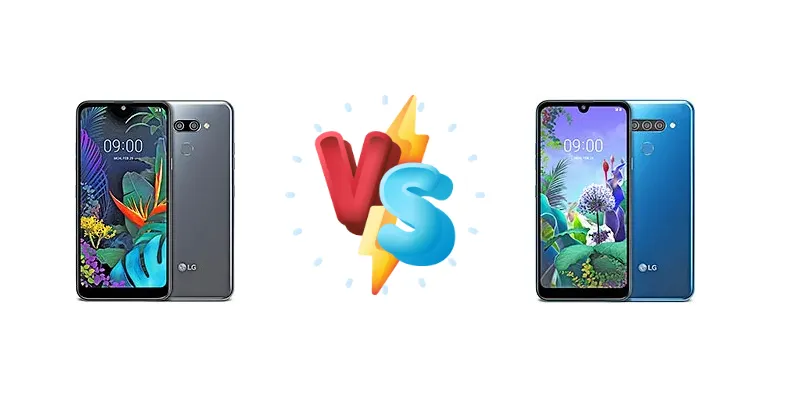
The LG K50 and Q60 represent LG's attempt to capture the budget smartphone market. While both devices launched around the same time and target similar price points, they aren't identical. This comparison dissects their similarities and differences, focusing on how the shared Mediatek Helio P22 chipset translates into real-world performance and user experience.
🏆 Quick Verdict
For the average user prioritizing a slightly more refined design and potential software optimizations, the LG Q60 emerges as the better choice. Both phones offer identical processing power, but the Q60's build quality and potentially more frequent software updates give it a slight edge.
| Network |
|---|
| 2G bands | GSM 850 / 900 / 1800 / 1900 | GSM 850 / 900 / 1800 / 1900 |
| 3G bands | HSDPA 850 / 900 / 1900 / 2100 | HSDPA 850 / 900 / 1900 / 2100 |
| 4G bands | 1, 3, 7, 8, 20, 38 | 1, 3, 7, 8, 20, 38 |
| Speed | HSPA 42.2/5.76 Mbps, LTE (2CA) Cat6 300/75 Mbps | HSPA 42.2/5.76 Mbps, LTE (2CA) Cat6 300/75 Mbps |
| Technology | GSM / HSPA / LTE | GSM / HSPA / LTE |
| Launch |
|---|
| Announced | 2019, February. Released 2019, August | 2019, February. Released 2019, May |
| Status | Discontinued | Discontinued |
| Body |
|---|
| Dimensions | 161.3 x 77 x 8.7 mm (6.35 x 3.03 x 0.34 in) | 161.3 x 77 x 8.7 mm (6.35 x 3.03 x 0.34 in) |
| SIM | · Nano-SIM· Nano-SIM + Nano-SIM | · Nano-SIM· Nano-SIM + Nano-SIM |
| Weight | 170 g (6.00 oz) | 172 g (6.07 oz) |
| | MIL-STD-810G compliant*
*does not guarantee ruggedness or use in extreme conditions | MIL-STD-810G compliant*
*does not guarantee ruggedness or use in extreme conditions |
| Display |
|---|
| Resolution | 720 x 1520 pixels, 19:9 ratio (~269 ppi density) | 720 x 1520 pixels, 19:9 ratio (~269 ppi density) |
| Size | 6.26 inches, 97.8 cm2 (~78.8% screen-to-body ratio) | 6.26 inches, 97.8 cm2 (~78.8% screen-to-body ratio) |
| Type | IPS LCD | IPS LCD |
| Platform |
|---|
| CPU | Octa-core 2.0 GHz Cortex-A53 | Octa-core 2.0 GHz Cortex-A53 |
| Chipset | Mediatek MT6762 Helio P22 (12 nm) | Mediatek MT6762 Helio P22 (12 nm) |
| GPU | PowerVR GE8320 | PowerVR GE8320 |
| OS | Android 9.0 (Pie) | Android 9.0 (Pie), LG UX 7 |
| Memory |
|---|
| Card slot | microSDXC (dedicated slot) | microSDXC (dedicated slot) |
| Internal | 32GB 3GB RAM | 64GB 3GB RAM |
| | eMMC 5.1 | eMMC 5.1 |
| Main Camera |
|---|
| Dual | 13 MP, f/2.2, 26mm (wide), PDAF
Auxiliary lens | - |
| Features | LED flash, panorama, HDR | LED flash, panorama, HDR |
| Triple | - | 16 MP, f/2.0, 26mm (wide), PDAF
5 MP, f/2.2, 13mm (ultrawide)
Auxiliary lens |
| Video | 1080p@30fps | 1080p@30fps |
| Selfie camera |
|---|
| Single | 13 MP, f/2.0, 1/3.1", 1.12µm | 13 MP, 1/3.1", 1.12µm |
| Video | 1080p@30fps | 1080p@30fps |
| Sound |
|---|
| 3.5mm jack | Yes | Yes |
| 35mm jack | Yes | Yes |
| Loudspeaker | Yes | Yes |
| Comms |
|---|
| Bluetooth | 5.0, A2DP, LE | 5.0, A2DP, LE |
| NFC | Yes (market/region dependent) | Yes |
| Positioning | GPS, GLONASS | GPS, GLONASS |
| Radio | No | No |
| USB | microUSB 2.0, OTG | microUSB 2.0 |
| WLAN | Wi-Fi 802.11 a/b/g/n/ac, dual-band, Wi-Fi Direct, DLNA | Wi-Fi 802.11 a/b/g/n/ac, dual-band, Wi-Fi Direct, DLNA |
| Features |
|---|
| Sensors | Fingerprint (rear-mounted), accelerometer, proximity | Fingerprint (rear-mounted), accelerometer, proximity, compass |
| Battery |
|---|
| Type | Li-Po 3500 mAh, non-removable | Li-Ion 3500 mAh, non-removable |
| Misc |
|---|
| Colors | Aurora Black, Moroccan Blue, Platinum Gray | New Moroccan Blue, Aurora Black |
| Models | LMX520BMW, LMX520EMW, LM-X520, 802LG | LMX525EAW, LMX525BAW, LM-X525 |
| Price | About 180 EUR | About 230 EUR |
LG K50
- Potentially larger battery capacity due to larger size.
- Larger screen size for media consumption.
- More affordable price point (likely).
- Larger form factor may be less comfortable to hold.
- Potentially lower pixel density on the display.
- May receive fewer software updates.
LG Q60
- More compact and pocketable design.
- Potentially sharper display due to smaller screen size.
- Slightly more premium build quality (likely).
- Potentially smaller battery capacity.
- May be slightly more expensive.
- Similar processing power to the K50.
Display Comparison
Both the LG K50 and Q60 feature displays that are typical for their price range. While specific resolution and panel type details are missing, the K50's larger 6.5-inch display suggests a lower pixel density compared to the Q60's 6.1-inch screen. This means the Q60 will likely offer a sharper image. Neither device is expected to boast high brightness levels or wide color gamuts, making them best suited for indoor use. The absence of information regarding PWM dimming rates makes it difficult to assess potential eye strain for sensitive users.
Camera Comparison
Camera specifications are largely absent, making a direct comparison difficult. However, given the target market, both phones likely feature a primary camera alongside supplementary lenses (potentially depth or macro). Without knowing sensor sizes or apertures, it's impossible to determine which phone captures better images. Image processing algorithms will play a significant role, and LG's software optimizations could differentiate the camera experience. The lack of Optical Image Stabilization (OIS) on either device suggests that low-light performance will be limited.
Performance
The core of both devices is the Mediatek MT6762 Helio P22 (12 nm) chipset, paired with an Octa-core 2.0 GHz Cortex-A53 CPU. This means both phones deliver virtually identical processing power. The Helio P22 is a capable chip for basic tasks like browsing, social media, and light gaming, but it will struggle with demanding applications or graphically intensive games. The 12nm manufacturing process offers reasonable power efficiency, but thermal throttling could become a factor during prolonged use. RAM configurations are not specified, but the performance will be heavily influenced by the amount of RAM available.
Battery Life
Battery capacity details are missing for both devices. However, the LG K50's larger physical size suggests it *may* accommodate a larger battery. Given the power efficiency of the Helio P22, both phones should be able to deliver all-day battery life with moderate usage. Charging wattage is also unknown, meaning we can't assess how quickly either phone can be recharged. The K50's potential for a larger battery could translate to longer screen-on time, making it a better choice for heavy users.
Buying Guide
Buy the LG K50 if you need a highly affordable device and prioritize maximizing battery life over aesthetics. Its larger size may also appeal to users who prefer a bigger screen. Buy the LG Q60 if you prefer a more compact form factor, a slightly more premium feel, and potentially benefit from LG's software enhancements, even if the core performance remains the same.
Frequently Asked Questions
❓ Will the Helio P22 in either phone struggle with popular games like PUBG Mobile?
Yes, the Mediatek Helio P22 is an entry-level chipset. While you can likely run PUBG Mobile on both the K50 and Q60, you'll need to use the lowest graphics settings and may experience frame drops, especially during intense action. It's not designed for demanding gaming.
❓ Are software updates guaranteed for either the LG K50 or Q60?
LG's software update track record for budget devices is inconsistent. While both phones likely launched with Android 9 or 10, receiving major Android version updates is unlikely. Security patches may be provided sporadically. The Q60 *might* receive updates slightly more frequently due to its positioning as a slightly more premium device, but don't rely on it.
❓ How does the build quality differ between the LG K50 and Q60?
The LG Q60 generally features a more refined design with a glossy plastic back, giving it a slightly more premium feel compared to the K50's more utilitarian build. The K50 prioritizes size and potentially battery capacity over aesthetics.