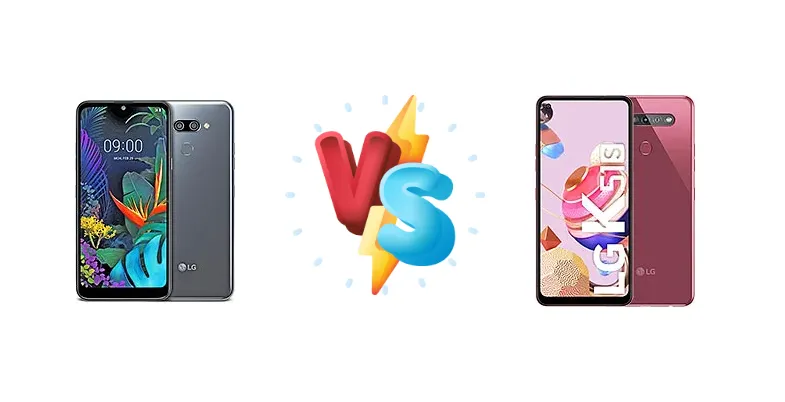
The LG K50 and K51S represent LG's attempts to capture the budget smartphone market. While visually similar, a key difference lies under the hood: the K51S boasts a more powerful processor. This comparison dives deep into the specifications to determine if the K51S's performance gains justify a potential upgrade or new purchase, especially for users prioritizing responsiveness and multitasking.
🏆 Quick Verdict
For the average user, the LG K51S is the better choice. Its Helio P35 chipset, with its faster core clock speeds, provides a noticeable performance boost over the K50's Helio P22, resulting in smoother app launches and improved multitasking. While both phones target the budget segment, the K51S offers a more future-proof experience.
| Network |
|---|
| 2G bands | GSM 850 / 900 / 1800 / 1900 | GSM 850 / 900 / 1800 / 1900 |
| 3G bands | HSDPA 850 / 900 / 1900 / 2100 | HSDPA 850 / 900 / 1900 / 2100 |
| 4G bands | 1, 3, 7, 8, 20, 38 | 1, 3, 7, 8, 20, 28, 38 |
| Speed | HSPA 42.2/5.76 Mbps, LTE (2CA) Cat6 300/75 Mbps | HSPA 42.2/5.76 Mbps, LTE (2CA) Cat6 300/50 Mbps |
| Technology | GSM / HSPA / LTE | GSM / HSPA / LTE |
| Launch |
|---|
| Announced | 2019, February. Released 2019, August | 2020, February 18. Released 2020, April 27 |
| Status | Discontinued | Discontinued |
| Body |
|---|
| Dimensions | 161.3 x 77 x 8.7 mm (6.35 x 3.03 x 0.34 in) | 165.2 x 76.7 x 8.3 mm (6.50 x 3.02 x 0.33 in) |
| SIM | · Nano-SIM· Nano-SIM + Nano-SIM | · Nano-SIM· Nano-SIM + Nano-SIM |
| Weight | 170 g (6.00 oz) | 194.5 g (6.88 oz) |
| | MIL-STD-810G compliant*
*does not guarantee ruggedness or use in extreme conditions | MIL-STD-810G compliant*
*does not guarantee ruggedness or use in extreme conditions |
| Display |
|---|
| Protection | - | Scratch-resistant glass |
| Resolution | 720 x 1520 pixels, 19:9 ratio (~269 ppi density) | 720 x 1600 pixels, 20:9 ratio (~282 ppi density) |
| Size | 6.26 inches, 97.8 cm2 (~78.8% screen-to-body ratio) | 6.55 inches, 93.6 cm2 (~73.8% screen-to-body ratio) |
| Type | IPS LCD | IPS LCD |
| Platform |
|---|
| CPU | Octa-core 2.0 GHz Cortex-A53 | Octa-core (4x2.3 GHz Cortex-A53 & 4x1.8 GHz Cortex-A53) |
| Chipset | Mediatek MT6762 Helio P22 (12 nm) | Mediatek MT6765 Helio P35 (12 nm) |
| GPU | PowerVR GE8320 | PowerVR GE8320 |
| OS | Android 9.0 (Pie) | Android 9.0 (Pie) |
| Memory |
|---|
| Card slot | microSDXC (dedicated slot) | microSDXC (dedicated slot) |
| Internal | 32GB 3GB RAM | 64GB 3GB RAM |
| | eMMC 5.1 | eMMC 5.1 |
| Main Camera |
|---|
| Dual | 13 MP, f/2.2, 26mm (wide), PDAF
Auxiliary lens | - |
| Features | LED flash, panorama, HDR | LED flash, panorama, HDR |
| Quad | - | 32 MP, (wide), PDAF
5 MP, f/2.2, 115˚, (ultrawide)
2 MP (macro)
Auxiliary lens |
| Video | 1080p@30fps | 1080p@30fps |
| Selfie camera |
|---|
| Single | 13 MP, f/2.0, 1/3.1", 1.12µm | 13 MP, 1/3.1", 1.12µm |
| Video | 1080p@30fps | 1080p@30fps |
| Sound |
|---|
| 3.5mm jack | Yes | Yes |
| 35mm jack | Yes | Yes |
| Loudspeaker | Yes | Yes |
| Comms |
|---|
| Bluetooth | 5.0, A2DP, LE | 5.0, A2DP, LE |
| NFC | Yes (market/region dependent) | Yes |
| Positioning | GPS, GLONASS | GPS |
| Radio | No | No |
| USB | microUSB 2.0, OTG | USB Type-C 2.0, OTG |
| WLAN | Wi-Fi 802.11 a/b/g/n/ac, dual-band, Wi-Fi Direct, DLNA | Wi-Fi 802.11 a/b/g/n, Wi-Fi Direct, DLNAorWi-Fi 802.11 b/g/n, Wi-Fi Direct, DLNA |
| Features |
|---|
| Sensors | Fingerprint (rear-mounted), accelerometer, proximity | Fingerprint (rear-mounted), accelerometer, proximity, compass |
| Battery |
|---|
| Type | Li-Po 3500 mAh, non-removable | Li-Po 4000 mAh |
| Misc |
|---|
| Colors | Aurora Black, Moroccan Blue, Platinum Gray | Titanium, Pink, Blue, Red |
| Models | LMX520BMW, LMX520EMW, LM-X520, 802LG | LMK510EMW, LM-K510EMW, LM-K510 |
| Price | About 180 EUR | About 200 EUR |
LG K50
- Potentially lower price point.
- Sufficient for basic smartphone tasks.
- Likely similar battery life to K51S.
- Slower processor compared to K51S.
- Less responsive user experience.
- May struggle with multitasking.
LG K51S
- Faster processor for smoother performance.
- Improved multitasking capabilities.
- More responsive user interface.
- Potentially slightly higher price.
- May not offer a significant camera upgrade.
- Battery life may be marginally lower under heavy load.
Display Comparison
Both the LG K50 and K51S likely feature similar LCD panels, given their market positioning. Specifics like resolution and brightness are not provided, but we can assume they are optimized for cost-effectiveness rather than premium visual fidelity. The focus here isn't on display quality, but on the processing power needed to drive the UI smoothly on these panels. Bezels are expected to be relatively substantial on both devices, typical of this price bracket.
Camera Comparison
Without detailed camera specifications, it's difficult to make a definitive comparison. Both phones likely feature a multi-camera setup, but image quality will heavily depend on sensor size and image processing algorithms. Given the budget nature of these devices, we can expect modest camera performance, suitable for casual snapshots in good lighting conditions. The presence of a 2MP macro lens on either device is unlikely to significantly impact image quality, serving more as a marketing feature than a practical benefit.
Performance
The core difference between these two devices is the chipset. The LG K50 utilizes the Mediatek MT6762 Helio P22, an octa-core processor clocked at 2.0 GHz using exclusively Cortex-A53 cores. The K51S steps up to the Mediatek MT6765 Helio P35. While also an octa-core processor, the P35 employs a big.LITTLE architecture with 4x2.3 GHz Cortex-A53 cores and 4x1.8 GHz Cortex-A53 cores. This architecture allows the P35 to dynamically allocate tasks to the faster cores when needed, resulting in a more responsive experience. The 15% clock speed increase on the faster cores of the K51S translates to noticeably quicker app loading times and smoother multitasking compared to the K50.
Battery Life
Battery capacity details are missing, but both phones likely feature batteries in the 3500-4000 mAh range, typical for this class. The K51S's more efficient processor, the Helio P35, could potentially offer slightly better battery life despite potentially drawing more power during peak performance. Charging wattage is also unknown, but we can assume both devices support standard 5W or 10W charging, resulting in relatively slow 0-100% charge times.
Buying Guide
Buy the LG K50 if you need a basic, functional smartphone for essential tasks like calls, texts, and light social media browsing, and are prioritizing the absolute lowest price point. Buy the LG K51S if you prefer a more responsive experience for everyday use, including moderate multitasking, occasional gaming, and a smoother overall user interface. The K51S is the better option for those who want a phone that feels less sluggish.
Frequently Asked Questions
❓ Will the LG K51S run demanding games like PUBG Mobile smoothly?
While the Helio P35 is an improvement over the P22, don't expect a high-end gaming experience. PUBG Mobile may be playable at lower graphics settings and frame rates. The K51S will offer a more stable experience than the K50, but it's still a budget chipset.
❓ Is the difference in performance between the K50 and K51S noticeable for everyday tasks like browsing and social media?
Yes, the difference is noticeable. The K51S's faster processor and big.LITTLE architecture result in quicker app launches, smoother scrolling, and a more responsive overall experience when browsing the web or using social media apps. The K50 may exhibit slight lag or stuttering during these tasks.
❓ Does the LG K51S offer any software advantages over the K50?
Both devices likely ran similar versions of LG's UX skin on top of Android at their respective launch times. Any software differences would likely be minor and related to bug fixes or security patches rather than significant feature additions.