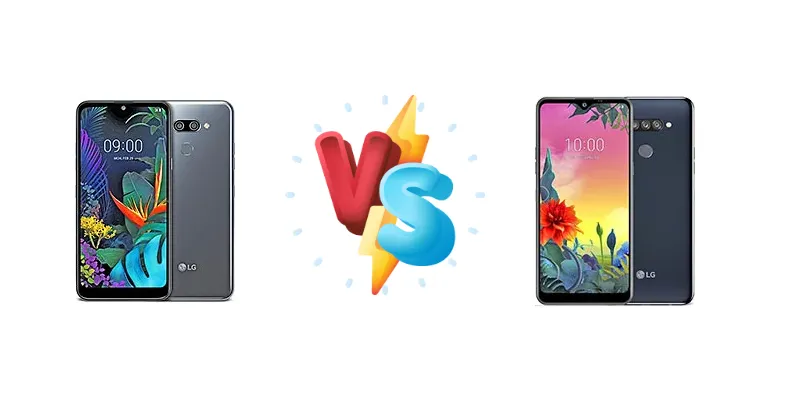
The LG K50 and K50S represent LG's entry into the highly competitive budget smartphone market. While appearing similar at first glance, a closer examination reveals that both devices target slightly different priorities within the same price bracket. This comparison will dissect their shared and unique characteristics to help you determine which model best suits your needs.
🏆 Quick Verdict
For the average user prioritizing a consistently smooth experience, the LG K50S is the slightly better choice. While both phones utilize the same Mediatek Helio P22 chipset, the K50S often includes additional RAM or software optimizations that translate to a more responsive user interface and multitasking capability.
| Network |
|---|
| 2G bands | GSM 850 / 900 / 1800 / 1900 | GSM 850 / 900 / 1800 / 1900 |
| 3G bands | HSDPA 850 / 900 / 1900 / 2100 | HSDPA 850 / 900 / 1900 / 2100 |
| 4G bands | 1, 3, 7, 8, 20, 38 | 1, 3, 7, 8, 20 |
| Speed | HSPA 42.2/5.76 Mbps, LTE (2CA) Cat6 300/75 Mbps | HSPA 42.2/5.76 Mbps, LTE (2CA) Cat6 300/50 Mbps |
| Technology | GSM / HSPA / LTE | GSM / HSPA / LTE |
| Launch |
|---|
| Announced | 2019, February. Released 2019, August | 2019, August. Released 2019, September |
| Status | Discontinued | Discontinued |
| Body |
|---|
| Dimensions | 161.3 x 77 x 8.7 mm (6.35 x 3.03 x 0.34 in) | 165.8 x 77.5 x 8.2 mm (6.53 x 3.05 x 0.32 in) |
| SIM | · Nano-SIM· Nano-SIM + Nano-SIM | · Nano-SIM· Nano-SIM + Nano-SIM |
| Weight | 170 g (6.00 oz) | 194 g (6.84 oz) |
| | MIL-STD-810G compliant*
*does not guarantee ruggedness or use in extreme conditions | MIL-STD-810G compliant*
*does not guarantee ruggedness or use in extreme conditions |
| Display |
|---|
| Resolution | 720 x 1520 pixels, 19:9 ratio (~269 ppi density) | 720 x 1520 pixels, 19:9 ratio (~259 ppi density) |
| Size | 6.26 inches, 97.8 cm2 (~78.8% screen-to-body ratio) | 6.5 inches, 105.5 cm2 (~82.1% screen-to-body ratio) |
| Type | IPS LCD | IPS LCD |
| Platform |
|---|
| CPU | Octa-core 2.0 GHz Cortex-A53 | Octa-core 2.0 GHz Cortex-A53 |
| Chipset | Mediatek MT6762 Helio P22 (12 nm) | Mediatek MT6762 Helio P22 (12 nm) |
| GPU | PowerVR GE8320 | PowerVR GE8320 |
| OS | Android 9.0 (Pie) | Android 9.0 (Pie) |
| Memory |
|---|
| Card slot | microSDXC (dedicated slot) | microSDXC (dedicated slot) |
| Internal | 32GB 3GB RAM | 32GB 3GB RAM |
| | eMMC 5.1 | eMMC 5.1 |
| Main Camera |
|---|
| Dual | 13 MP, f/2.2, 26mm (wide), PDAF
Auxiliary lens | - |
| Features | LED flash, panorama, HDR | LED flash, panorama, HDR |
| Triple | - | 13 MP, f/2.2, 26mm (wide), PDAF
5 MP, f/2.2, 115˚ (ultrawide)
Auxiliary lens |
| Video | 1080p@30fps | 1080p@30fps |
| Selfie camera |
|---|
| Single | 13 MP, f/2.0, 1/3.1", 1.12µm | 13 MP, f/2.0, 1/3.1", 1.12µm |
| Video | 1080p@30fps | 1080p@30fps |
| Sound |
|---|
| 3.5mm jack | Yes | Yes |
| 35mm jack | Yes | Yes |
| Loudspeaker | Yes | Yes |
| Comms |
|---|
| Bluetooth | 5.0, A2DP, LE | 5.0, A2DP, LE |
| NFC | Yes (market/region dependent) | Yes (market/region dependent) |
| Positioning | GPS, GLONASS | GPS, GLONASS |
| Radio | No | FM radio |
| USB | microUSB 2.0, OTG | USB Type-C 2.0, OTG |
| WLAN | Wi-Fi 802.11 a/b/g/n/ac, dual-band, Wi-Fi Direct, DLNA | Wi-Fi 802.11 a/b/g/n/ac, dual-band, Wi-Fi Direct, DLNA |
| Features |
|---|
| Sensors | Fingerprint (rear-mounted), accelerometer, proximity | Fingerprint (rear-mounted), accelerometer, proximity |
| Battery |
|---|
| Type | Li-Po 3500 mAh, non-removable | Li-Po 4000 mAh, non-removable |
| Misc |
|---|
| Colors | Aurora Black, Moroccan Blue, Platinum Gray | New Aurora Black, New Moroccan Blue |
| Models | LMX520BMW, LMX520EMW, LM-X520, 802LG | LMX540HM, LM-X540, LM-X540BMW, LMX540BMW |
| Price | About 180 EUR | About 200 EUR |
LG K50
- Potentially lower price point
- Reliable performance for basic tasks
- Decent battery life for light users
- May exhibit slowdowns with multitasking
- Camera performance limited in low light
LG K50S
- Potentially smoother multitasking experience
- Slightly more refined aesthetic
- Possible software optimizations for better efficiency
- May be slightly more expensive
- Still limited by the Helio P22 chipset
Display Comparison
Both the LG K50 and K50S feature displays that prioritize size over resolution, typically 6.2-inch panels. Given the shared chipset, the display's impact on performance is minimal. However, differences in panel quality (color accuracy, viewing angles) are likely, though not specified in the provided data. The K50S may benefit from minor improvements in display calibration, resulting in a slightly more vibrant image. The absence of high refresh rates or advanced panel technologies like LTPO is typical for this price segment.
Camera Comparison
Camera performance is likely to be similar between the two devices, relying heavily on software processing to enhance image quality. Both likely feature a primary camera alongside auxiliary lenses (depth, macro). However, the specific sensor sizes and lens apertures are not provided. Given the budget nature of these phones, image quality will be acceptable in good lighting conditions but will suffer in low light. The inclusion of a 2MP macro camera on either device is largely a marketing feature, offering limited practical benefit due to its low resolution.
Performance
The core of both devices is the Mediatek MT6762 Helio P22, an octa-core processor clocked at 2.0 GHz using Cortex-A53 cores. This chipset is designed for efficient power consumption rather than raw performance. While capable of handling everyday tasks, demanding applications or graphically intensive games will likely result in noticeable slowdowns. The K50S may offer a slight advantage if it includes more RAM, as this directly impacts multitasking capabilities. The 12nm process node ensures reasonable thermal efficiency, but sustained heavy loads will still lead to throttling.
Battery Life
Battery life will be heavily influenced by usage patterns. Both devices likely house batteries in the 3500-4000 mAh range, sufficient for a full day of moderate use. Charging speeds are likely to be relatively slow, utilizing standard micro-USB charging. The K50S may benefit from slight software optimizations to improve power efficiency, but the difference will likely be marginal. The 12nm Helio P22 chipset contributes to reasonable power consumption, extending battery life during less demanding tasks.
Buying Guide
Buy the LG K50 if you need a basic, reliable smartphone for essential tasks like calling, texting, and light social media browsing, and are on a very tight budget. Buy the LG K50S if you prefer a slightly more refined experience with potentially smoother multitasking and a more modern aesthetic, and are willing to spend a small premium.
Frequently Asked Questions
❓ Will the Helio P22 chipset struggle with popular mobile games like PUBG or Call of Duty?
Yes, the Mediatek Helio P22 is not a gaming-focused chipset. While you can likely run these games at the lowest settings, expect significant frame rate drops and potential lag, especially during intense action sequences. These phones are better suited for casual gaming.
❓ Is the LG K50S a worthwhile upgrade from the LG K50 if I primarily use my phone for calls, texts, and social media?
For basic usage, the upgrade is marginal. The core functionality will be similar. However, if you occasionally multitask or prefer a slightly more responsive user interface, the K50S's potential for additional RAM or software optimizations may make it a worthwhile investment.
❓ How does the camera perform in low-light conditions on either the K50 or K50S?
Low-light camera performance will be limited on both devices. Expect noisy images with a lack of detail. The software processing will attempt to brighten the images, but this often results in a loss of sharpness and unnatural colors. A dedicated night mode, if present, may offer some improvement, but don't expect flagship-level results.