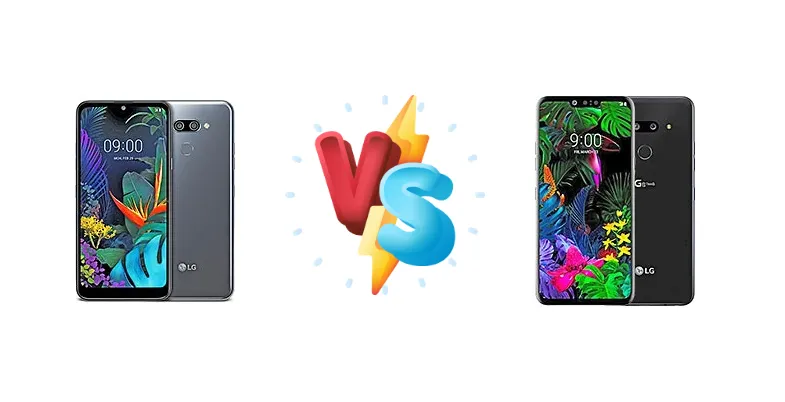
The LG G8 ThinQ represented LG's 2019 flagship offering, packed with high-end features and a premium price tag. The LG K50, released around the same time, targeted the budget-conscious consumer. This comparison dissects the core differences between these two devices, helping you determine if the G8's power justifies its cost, or if the K50 provides sufficient functionality for everyday tasks.
🏆 Quick Verdict
For the average user prioritizing performance and a better overall experience, the LG G8 ThinQ is the clear winner. Its Snapdragon 855 chipset offers significantly faster processing speeds and superior graphics capabilities. However, the LG K50 remains a viable option for those on a tight budget who prioritize affordability over raw power.
| Network |
|---|
| 2G bands | GSM 850 / 900 / 1800 / 1900 | GSM 850 / 900 / 1800 / 1900 |
| 3G bands | HSDPA 850 / 900 / 1900 / 2100 | HSDPA 850 / 900 / 1900 / 2100 |
| 4G bands | 1, 3, 7, 8, 20, 38 | 1, 2, 3, 4, 5, 7, 8, 12, 13, 14, 17, 20, 25, 26, 28, 29, 30, 38, 39, 40, 41, 46, 48, 66, 71 - USA |
| Speed | HSPA 42.2/5.76 Mbps, LTE (2CA) Cat6 300/75 Mbps | HSPA 42.2/5.76 Mbps, LTE Cat19 1600/150 Mbps |
| Technology | GSM / HSPA / LTE | GSM / CDMA / HSPA / EVDO / LTE |
| | - | 2, 3, 4, 5, 7, 13, 20, 28, 46, 48, 66 - Verison |
| Launch |
|---|
| Announced | 2019, February. Released 2019, August | 2019, February 24. Released 2019, April 11 |
| Status | Discontinued | Discontinued |
| Body |
|---|
| Build | - | Glass front (Gorilla Glass 5), glass back (Gorilla Glass 6), aluminum frame |
| Dimensions | 161.3 x 77 x 8.7 mm (6.35 x 3.03 x 0.34 in) | 151.9 x 71.8 x 8.4 mm (5.98 x 2.83 x 0.33 in) |
| SIM | · Nano-SIM· Nano-SIM + Nano-SIM | · Nano-SIM· Nano-SIM + Nano-SIM |
| Weight | 170 g (6.00 oz) | 167 g (5.89 oz) |
| | MIL-STD-810G compliant*
*does not guarantee ruggedness or use in extreme conditions | IP68 dust/water resistant (up to 1.5m for 30 min)
MIL-STD-810G compliant*
Method 516.6, Procedure IV "Transit Drop"
*does not guarantee ruggedness or use in extreme conditions |
| Display |
|---|
| Protection | - | Corning Gorilla Glass 5 |
| Resolution | 720 x 1520 pixels, 19:9 ratio (~269 ppi density) | 1440 x 3120 pixels, 19.5:9 ratio (~564 ppi density) |
| Size | 6.26 inches, 97.8 cm2 (~78.8% screen-to-body ratio) | 6.1 inches, 91.0 cm2 (~83.5% screen-to-body ratio) |
| Type | IPS LCD | P-OLED, HDR10 |
| | - | Always-on display |
| Platform |
|---|
| CPU | Octa-core 2.0 GHz Cortex-A53 | Octa-core (1x2.84 GHz Kryo 485 & 3x2.42 GHz Kryo 485 & 4x1.78 GHz Kryo 485) |
| Chipset | Mediatek MT6762 Helio P22 (12 nm) | Qualcomm SM8150 Snapdragon 855 (7 nm) |
| GPU | PowerVR GE8320 | Adreno 640 |
| OS | Android 9.0 (Pie) | Android 9.0 (Pie), upgradable to Android 11 |
| Memory |
|---|
| Card slot | microSDXC (dedicated slot) | microSDXC (dedicated slot) - single-SIM modelmicroSDXC (uses shared SIM slot) - dual-SIM model |
| Internal | 32GB 3GB RAM | 128GB 6GB RAM |
| | eMMC 5.1 | UFS 2.1 |
| Main Camera |
|---|
| Dual | 13 MP, f/2.2, 26mm (wide), PDAF
Auxiliary lens | - |
| Dual or Triple | - | 12 MP, f/1.5, 27mm (standard), 1/2.55", 1.4µm, dual pixel PDAF, OIS
16 MP, f/1.9, 16mm (ultrawide), 1/3.1", 1.0µm, no AF
or
12 MP, f/1.5, 27mm (standard), 1/2.55", 1.4µm, dual pixel PDAF, OIS
16 MP, f/1.9, 16mm (ultrawide), 1/3.1", 1.0µm, no AF
12 MP, 52mm (telephoto), f/2.4, 1.0µm, 2x optical zoom, dual pixel PDAF, OIS |
| Features | LED flash, panorama, HDR | LED flash, HDR, panorama |
| Video | 1080p@30fps | 4K@30/60fps, 1080p@30/60fps, 720p@240fps, HDR10, 24-bit/192kHz stereo sound rec. |
| Selfie camera |
|---|
| Features | - | HDR |
| Single | 13 MP, f/2.0, 1/3.1", 1.12µm | 8 MP, f/1.7, 26mm (wide), 1/3.6", 1.22µm, AF
TOF 3D, f/1.4, (depth/biometrics sensor) |
| Video | 1080p@30fps | 1080p@60fps |
| Sound |
|---|
| 3.5mm jack | Yes | Yes |
| 35mm jack | Yes | Yes |
| Loudspeaker | Yes | Yes |
| | - | 32-bit/192kHz audio |
| Comms |
|---|
| Bluetooth | 5.0, A2DP, LE | 5.0, A2DP, LE, aptX HD |
| NFC | Yes (market/region dependent) | Yes |
| Positioning | GPS, GLONASS | GPS, GLONASS, GALILEO, BDS |
| Radio | No | FM radio (market/region dependent) |
| USB | microUSB 2.0, OTG | USB Type-C 3.1, OTG |
| WLAN | Wi-Fi 802.11 a/b/g/n/ac, dual-band, Wi-Fi Direct, DLNA | Wi-Fi 802.11 a/b/g/n/ac, dual-band, Wi-Fi Direct, DLNA |
| Features |
|---|
| Sensors | Fingerprint (rear-mounted), accelerometer, proximity | Face ID, Hand ID, fingerprint (rear-mounted), accelerometer, gyro, proximity, compass, barometer |
| Battery |
|---|
| Charging | - | 21W wired, PD, QC3
9W wireless |
| Type | Li-Po 3500 mAh, non-removable | Li-Po 3500 mAh, non-removable |
| Misc |
|---|
| Colors | Aurora Black, Moroccan Blue, Platinum Gray | Platinum Gray, New Aurora Black, New Moroccan Blue, Carmine Red |
| Models | LMX520BMW, LMX520EMW, LM-X520, 802LG | LMG820QM7, LM-G820UMB, LMG820UM0, LMG820UM1, LMG820UM2, LM-G820N, LM-G820, LM-G820QM |
| Price | About 180 EUR | About 350 EUR |
| Tests |
|---|
| Audio quality | - |
Noise -94.1dB / Crosstalk -87.6dB |
| Battery life | - |
Endurance rating 79h
|
| Camera | - |
Photo / Video |
| Display | - |
Contrast ratio: infinite |
| Loudspeaker | - |
Voice 68dB / Noise 74dB / Ring 92dB
|
| Performance | - |
AnTuTu: 331537 (v7), 362730 (v8)
GeekBench: 10735 (v4.4), 2700 (v5.1)
GFXBench: 20fps (ES 3.1 onscreen) |
LG K50
- Affordable price point
- Functional for basic tasks
- Decent battery endurance
- Slow processor
- Limited camera capabilities
- Lower display quality
LG G8 ThinQ
- Flagship-level performance
- Superior camera quality
- Fast charging capabilities
- Higher price
- May be harder to find new
- Potentially larger size/weight
Display Comparison
The LG G8 ThinQ boasts a superior display experience. While both phones lack detailed display specifications beyond the G8's measured 655 nits of peak brightness, this figure alone indicates a much more visible screen in outdoor conditions compared to the K50. The G8’s infinite contrast ratio suggests a high-quality panel capable of deep blacks, enhancing video consumption. The K50, positioned in the budget segment, likely utilizes a less advanced panel with lower brightness and contrast, impacting overall visual clarity.
Camera Comparison
Both phones feature photo and video capabilities, but the LG G8 ThinQ is expected to deliver superior image quality. While specific camera specs are missing for both, the G8’s flagship status suggests a more advanced sensor, image processing algorithms, and potentially optical image stabilization (OIS). The K50, being a budget device, likely utilizes a simpler camera system with a smaller sensor and less sophisticated image processing. The G8’s superior processing power also aids in faster image capture and better low-light performance.
Performance
The performance gap between these devices is substantial. The LG G8 ThinQ’s Qualcomm Snapdragon 855 (7nm) is a flagship-tier chipset featuring an octa-core CPU with a Kryo 485 architecture, designed for demanding tasks. In contrast, the LG K50 is powered by the Mediatek MT6762 Helio P22 (12nm) and its octa-core Cortex-A53 CPU. The 7nm fabrication process of the Snapdragon 855 offers significantly improved power efficiency and thermal performance, allowing for sustained peak performance without excessive throttling. The G8’s CPU architecture is also far more advanced, resulting in faster processing speeds and smoother multitasking.
Battery Life
Both the LG G8 ThinQ and K50 share an endurance rating of 79 hours, suggesting similar overall battery life despite the G8’s more powerful components. However, the G8 offers significantly faster charging capabilities with 21W wired charging (PD, QC3) and 9W wireless charging, allowing for quicker top-ups. The K50 likely supports slower charging speeds, meaning a longer time to reach a full charge. The G8’s power efficiency, stemming from the 7nm Snapdragon 855, contributes to maintaining comparable battery life despite its higher performance demands.
Buying Guide
Buy the LG K50 if you need a functional smartphone for basic tasks like calling, texting, and light social media use, and your budget is under $150. You'll accept compromises in performance and camera quality. Buy the LG G8 ThinQ if you prioritize a smooth, responsive experience for demanding apps, gaming, and photography, and are willing to spend more for a flagship-level device. The G8 offers a significantly more refined user experience.
Frequently Asked Questions
❓ Is the LG K50 suitable for playing demanding mobile games like PUBG or Call of Duty?
The LG K50's Mediatek Helio P22 chipset is not designed for demanding games. While it can run less intensive titles, you'll likely experience significant lag and low frame rates in PUBG or Call of Duty, even on low settings. The G8 ThinQ, with its Snapdragon 855, is far better suited for gaming.
❓ Does the LG G8 ThinQ still receive software updates and security patches?
As a 2019 flagship, the LG G8 ThinQ's software update support is limited. While it likely received Android 11, further major Android updates are unlikely. Security patches may also be infrequent. Consider this if long-term software support is a priority.
❓ What type of charging does the LG K50 support?
The LG K50 likely supports standard micro-USB charging, but specific wattage information is unavailable. Expect slower charging speeds compared to the LG G8 ThinQ's 21W fast charging capabilities.
❓ Is the camera on the LG G8 ThinQ good for low-light photography?
The LG G8 ThinQ's camera is expected to perform significantly better in low-light conditions than the K50. The Snapdragon 855's image signal processor (ISP) and potentially OIS contribute to brighter, clearer photos with less noise in challenging lighting environments.