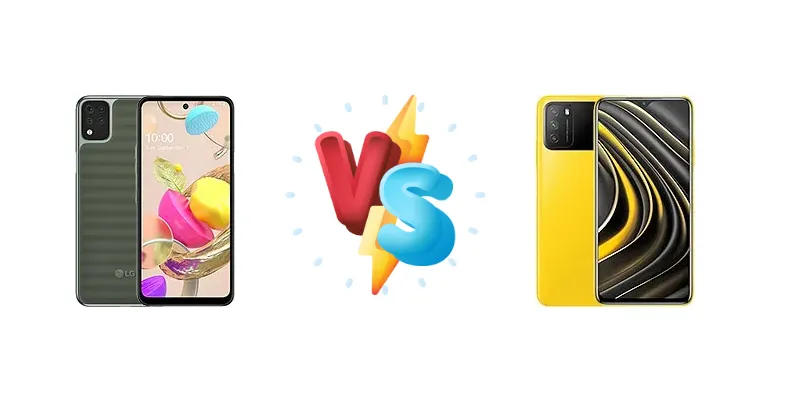
The LG K42 and Xiaomi Poco M3 represent compelling options in the ultra-budget smartphone space. While both aim to deliver essential functionality at a low price, they take distinctly different approaches to achieving this. The K42 relies on LG’s established brand and a more conservative design, while the Poco M3 aggressively targets performance with a more modern chipset and faster charging. This comparison will dissect their key differences to determine which phone offers the best value.
🏆 Quick Verdict
For most users, the Xiaomi Poco M3 is the superior choice. Its Snapdragon 662 chipset provides a noticeable performance uplift over the LG K42’s Helio P22, and the 18W charging significantly reduces downtime. While both offer similar battery endurance ratings, the Poco M3’s faster charging is a critical advantage.
| Network |
|---|
| 2G bands | GSM 850 / 900 / 1800 / 1900 | GSM 850 / 900 / 1800 / 1900 |
| 3G bands | HSDPA 850 / 900 / 1900 / 2100 | HSDPA 850 / 900 / 1700(AWS) / 1900 / 2100 |
| 4G bands | 1, 3, 7, 8, 20, 28, 38 - Europe | 1, 2, 3, 4, 5, 7, 8, 20, 28, 38, 40, 41 |
| Speed | Yes, 384 kbps | HSPA, LTE |
| Technology | GSM / HSPA / LTE | GSM / HSPA / LTE |
| | 1, 3, 5, 7, 8, 20, 28, 38, 39, 40, 41 - Australia | - |
| Launch |
|---|
| Announced | 2020, September 21. Released 2020, September 21 | 2020, November 24 |
| Status | Discontinued | Available. Released 2020, November 27 |
| Body |
|---|
| Build | - | Glass front (Gorilla Glass 3), plastic back, plastic frame |
| Dimensions | 165 x 76.7 x 8.4 mm (6.50 x 3.02 x 0.33 in) | 162.3 x 77.3 x 9.6 mm (6.39 x 3.04 x 0.38 in) |
| SIM | Nano-SIM + Nano-SIM | Nano-SIM + Nano-SIM |
| Weight | 182 g (6.42 oz) | 198 g (6.98 oz) |
| | MIL-STD-810G compliant*
*does not guarantee ruggedness or use in extreme conditions | - |
| Display |
|---|
| Protection | - | Corning Gorilla Glass 3 |
| Resolution | 720 x 1600 pixels, 20:9 ratio (~266 ppi density) | 1080 x 2340 pixels, 19.5:9 ratio (~395 ppi density) |
| Size | 6.6 inches, 105.2 cm2 (~83.1% screen-to-body ratio) | 6.53 inches, 104.7 cm2 (~83.4% screen-to-body ratio) |
| Type | IPS LCD | IPS LCD, 400 nits (typ) |
| Platform |
|---|
| CPU | Octa-core 2.0 GHz Cortex-A53 | Octa-core (4x2.0 GHz Kryo 260 Gold & 4x1.8 GHz Kryo 260 Silver) |
| Chipset | Mediatek MT6762 Helio P22 (12 nm) | Qualcomm SM6115 Snapdragon 662 (11 nm) |
| GPU | PowerVR GE8320 | Adreno 610 |
| OS | Android 10, upgradable to Android 11 | Android 10, MIUI 12 |
| Memory |
|---|
| Card slot | microSDXC | microSDXC (dedicated slot) |
| Internal | 64GB 3GB RAM | 64GB 4GB RAM, 64GB 6GB RAM, 128GB 4GB RAM, 128GB 6GB RAM |
| | eMMC 5.1 | UFS 2.1 - 64GB
UFS 2.2 - 128GB |
| Main Camera |
|---|
| Features | LED flash, panorama, HDR | LED flash, HDR, panorama |
| Quad | 13 MP, 27mm (wide), 1/3.1", 1.12µm, PDAF
5 MP, f/2.2, 115˚ (ultrawide), 1/5.0", 1.12µm
2 MP (macro)
Auxiliary lens | - |
| Triple | - | 48 MP, f/1.8, (wide), 1/2.0", 0.8µm, PDAF
2 MP (macro)
Auxiliary lens |
| Video | 1080p@30fps | 1080p@30fps |
| Selfie camera |
|---|
| Features | - | Panorama |
| Single | 8 MP, (wide) | 8 MP, f/2.1, (wide), 1/4.0", 1.12µm |
| Video | 1080p@30fps | 1080p@30fps |
| Sound |
|---|
| 3.5mm jack | Yes | Yes |
| 35mm jack | Yes | Yes |
| Loudspeaker | Yes | Yes, with dual speakers |
| | - | 24-bit/192kHz audio |
| Comms |
|---|
| Bluetooth | 5.0, A2DP, LE | 5.0, A2DP, LE |
| Infrared port | - | Yes |
| NFC | Yes (market/region dependent) | No |
| Positioning | GPS | GPS, GLONASS, BDS, GALILEO |
| Radio | No | FM radio |
| USB | USB Type-C 2.0, OTG | USB Type-C 2.0, OTG |
| WLAN | Wi-Fi 802.11 b/g/n, Wi-Fi Direct | Wi-Fi 802.11 a/b/g/n/ac, dual-band, Wi-Fi Direct |
| Features |
|---|
| Sensors | Fingerprint (side-mounted), accelerometer, proximity, compass | Fingerprint (side-mounted), accelerometer, proximity, compass |
| Battery |
|---|
| Charging | 10W wired | 18W wired
2.5W reverse wired |
| Type | Li-Po 4000 mAh | Li-Po 6000 mAh |
| Misc |
|---|
| Colors | Gray, Green | Cool Blue, Poco Yellow, Power Black |
| Models | LMK420, LM-K420, LMK420H, LM-K420H, LMK420E, LM-K420E, LMK420Y, LM-K420Y | M2010J19CG, M2010J19CI |
| Price | About 140 EUR | $ 130.00 / ₹ 11,590 |
| SAR | - | 1.09 W/kg (head) 1.00 W/kg (body) |
| SAR EU | - | 0.60 W/kg (head) 0.81 W/kg (body) |
| Tests |
|---|
| Battery life | - | Endurance rating 154h |
| Camera | - |
Photo / Video |
| Display | - |
Contrast ratio: 1567:1 (nominal) |
| Loudspeaker | - |
-26.5 LUFS (Good) |
| Performance | - |
AnTuTu: 177904 (v8)
GeekBench: 1398 (v5.1)
GFXBench: 5.9fps (ES 3.1 onscreen) |
LG K42
- Potentially wider carrier compatibility
- Familiar LG user interface
- Simple and straightforward design
- Significantly weaker processor
- Slow 10W charging
- Likely lower display brightness
Xiaomi Poco M3
- Faster Snapdragon 662 processor
- 18W fast charging with reverse charging
- Brighter and larger display
- Xiaomi’s MIUI software can be polarizing
- May require more configuration for optimal performance
- Potentially less brand recognition in some markets
Display Comparison
The Poco M3 boasts a measured peak brightness of 439 nits and a 1567:1 contrast ratio, offering a more vibrant and visible display experience, especially outdoors. While the LG K42’s display specifications aren’t publicly available, it’s likely to offer lower brightness and contrast. The Poco M3’s larger screen size (6.53 inches vs. the K42’s 6.1 inches) also contributes to a more immersive viewing experience. Both share the same nominal contrast ratio, suggesting similar panel technology, but the Poco M3’s higher measured brightness is a clear advantage.
Camera Comparison
Both phones feature 'Photo / Video' capabilities, but detailed camera specifications are limited. The Poco M3 likely benefits from Qualcomm’s image signal processor (ISP) within the Snapdragon 662, which generally provides better image processing and noise reduction compared to the ISP found in the Helio P22. Without specific sensor details for the LG K42, it’s difficult to make a definitive comparison, but the Poco M3’s chipset advantage suggests superior image quality, particularly in low-light conditions. The prevalence of 48MP main sensors in this price bracket suggests the Poco M3 likely features a higher resolution primary camera.
Performance
The Poco M3’s Qualcomm Snapdragon 662 (11nm) is a significant step up from the LG K42’s MediaTek Helio P22 (12nm). The Snapdragon 662 utilizes a Kryo CPU architecture with a combination of performance (2.0 GHz) and efficiency (1.8 GHz) cores, offering better multi-tasking and responsiveness. The Helio P22’s Cortex-A53 cores, while efficient, struggle with more demanding applications. The 11nm process node of the Snapdragon 662 also contributes to improved thermal efficiency, reducing the likelihood of performance throttling during sustained use. This translates to a smoother experience for gaming and resource-intensive apps on the Poco M3.
Battery Life
Both the LG K42 and Xiaomi Poco M3 achieve an endurance rating of 154 hours, indicating comparable battery life under similar usage conditions. However, the Poco M3’s 18W wired charging is a game-changer. This allows for significantly faster charging times compared to the LG K42’s slow 10W charging. The Poco M3 also includes 2.5W reverse wired charging, a feature absent on the K42, enabling it to top up other devices, albeit slowly. While both phones will likely last a full day on a single charge, the Poco M3’s faster charging minimizes downtime.
Buying Guide
Buy the LG K42 if you prioritize a familiar brand experience and are primarily focused on basic smartphone tasks like calls, texts, and light social media use. Its simplicity and potentially wider carrier compatibility might appeal to some. Buy the Xiaomi Poco M3 if you want a phone that can handle more demanding apps, occasional gaming, and appreciate faster charging speeds. It’s the better option for users who want more performance for their money.
Frequently Asked Questions
❓ Does the Poco M3’s Snapdragon 662 handle popular games like PUBG Mobile smoothly?
Yes, the Snapdragon 662 in the Poco M3 is capable of running PUBG Mobile at medium settings with stable frame rates. While it won’t deliver the highest graphical fidelity, it provides a playable and enjoyable gaming experience, a significant improvement over the LG K42’s Helio P22.
❓ Is the 2.5W reverse charging on the Poco M3 useful for anything?
While slow, the 2.5W reverse charging on the Poco M3 can be a lifesaver in emergencies. It’s suitable for topping up wireless earbuds, smartwatches, or other low-power devices when you’re away from a power outlet. Don’t expect to quickly charge a phone with it, but it’s a handy feature to have.
❓ How does MIUI (Xiaomi’s software) compare to LG’s software on the K42?
MIUI is a heavily customized Android skin known for its features and customization options. However, it also includes pre-installed apps (bloatware) and can be more resource-intensive than LG’s more stock-Android-like interface. LG’s software is generally simpler and cleaner, but lacks the extensive customization options of MIUI.
❓ Will the LG K42 receive software updates for an extended period?
LG has exited the smartphone market, meaning the LG K42 is unlikely to receive significant software updates or security patches in the future. The Poco M3, backed by Xiaomi, will likely receive updates for a longer period, though the exact duration is uncertain.