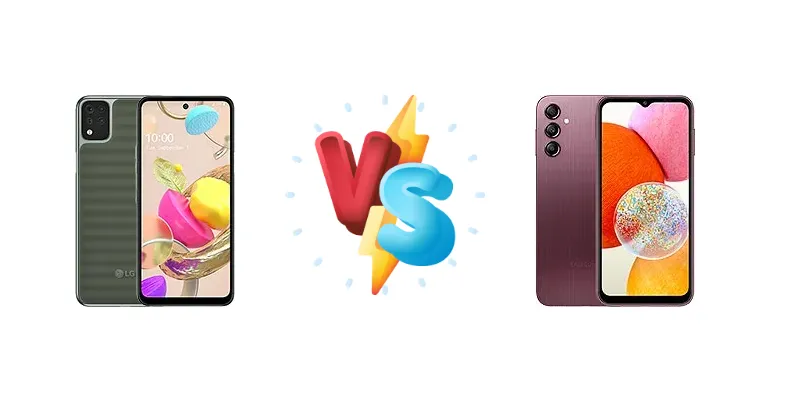
The LG K42 and Samsung Galaxy A14 represent two compelling options in the ultra-budget smartphone space. While both aim to deliver essential smartphone functionality at a low price, they differ significantly in their internal hardware, impacting performance and user experience. This comparison dives deep into those differences to help you choose the right device.
🏆 Quick Verdict
For most users, the Samsung Galaxy A14 is the better choice. Its Mediatek Helio G80 (or Exynos 850) chipset offers a substantial performance uplift over the LG K42’s Helio P22, making it more capable for everyday tasks and light gaming. The 15W charging is also a welcome improvement.
| Network |
|---|
| 2G bands | GSM 850 / 900 / 1800 / 1900 | GSM 850 / 900 / 1800 / 1900 |
| 3G bands | HSDPA 850 / 900 / 1900 / 2100 | HSDPA 850 / 900 / 2100 |
| 4G bands | 1, 3, 7, 8, 20, 28, 38 - Europe | 1, 3, 5, 7, 8, 20, 28, 38, 40, 41 |
| Speed | Yes, 384 kbps | HSPA, LTE |
| Technology | GSM / HSPA / LTE | GSM / HSPA / LTE |
| | 1, 3, 5, 7, 8, 20, 28, 38, 39, 40, 41 - Australia | - |
| Launch |
|---|
| Announced | 2020, September 21. Released 2020, September 21 | 2023, February 28 |
| Status | Discontinued | Available. Released 2023, March 27 |
| Body |
|---|
| Build | - | Glass front, plastic back, plastic frame |
| Dimensions | 165 x 76.7 x 8.4 mm (6.50 x 3.02 x 0.33 in) | 167.7 x 78 x 9.1 mm (6.60 x 3.07 x 0.36 in) |
| SIM | Nano-SIM + Nano-SIM | · Nano-SIM· Nano-SIM + Nano-SIM |
| Weight | 182 g (6.42 oz) | 201 g (7.09 oz) |
| | MIL-STD-810G compliant*
*does not guarantee ruggedness or use in extreme conditions | - |
| Display |
|---|
| Resolution | 720 x 1600 pixels, 20:9 ratio (~266 ppi density) | 1080 x 2408 pixels, 20:9 ratio (~400 ppi density) |
| Size | 6.6 inches, 105.2 cm2 (~83.1% screen-to-body ratio) | 6.6 inches, 104.9 cm2 (~80.2% screen-to-body ratio) |
| Type | IPS LCD | PLS LCD |
| Platform |
|---|
| CPU | Octa-core 2.0 GHz Cortex-A53 | Octa-core (2x2.0 GHz Cortex-A75 & 6x1.8 GHz Cortex-A55) - Version AOcta-core (4x2.0 GHz Cortex-A55 & 4x2.0 GHz Cortex-A55) - Version B |
| Chipset | Mediatek MT6762 Helio P22 (12 nm) | Mediatek MT6769 Helio G80 (12 nm) - Version AExynos 850 (8 nm) - Version B |
| GPU | PowerVR GE8320 | Mali-G52 MC2 |
| OS | Android 10, upgradable to Android 11 | Android 13, upgradable to Android 15, One UI 7 |
| Memory |
|---|
| Card slot | microSDXC | microSDXC (dedicated slot) |
| Internal | 64GB 3GB RAM | 64GB 4GB RAM, 128GB 4GB RAM, 128GB 6GB RAM |
| | eMMC 5.1 | - |
| Main Camera |
|---|
| Features | LED flash, panorama, HDR | LED flash, panorama, HDR |
| Quad | 13 MP, 27mm (wide), 1/3.1", 1.12µm, PDAF
5 MP, f/2.2, 115˚ (ultrawide), 1/5.0", 1.12µm
2 MP (macro)
Auxiliary lens | - |
| Single | - | 13 MP, f/2.0, (wide) |
| Triple | - | 50 MP, f/1.8, 26mm (wide), 1/2.75", 0.64µm, PDAF
5 MP, f/2.2, 17mm (ultrawide), 1/5.0", 1.12µm
2 MP (macro) |
| Video | 1080p@30fps | 1080p@30fps |
| Selfie camera |
|---|
| Single | 8 MP, (wide) | 13 MP, f/2.0, 26mm (wide), 1/3.1", 1.12µm |
| Video | 1080p@30fps | 1080p@30fps |
| Sound |
|---|
| 3.5mm jack | Yes | Yes |
| 35mm jack | Yes | Yes |
| Loudspeaker | Yes | Yes |
| Comms |
|---|
| Bluetooth | 5.0, A2DP, LE | 5.1 or 5.3, A2DP, LE |
| NFC | Yes (market/region dependent) | Yes (market/region dependent) |
| Positioning | GPS | GPS, GALILEO, GLONASS, BDS, QZSS |
| Radio | No | Unspecified |
| USB | USB Type-C 2.0, OTG | USB Type-C 2.0 |
| WLAN | Wi-Fi 802.11 b/g/n, Wi-Fi Direct | Wi-Fi 802.11 a/b/g/n/ac, dual-band, Wi-Fi Direct |
| Features |
|---|
| Sensors | Fingerprint (side-mounted), accelerometer, proximity, compass | Fingerprint (side-mounted), accelerometer, proximity, compass |
| Battery |
|---|
| Charging | 10W wired | 15W wired |
| Type | Li-Po 4000 mAh | Li-Po 5000 mAh |
| Misc |
|---|
| Colors | Gray, Green | Black, Dark Red, Silver, Green |
| Models | LMK420, LM-K420, LMK420H, LM-K420H, LMK420E, LM-K420E, LMK420Y, LM-K420Y | SM-A145F, SM-A145F/DSN, SM-A145M, SM-A145M/DS, SM-A145P, SM-A145R |
| Price | About 140 EUR | € 85.76 / $ 147.60 / £ 79.95 |
| SAR EU | - | 0.46 W/kg (head) 1.37 W/kg (body) |
LG K42
- Potentially lower price point
- Simple and straightforward user experience
- Reliable for basic tasks
- Outdated chipset limits performance
- Slow charging speed (10W)
- Likely inferior camera quality
Samsung Galaxy A14
- Significantly better performance (Helio G80 or Exynos 850)
- Faster charging (15W)
- More capable for multitasking and gaming
- May be slightly more expensive
- Software bloatware (typical of Samsung)
- Display quality is still basic
Display Comparison
Neither device boasts a standout display. Both utilize 12nm chipsets, suggesting similar power constraints impacting display capabilities. While specific display specs (resolution, panel type) are missing for the K42, it's likely a basic IPS LCD. The A14’s display is also likely IPS LCD. The key difference lies in the processing power available to drive the display; the A14’s more powerful chipset can potentially handle more complex visual tasks and smoother animations. Bezels are expected to be substantial on both devices, typical of this price bracket.
Camera Comparison
Camera performance is likely to be similar in real-world usage, given the focus on cost reduction in both devices. Both will likely feature a primary camera alongside basic auxiliary lenses (depth, macro). The LG K42’s camera specs are unavailable, but it’s reasonable to assume a lower resolution main sensor. The Samsung Galaxy A14’s camera setup is also likely to prioritize quantity over quality, with a main sensor and supporting lenses. Image processing will be a key factor, and Samsung’s software typically offers more refined results than LG’s in this segment. The presence of OIS (Optical Image Stabilization) is unlikely on either device.
Performance
The performance gap is the most significant differentiator. The LG K42’s Mediatek Helio P22, with its Cortex-A53 cores clocked at 2.0 GHz, is a relatively dated chipset. The Samsung Galaxy A14, however, offers two chipset options: the Mediatek Helio G80 and the Exynos 850. The Helio G80 features a combination of Cortex-A75 and A55 cores, providing a noticeable boost in CPU performance compared to the K42’s all-A53 configuration. The Exynos 850, built on an 8nm process versus the 12nm of both other chips, further enhances efficiency and sustained performance. This translates to faster app loading times, smoother multitasking, and a more responsive user experience on the A14. The A14’s GPU is also significantly more capable, making it better suited for light gaming.
Battery Life
Battery life will depend heavily on usage patterns. While specific battery capacities are not provided, both devices likely feature batteries in the 4000-5000 mAh range. However, the Samsung Galaxy A14’s 15W wired charging is a clear advantage over the LG K42’s 10W charging. This means the A14 will recharge significantly faster, reducing downtime. The more efficient chipset in the A14 will also contribute to better battery life under load.
Buying Guide
Buy the LG K42 if your primary need is a basic, reliable smartphone for calls, texts, and very light app usage, and you prioritize a minimal financial investment. Buy the Samsung Galaxy A14 if you want a phone that can handle multitasking, streaming video, and casual gaming with greater ease, and you appreciate faster charging speeds. The A14 is the better all-rounder.
Frequently Asked Questions
❓ Does the Samsung Galaxy A14’s Exynos 850 chip overheat during prolonged gaming sessions?
The Exynos 850, built on an 8nm process, is relatively efficient. While it will get warm during extended gaming, it’s unlikely to experience significant thermal throttling, offering a more consistent gaming experience than the LG K42’s Helio P22.
❓ Is the 2MP macro camera on either phone actually useful for taking detailed close-up photos?
Generally, 2MP macro cameras on budget phones are limited in their usefulness. Image quality is often soft and lacks detail. They can be fun to experiment with, but don’t expect professional-level macro photography.
❓ Can the Samsung Galaxy A14 handle popular games like PUBG Mobile at playable frame rates?
The Samsung Galaxy A14, particularly the version with the Helio G80 or Exynos 850, can run PUBG Mobile at medium settings with acceptable frame rates. Expect some occasional stuttering, but it’s a significantly better gaming experience than the LG K42.
❓ How long does it take to fully charge the LG K42 with its 10W charger?
With a 10W charger, the LG K42 will likely take over 3 hours to fully charge from 0% to 100%, depending on battery capacity and usage during charging. This is considerably slower than the Samsung Galaxy A14’s 15W charging.