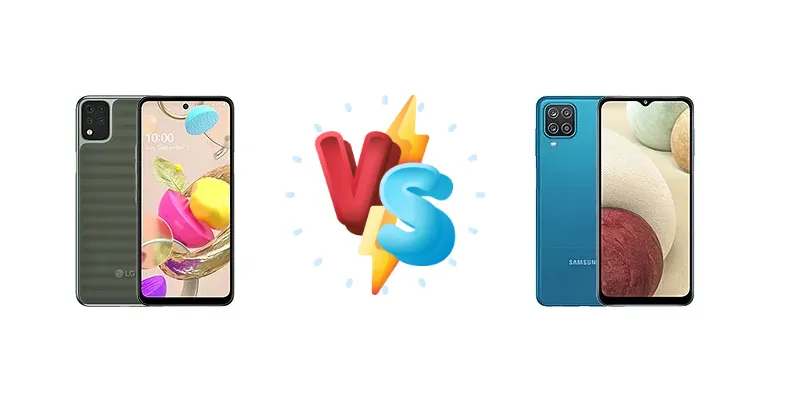
The LG K42 and Samsung Galaxy A12 represent the lower end of the smartphone market, targeting users prioritizing affordability. Both devices offer a full Android experience, but significant differences in chipset and charging capabilities dictate which phone is better suited for specific needs. This comparison dissects these differences to help you make an informed decision.
🏆 Quick Verdict
For most users, the Samsung Galaxy A12 emerges as the slightly better choice. Its Helio P35 chipset provides a noticeable performance boost over the K42’s Helio P22, and the 15W charging is a welcome addition, despite both phones sharing the same 123-hour endurance rating.
| Network |
|---|
| 2G bands | GSM 850 / 900 / 1800 / 1900 | GSM 850 / 900 / 1800 / 1900 |
| 3G bands | HSDPA 850 / 900 / 1900 / 2100 | HSDPA 850 / 900 / 2100 |
| 4G bands | 1, 3, 7, 8, 20, 28, 38 - Europe | 1, 3, 5, 7, 8, 20, 28, 38, 40, 41 |
| Speed | Yes, 384 kbps | HSPA 42.2/5.76 Mbps, LTE Cat4 150/50 Mbps |
| Technology | GSM / HSPA / LTE | GSM / HSPA / LTE |
| | 1, 3, 5, 7, 8, 20, 28, 38, 39, 40, 41 - Australia | - |
| Launch |
|---|
| Announced | 2020, September 21. Released 2020, September 21 | 2020, November 24. Released 2020, December 21 |
| Status | Discontinued | Discontinued |
| Body |
|---|
| Build | - | Glass front, plastic back, plastic frame |
| Dimensions | 165 x 76.7 x 8.4 mm (6.50 x 3.02 x 0.33 in) | 164 x 75.8 x 8.9 mm (6.46 x 2.98 x 0.35 in) |
| SIM | Nano-SIM + Nano-SIM | · Nano-SIM· Nano-SIM + Nano-SIM |
| Weight | 182 g (6.42 oz) | 205 g (7.23 oz) |
| | MIL-STD-810G compliant*
*does not guarantee ruggedness or use in extreme conditions | - |
| Display |
|---|
| Resolution | 720 x 1600 pixels, 20:9 ratio (~266 ppi density) | 720 x 1600 pixels, 20:9 ratio (~270 ppi density) |
| Size | 6.6 inches, 105.2 cm2 (~83.1% screen-to-body ratio) | 6.5 inches, 102.0 cm2 (~82.1% screen-to-body ratio) |
| Type | IPS LCD | PLS LCD |
| Platform |
|---|
| CPU | Octa-core 2.0 GHz Cortex-A53 | Octa-core (4x2.35 GHz Cortex-A53 & 4x1.8 GHz Cortex-A53) |
| Chipset | Mediatek MT6762 Helio P22 (12 nm) | Mediatek MT6765 Helio P35 (12 nm) |
| GPU | PowerVR GE8320 | PowerVR GE8320 |
| OS | Android 10, upgradable to Android 11 | Android 10, upgradable to Android 12, One UI 4.1 |
| Memory |
|---|
| Card slot | microSDXC | microSDXC (dedicated slot) |
| Internal | 64GB 3GB RAM | 32GB 2GB RAM, 32GB 3GB RAM, 32GB 4GB RAM, 64GB 2GB RAM, 64GB 4GB RAM, 128GB 2GB RAM, 128GB 3GB RAM, 128GB 4GB RAM, 128GB 6GB RAM |
| | eMMC 5.1 | eMMC 5.1 |
| Main Camera |
|---|
| - | Go |
| Features | LED flash, panorama, HDR | LED flash, panorama, HDR |
| Quad | 13 MP, 27mm (wide), 1/3.1", 1.12µm, PDAF
5 MP, f/2.2, 115˚ (ultrawide), 1/5.0", 1.12µm
2 MP (macro)
Auxiliary lens | 48 MP, f/2.0, 26mm (wide), AF
5 MP, f/2.2, 123˚ (ultrawide)
2 MP (macro)
Auxiliary lens |
| Video | 1080p@30fps | 1080p@30fps |
| Selfie camera |
|---|
| Single | 8 MP, (wide) | 8 MP, f/2.2 |
| Video | 1080p@30fps | 1080p@30fps |
| Sound |
|---|
| 3.5mm jack | Yes | Yes |
| 35mm jack | Yes | Yes |
| Loudspeaker | Yes | Yes |
| Comms |
|---|
| Bluetooth | 5.0, A2DP, LE | 5.0, A2DP, LE |
| NFC | Yes (market/region dependent) | Yes (market/region dependent) |
| Positioning | GPS | GPS, GLONASS, GALILEO, BDS |
| Radio | No | FM radio, RDS, recording |
| USB | USB Type-C 2.0, OTG | USB Type-C 2.0 |
| WLAN | Wi-Fi 802.11 b/g/n, Wi-Fi Direct | Wi-Fi 802.11 b/g/n, Wi-Fi Direct |
| Features |
|---|
| Sensors | Fingerprint (side-mounted), accelerometer, proximity, compass | Fingerprint (side-mounted), accelerometer |
| | - | Virtual proximity sensing |
| Battery |
|---|
| Charging | 10W wired | 15W wired |
| Type | Li-Po 4000 mAh | Li-Po 5000 mAh |
| Misc |
|---|
| Colors | Gray, Green | Black, White, Blue, Red |
| Models | LMK420, LM-K420, LMK420H, LM-K420H, LMK420E, LM-K420E, LMK420Y, LM-K420Y | SM-A125F/DSN, SM-A125F/DS, SM-A125F, SM-A125M, SM-A125U, SM-A125U1, SM-A125N, SM-A125W |
| Price | About 140 EUR | € 78.89 / $ 60.00 / £ 69.99 |
| SAR EU | - | 0.67 W/kg (head) 1.38 W/kg (body) |
| Tests |
|---|
| Battery life | - | Endurance rating 123h |
| Camera | - |
Photo / Video |
| Display | - |
Contrast ratio: 1363:1 (nominal) |
| Loudspeaker | - |
-30.4 LUFS (Below average) |
| Performance | - |
AnTuTu: 107189 (v8)
GeekBench: 1034 (v5.1)
GFXBench: 5fps (ES 3.1 onscreen) |
LG K42
- Potentially lower price point
- Acceptable battery endurance
- Standard Android experience
- Slower Helio P22 chipset
- Slower 10W charging
- Likely lower display brightness
Samsung Galaxy A12
- Faster Helio P35 chipset
- Faster 15W charging
- Brighter display (472 nits)
- May be slightly more expensive
- Similar battery endurance to K42
- Potential for Samsung’s software bloat
Display Comparison
Both the LG K42 and Samsung Galaxy A12 feature displays with a 1363:1 contrast ratio, suggesting similar visual pop. However, the Galaxy A12 boasts a measured peak brightness of 472 nits, significantly brighter than what we'd expect from the K42 based on its market positioning. This brighter display will be more visible outdoors under direct sunlight. While both are likely LCD panels, the A12’s higher brightness provides a superior viewing experience.
Camera Comparison
Both phones list 'Photo / Video' capabilities, but lack specific details. Given the price point, image quality will likely be similar in good lighting conditions. However, the A12’s potential for slightly better image processing, stemming from the more capable chipset, could give it an edge. It's important to note that both phones likely include low-resolution auxiliary cameras (e.g., 2MP macro) that offer limited practical benefit.
Performance
The Samsung Galaxy A12’s Mediatek Helio P35 chipset is the key performance differentiator. Its octa-core configuration, split between 4x2.35 GHz Cortex-A53 and 4x1.8 GHz Cortex-A53 cores, offers a clear advantage over the LG K42’s Helio P22, which utilizes a uniform octa-core 2.0 GHz Cortex-A53 setup. The P35’s higher clock speeds on four cores translate to snappier app launches and smoother multitasking. While neither phone is a gaming powerhouse, the A12 will handle less demanding titles with greater ease.
Battery Life
Interestingly, both the LG K42 and Samsung Galaxy A12 share an endurance rating of 123 hours. This suggests similar real-world battery life despite the K42’s slower 10W charging compared to the A12’s 15W charging. The faster charging on the A12 will reduce the time spent tethered to a wall, offering a more convenient user experience, even if the overall battery longevity is comparable.
Buying Guide
Buy the LG K42 if you absolutely need the lowest possible price and are primarily using the phone for basic communication tasks like calls and messaging. Buy the Samsung Galaxy A12 if you value slightly smoother performance for social media, light gaming, and appreciate faster charging speeds, even if it means spending a little more.
Frequently Asked Questions
❓ Will the Samsung Galaxy A12 struggle with demanding games like PUBG Mobile?
While the Helio P35 can run PUBG Mobile, expect to play at lower graphics settings and frame rates to maintain a smooth experience. It's not designed for high-end gaming, but it's capable of handling less intensive titles without issue.
❓ How long will it take to fully charge the Samsung Galaxy A12 with the 15W charger?
While a precise time isn't available, 15W charging should fully charge the Galaxy A12 in approximately 2.5 to 3 hours, depending on usage during charging. This is significantly faster than the LG K42’s 10W charging.
❓ Is the camera on either phone good enough for casual social media photos?
Both phones will produce acceptable photos for casual social media use in good lighting conditions. However, don't expect exceptional detail or low-light performance. The A12's slightly better chipset may offer a small advantage in image processing.
❓ Does the Samsung Galaxy A12 come with a lot of pre-installed bloatware?
Samsung phones are known for including some pre-installed apps. The Galaxy A12 is likely to have some bloatware, but most can be uninstalled or disabled to free up storage space and improve performance.