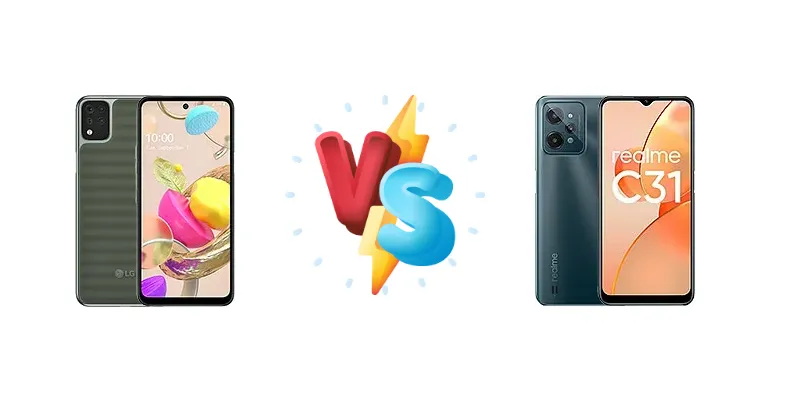
The LG K42 and Realme C31 represent the lower end of the smartphone market, targeting users prioritizing affordability. However, despite similar price points, they diverge significantly in their internal hardware. This comparison dissects the key differences between the Mediatek Helio P22-powered LG K42 and the Unisoc Tiger T612-equipped Realme C31, focusing on performance, battery life, and overall user experience.
🏆 Quick Verdict
For most users, the Realme C31 offers a more compelling experience. Its Unisoc Tiger T612 chipset, featuring Cortex-A75 cores, provides a noticeable performance uplift over the LG K42’s Helio P22, making it better suited for multitasking and moderately demanding apps. While both charge at 10W, the C31’s more efficient processor may translate to slightly better real-world battery endurance.
| Network |
|---|
| 2G bands | GSM 850 / 900 / 1800 / 1900 | GSM 850 / 900 / 1800 / 1900 |
| 3G bands | HSDPA 850 / 900 / 1900 / 2100 | HSDPA 850 / 900 / 2100 |
| 4G bands | 1, 3, 7, 8, 20, 28, 38 - Europe | 1, 3, 5, 8, 38, 40, 41 |
| Speed | Yes, 384 kbps | HSPA, LTE |
| Technology | GSM / HSPA / LTE | GSM / HSPA / LTE |
| | 1, 3, 5, 7, 8, 20, 28, 38, 39, 40, 41 - Australia | - |
| Launch |
|---|
| Announced | 2020, September 21. Released 2020, September 21 | 2022, March 25 |
| Status | Discontinued | Available. Released 2022, March 31 |
| Body |
|---|
| Build | - | Glass front, plastic frame, plastic back |
| Dimensions | 165 x 76.7 x 8.4 mm (6.50 x 3.02 x 0.33 in) | 164.7 x 76.1 x 8.4 mm (6.48 x 3.00 x 0.33 in) |
| SIM | Nano-SIM + Nano-SIM | Nano-SIM + Nano-SIM |
| Weight | 182 g (6.42 oz) | 197 g (6.95 oz) |
| | MIL-STD-810G compliant*
*does not guarantee ruggedness or use in extreme conditions | - |
| Display |
|---|
| Protection | - | Panda Glass |
| Resolution | 720 x 1600 pixels, 20:9 ratio (~266 ppi density) | 720 x 1600 pixels, 20:9 ratio (~270 ppi density) |
| Size | 6.6 inches, 105.2 cm2 (~83.1% screen-to-body ratio) | 6.5 inches, 102.0 cm2 (~81.4% screen-to-body ratio) |
| Type | IPS LCD | IPS LCD, 400 nits |
| Platform |
|---|
| CPU | Octa-core 2.0 GHz Cortex-A53 | Octa-core (2x1.8 GHz Cortex-A75 & 6x1.8 GHz Cortex-A55) |
| Chipset | Mediatek MT6762 Helio P22 (12 nm) | Unisoc Tiger T612 (12 nm) |
| GPU | PowerVR GE8320 | Mali-G57 |
| OS | Android 10, upgradable to Android 11 | Android 11, Realme UI 2.0 |
| Memory |
|---|
| Card slot | microSDXC | microSDXC (dedicated slot) |
| Internal | 64GB 3GB RAM | 32GB 3GB RAM, 64GB 4GB RAM |
| | eMMC 5.1 | UFS 2.2 |
| Main Camera |
|---|
| Features | LED flash, panorama, HDR | LED flash, HDR, panorama |
| Quad | 13 MP, 27mm (wide), 1/3.1", 1.12µm, PDAF
5 MP, f/2.2, 115˚ (ultrawide), 1/5.0", 1.12µm
2 MP (macro)
Auxiliary lens | - |
| Single | - | 5 MP, f/2.2, 27mm (wide), 1/5.0", 1.12µm |
| Triple | - | 13 MP, f/2.2, 25mm (wide), 1/3.06", 1.12µm, AF
2 MP (macro)
Auxiliary lens |
| Video | 1080p@30fps | 1080p@30fps |
| Selfie camera |
|---|
| Features | - | HDR |
| Single | 8 MP, (wide) | 5 MP, f/2.2, 27mm (wide), 1/5.0", 1.12µm |
| Video | 1080p@30fps | 720p@30fps |
| Sound |
|---|
| 3.5mm jack | Yes | Yes |
| 35mm jack | Yes | Yes |
| Loudspeaker | Yes | Yes |
| Comms |
|---|
| Bluetooth | 5.0, A2DP, LE | 5.0, A2DP, LE |
| NFC | Yes (market/region dependent) | No |
| Positioning | GPS | GPS, GLONASS, GALILEO, BDS |
| Radio | No | No |
| USB | USB Type-C 2.0, OTG | microUSB 2.0 |
| WLAN | Wi-Fi 802.11 b/g/n, Wi-Fi Direct | Wi-Fi 802.11 b/g/n |
| Features |
|---|
| Sensors | Fingerprint (side-mounted), accelerometer, proximity, compass | Fingerprint (side-mounted), accelerometer, gyro, proximity |
| Battery |
|---|
| Charging | 10W wired | 10W wired |
| Type | Li-Po 4000 mAh | 5000 mAh |
| Misc |
|---|
| Colors | Gray, Green | Light Silver, Dark Green |
| Models | LMK420, LM-K420, LMK420H, LM-K420H, LMK420E, LM-K420E, LMK420Y, LM-K420Y | RMX3501 |
| Price | About 140 EUR | About 150 EUR |
LG K42
- Established Brand (LG)
- Potentially more durable build quality (based on LG's reputation)
- Simple, user-friendly interface
- Outdated Helio P22 chipset
- Limited performance for multitasking
- Likely slower app launch times
Realme C31
- More powerful Unisoc Tiger T612 chipset
- Improved multitasking capabilities
- Larger display for better media consumption
- Less established brand (Realme)
- Potential for more bloatware
- Build quality may be less premium
Display Comparison
Neither device boasts a standout display. Both likely utilize LCD panels, common in this price bracket. Detailed display specs (resolution, brightness) are unavailable, but the Realme C31’s larger screen size (6.5 inches vs. K42’s 6.1 inches) offers a more immersive viewing experience. The absence of high refresh rates or advanced panel technologies like LTPO on either device means users should expect standard visual performance.
Camera Comparison
Camera performance is likely to be similar, with both devices targeting basic photography needs. Without detailed sensor information, it’s safe to assume both feature a primary camera and potentially depth/macro sensors of limited utility. Image processing will likely be the differentiating factor, with Realme’s software often prioritizing vibrant, social media-ready images. The LG K42 may lean towards more natural color reproduction. Given the price point, low-light performance will be a weakness on both.
Performance
The core difference lies in the chipsets. The Realme C31’s Unisoc Tiger T612 utilizes a more modern architecture with 2x 1.8 GHz Cortex-A75 cores and 6x 1.8 GHz Cortex-A55 cores, offering a significant advantage over the LG K42’s older Mediatek Helio P22, which relies solely on 8x 2.0 GHz Cortex-A53 cores. The A75 cores in the C31 provide a substantial boost in single-core performance, crucial for app launch speeds and general responsiveness. While both are built on a 12nm process, the architectural improvements in the T612 translate to a smoother user experience, particularly when multitasking. The K42 will likely struggle with more demanding applications.
Battery Life
Both the LG K42 and Realme C31 feature 10W wired charging, indicating similar charging speeds (expect around 2.5-3 hours for a full charge). However, the Unisoc Tiger T612 in the Realme C31 is generally more power-efficient than the Helio P22 in the LG K42. This efficiency could translate to slightly longer battery life for the C31, even with a similar battery capacity (specific mAh figures are unavailable). Users should not expect fast charging capabilities from either device.
Buying Guide
Buy the LG K42 if you prioritize brand recognition within the LG ecosystem and are looking for a very basic smartphone for essential tasks like calls and messaging. Buy the Realme C31 if you need a more responsive device for everyday use, including social media, light gaming, and running multiple apps simultaneously, all while staying within a tight budget.
Frequently Asked Questions
❓ Will the Realme C31 handle popular games like PUBG Mobile or Call of Duty?
While the Unisoc Tiger T612 is an improvement over the Helio P22, don't expect high frame rates or graphics settings in demanding games like PUBG Mobile or Call of Duty. You'll likely need to play on low settings to achieve playable frame rates, and even then, some stuttering may occur. The LG K42 would struggle even more with these titles.
❓ Is the 10W charging speed on either phone acceptable for daily use?
10W charging is slow by modern standards. Both the LG K42 and Realme C31 will take over 2.5 hours to fully charge from 0%. This is best suited for overnight charging. If you need faster charging, you'll need to consider a different device.
❓ How does the software experience differ between the LG K42 and Realme C31?
The LG K42 likely runs a relatively clean version of Android, though software updates may be limited given LG's exit from the smartphone market. The Realme C31 runs Realme UI, based on Android, which is known for its customization options and features, but also includes pre-installed apps (bloatware). Realme generally provides more frequent software updates than LG would at this point.