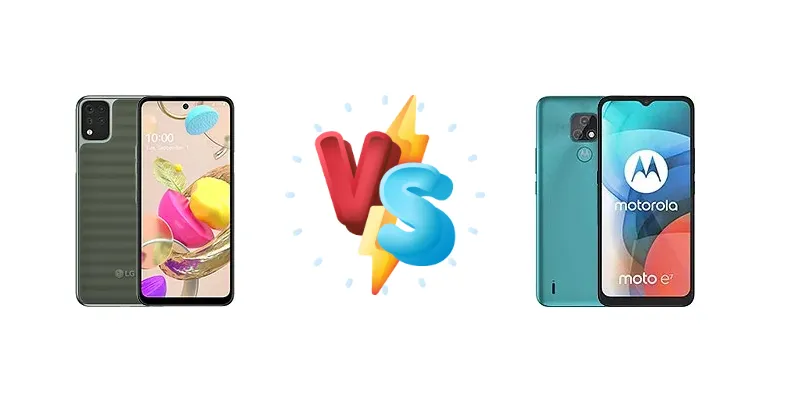
The Motorola Moto E7 and LG K42 represent the ultra-budget end of the smartphone spectrum. Both devices aim to deliver essential smartphone functionality at the lowest possible price point. However, subtle differences in their underlying hardware, specifically the chipset, can significantly impact the user experience. This comparison dissects those differences to determine which phone offers the best value.
🏆 Quick Verdict
For the average user prioritizing slightly better performance and potentially longer sustained workloads, the Motorola Moto E7 is the superior choice. Its Mediatek Helio G25 chipset, while still entry-level, offers a modest performance advantage over the LG K42’s Helio P22, making it more responsive for everyday tasks and light gaming.
| Network |
|---|
| 2G bands | GSM 850 / 900 / 1800 / 1900 | GSM 850 / 900 / 1800 / 1900 |
| 3G bands | HSDPA 850 / 900 / 1900 / 2100 | HSDPA 850 / 900 / 1900 / 2100 - Europe, Asia |
| 4G bands | 1, 3, 7, 8, 20, 28, 38 - Europe | 1, 3, 5, 7, 8, 20, 38, 40, 41 - Europe |
| Speed | Yes, 384 kbps | HSPA 42.2/5.76 Mbps, LTE Cat4 150/50 Mbps |
| Technology | GSM / HSPA / LTE | GSM / HSPA / LTE |
| | 1, 3, 5, 7, 8, 20, 28, 38, 39, 40, 41 - Australia | 1, 2, 3, 5, 7, 8, 18, 19, 20, 26, 28, 38, 40, 41 - Asia |
| Launch |
|---|
| Announced | 2020, September 21. Released 2020, September 21 | 2020, November 24. Released 2020, December 09 |
| Status | Discontinued | Discontinued |
| Body |
|---|
| Build | - | Glass front, plastic frame, plastic back |
| Dimensions | 165 x 76.7 x 8.4 mm (6.50 x 3.02 x 0.33 in) | 164.9 x 75.7 x 8.9 mm (6.49 x 2.98 x 0.35 in) |
| SIM | Nano-SIM + Nano-SIM | Nano-SIM + Nano-SIM |
| Weight | 182 g (6.42 oz) | 180 g (6.35 oz) |
| | MIL-STD-810G compliant*
*does not guarantee ruggedness or use in extreme conditions | Water-repellent coating |
| Display |
|---|
| Resolution | 720 x 1600 pixels, 20:9 ratio (~266 ppi density) | 720 x 1600 pixels, 20:9 ratio (~269 ppi density) |
| Size | 6.6 inches, 105.2 cm2 (~83.1% screen-to-body ratio) | 6.5 inches, 102.8 cm2 (~82.3% screen-to-body ratio) |
| Type | IPS LCD | IPS LCD |
| Platform |
|---|
| CPU | Octa-core 2.0 GHz Cortex-A53 | Octa-core (4x2.0 GHz Cortex-A53 & 4x1.5 GHz Cortex-A53) |
| Chipset | Mediatek MT6762 Helio P22 (12 nm) | Mediatek MT6762G Helio G25 (12 nm) |
| GPU | PowerVR GE8320 | PowerVR GE8320 |
| OS | Android 10, upgradable to Android 11 | Android 10 |
| Memory |
|---|
| Card slot | microSDXC | microSDXC (uses shared SIM slot) |
| Internal | 64GB 3GB RAM | 32GB 2GB RAM, 64GB 2GB RAM, 64GB 4GB RAM |
| | eMMC 5.1 | eMMC 5.1 |
| Main Camera |
|---|
| Dual | - | 48 MP, f/1.7, 26mm (wide), 1/2.0", 0.8µm, PDAF
2 MP (macro) |
| Features | LED flash, panorama, HDR | LED flash, HDR, panorama |
| Quad | 13 MP, 27mm (wide), 1/3.1", 1.12µm, PDAF
5 MP, f/2.2, 115˚ (ultrawide), 1/5.0", 1.12µm
2 MP (macro)
Auxiliary lens | - |
| Video | 1080p@30fps | 1080p@30fps |
| Selfie camera |
|---|
| Features | - | HDR |
| Single | 8 MP, (wide) | 5 MP, f/2.2 |
| Video | 1080p@30fps | 1080p@30fps |
| Sound |
|---|
| 3.5mm jack | Yes | Yes |
| 35mm jack | Yes | Yes |
| Loudspeaker | Yes | Yes |
| Comms |
|---|
| Bluetooth | 5.0, A2DP, LE | 5.0, A2DP, LE |
| NFC | Yes (market/region dependent) | No |
| Positioning | GPS | GPS, GLONASS, GALILEO |
| Radio | No | FM radio |
| USB | USB Type-C 2.0, OTG | USB Type-C 2.0 |
| WLAN | Wi-Fi 802.11 b/g/n, Wi-Fi Direct | Wi-Fi 802.11 b/g/n |
| Features |
|---|
| Sensors | Fingerprint (side-mounted), accelerometer, proximity, compass | Fingerprint (rear-mounted), accelerometer, proximity |
| Battery |
|---|
| Charging | 10W wired | 10W wired |
| Type | Li-Po 4000 mAh | Li-Po 4000 mAh |
| Misc |
|---|
| Colors | Gray, Green | Mineral Gray, Aqua Blue, Satin Coral |
| Models | LMK420, LM-K420, LMK420H, LM-K420H, LMK420E, LM-K420E, LMK420Y, LM-K420Y | - |
| Price | About 140 EUR | About 110 EUR |
LG K42
- Established brand reputation (LG)
- Potentially more readily available in certain regions
- Uniform CPU clock speed
- Less efficient chipset (Helio P22)
- Potentially slower performance in gaming
- Likely lower sustained performance due to thermal throttling
Motorola Moto E7
- More efficient chipset (Helio G25)
- Slightly better GPU performance for gaming
- Potentially longer battery life
- Motorola’s software update track record is inconsistent
- May have less brand recognition in some markets
Display Comparison
Neither the LG K42 nor the Motorola Moto E7 are display champions. Both are expected to feature LCD panels, typical for this price bracket. Specific details like resolution and brightness are not provided, but we can assume they are optimized for power efficiency rather than visual fidelity. Bezels are likely to be substantial on both devices, maximizing screen real estate within a compact form factor. Color accuracy will likely be standard for the segment, prioritizing natural tones over vibrant, oversaturated colors.
Camera Comparison
Camera performance on both devices will be basic. Details are scarce, but it’s safe to assume both feature a primary camera and potentially depth or macro sensors of limited utility. The image processing will likely focus on basic scene optimization and HDR. Without sensor size or aperture information, it’s difficult to definitively declare a winner. However, the slightly more capable GPU in the Moto E7 *could* contribute to faster image processing times. Expect acceptable results in well-lit conditions, but significant noise and lack of detail in low light.
Performance
The core difference lies in the chipsets. The Motorola Moto E7 utilizes the Mediatek Helio G25 (MT6762G), featuring an octa-core configuration with a split core arrangement: four cores clocked at 2.0 GHz (Cortex-A53) and four at 1.5 GHz (Cortex-A53). The LG K42, conversely, employs the Mediatek Helio P22 (MT6762), with all eight cores running at a consistent 2.0 GHz (Cortex-A53). While the K42 has a uniform clock speed, the G25’s architecture, designed for gaming, offers a slight edge in GPU performance. This translates to marginally smoother performance in graphically demanding applications. Both phones will likely be paired with 2GB or 3GB of RAM, limiting multitasking capabilities. Thermal management will be passive on both, meaning sustained performance will be impacted by heat buildup.
Battery Life
Both the LG K42 and Motorola Moto E7 support 10W wired charging, indicating a similar charging experience – expect around 2.5 to 3.5 hours for a full charge. Battery capacity is not specified, but given the target market and chipset power draw, both are likely to house batteries in the 3000-4000 mAh range. The Helio G25’s slightly improved efficiency in the Moto E7 *may* translate to marginally longer battery life during typical usage, but the difference will likely be minimal.
Buying Guide
Buy the LG K42 if you prioritize a brand with a longer history in the smartphone market and are comfortable with slightly slower performance. Buy the Motorola Moto E7 if you prefer a device with a marginally more efficient processor for smoother multitasking and a potentially better gaming experience within the constraints of these budget chipsets. Both phones are ideal for first-time smartphone users or those needing a reliable secondary device.
Frequently Asked Questions
❓ Will the Motorola Moto E7 handle popular games like PUBG Mobile?
While the Helio G25 is designed for light gaming, PUBG Mobile will likely be playable at the lowest graphics settings and frame rates. Expect occasional stuttering and frame drops, especially during intense action sequences. It's not a gaming powerhouse, but it's capable of providing a basic gaming experience.
❓ How does the software experience differ between the LG K42 and Motorola Moto E7?
The LG K42 typically runs LG’s UX skin on top of Android, which can include pre-installed apps and customizations. Motorola, on the other hand, generally offers a near-stock Android experience with minimal bloatware. This results in a cleaner, faster interface on the Moto E7, but LG’s software may offer more features, albeit at the cost of performance.
❓ Is the difference in performance between the Helio P22 and Helio G25 noticeable in everyday use?
The difference isn't dramatic, but it is perceptible. The Moto E7 with the Helio G25 will feel slightly snappier when opening apps, switching between tasks, and browsing the web. The LG K42 with the Helio P22 will still be functional, but may exhibit more noticeable lag in these scenarios.