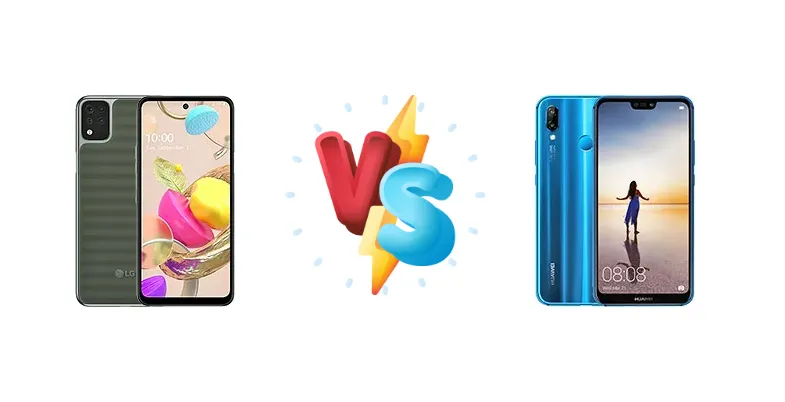
The Huawei P20 Lite and LG K42 represent two approaches to the budget smartphone market. The P20 Lite, released in 2018, offers a more mature software experience and a slightly faster chipset, while the K42, a more recent release, aims to provide a modern feature set at a competitive price. This comparison dives deep into their specifications to determine which device offers the best value in 2024.
🏆 Quick Verdict
For the average user prioritizing a slightly smoother experience and faster charging, the Huawei P20 Lite edges out the LG K42. While the K42 is newer, the Kirin 659’s architecture provides a performance advantage, and the 18W charging is a significant benefit over the K42’s 10W.
| Network |
|---|
| 2G bands | GSM 850 / 900 / 1800 / 1900 | GSM 850 / 900 / 1800 / 1900 |
| 3G bands | HSDPA 850 / 900 / 1900 / 2100 | HSDPA 850 / 900 / 1900 / 2100 |
| 4G bands | 1, 3, 7, 8, 20, 28, 38 - Europe | 1, 3, 7, 8, 20 |
| Speed | Yes, 384 kbps | HSPA 42.2/5.76 Mbps, LTE (2CA) Cat6 300/50 Mbps |
| Technology | GSM / HSPA / LTE | GSM / HSPA / LTE |
| | 1, 3, 5, 7, 8, 20, 28, 38, 39, 40, 41 - Australia | - |
| Launch |
|---|
| Announced | 2020, September 21. Released 2020, September 21 | 2018, March 20. Released 2018, March 26 |
| Status | Discontinued | Discontinued |
| Body |
|---|
| Build | - | Glass front, glass back, aluminum frame |
| Dimensions | 165 x 76.7 x 8.4 mm (6.50 x 3.02 x 0.33 in) | 148.6 x 71.2 x 7.4 mm (5.85 x 2.80 x 0.29 in) |
| SIM | Nano-SIM + Nano-SIM | · Nano-SIM· Nano-SIM + Nano-SIM |
| Weight | 182 g (6.42 oz) | 145 g (5.11 oz) |
| | MIL-STD-810G compliant*
*does not guarantee ruggedness or use in extreme conditions | - |
| Display |
|---|
| Resolution | 720 x 1600 pixels, 20:9 ratio (~266 ppi density) | 1080 x 2280 pixels, 19:9 ratio (~432 ppi density) |
| Size | 6.6 inches, 105.2 cm2 (~83.1% screen-to-body ratio) | 5.84 inches, 85.1 cm2 (~80.5% screen-to-body ratio) |
| Type | IPS LCD | IPS LCD |
| Platform |
|---|
| CPU | Octa-core 2.0 GHz Cortex-A53 | Octa-core (4x2.36 GHz Cortex-A53 & 4x1.7 GHz Cortex-A53) |
| Chipset | Mediatek MT6762 Helio P22 (12 nm) | Kirin 659 (16 nm) |
| GPU | PowerVR GE8320 | Mali-T830 MP2 |
| OS | Android 10, upgradable to Android 11 | Android 8.0 (Oreo), upgradable to Android 9.0 (Pie), EMUI 9.0 |
| Memory |
|---|
| Card slot | microSDXC | microSDXC (uses shared SIM slot) |
| Internal | 64GB 3GB RAM | 32GB 3GB RAM, 32GB 4GB RAM, 64GB 4GB RAM, 128GB 4GB RAM |
| | eMMC 5.1 | eMMC 5.1 |
| Main Camera |
|---|
| Dual | - | 16 MP, f/2.2, 1/3.1", 1.0µm, PDAF
Auxiliary lens |
| Features | LED flash, panorama, HDR | LED flash, HDR, panorama |
| Quad | 13 MP, 27mm (wide), 1/3.1", 1.12µm, PDAF
5 MP, f/2.2, 115˚ (ultrawide), 1/5.0", 1.12µm
2 MP (macro)
Auxiliary lens | - |
| Video | 1080p@30fps | 1080p@30fps |
| Selfie camera |
|---|
| Single | 8 MP, (wide) | 16 MP, f/2.0, 28mm (wide), 1/2.8", 1.12µm
24 MP, f/2.0, 26mm (wide), 1/2.8", 0.9µm (AL00 for India; TL00 for China) |
| Video | 1080p@30fps | 1080p@30fps |
| Sound |
|---|
| 3.5mm jack | Yes | Yes |
| 35mm jack | Yes | Yes |
| Loudspeaker | Yes | Yes |
| Comms |
|---|
| Bluetooth | 5.0, A2DP, LE | 4.2, A2DP, LE, EDR, aptX HD |
| NFC | Yes (market/region dependent) | Yes (LX1 only) |
| Positioning | GPS | GPS, GLONASS, BDS |
| Radio | No | FM radio |
| USB | USB Type-C 2.0, OTG | USB Type-C 2.0, OTG |
| WLAN | Wi-Fi 802.11 b/g/n, Wi-Fi Direct | Wi-Fi 802.11 b/g/n (LX2/LX3) or a/b/g/n/ac (LX1/LX2J), Wi-Fi Direct |
| Features |
|---|
| Sensors | Fingerprint (side-mounted), accelerometer, proximity, compass | Fingerprint (rear-mounted), accelerometer, gyro (except LX2, AL00), proximity, compass |
| Battery |
|---|
| Charging | 10W wired | 18W wired |
| Type | Li-Po 4000 mAh | Li-Po 3000 mAh, non-removable |
| Misc |
|---|
| Colors | Gray, Green | Klein Blue, Sakura Pink, Midnight Black |
| Models | LMK420, LM-K420, LMK420H, LM-K420H, LMK420E, LM-K420E, LMK420Y, LM-K420Y | NE-TL00, ANE-LX1, ANE-LX2, ANE-LX3, ANE-LX2J, ANE-AL00, ANE-L23, ANE-L22, ANE-L21, HWV32, ANE-TL00, ANY-LX2 |
| Price | About 140 EUR | About 240 EUR |
| Tests |
|---|
| Audio quality | - |
Noise -87.9dB / Crosstalk -82.1dB |
| Battery life | - |
Endurance rating 77h
|
| Camera | - |
Photo / Video |
| Display | - |
Contrast ratio: 1785:1 (nominal), 2.952 (sunlight) |
| Loudspeaker | - |
Voice 66dB / Noise 71dB / Ring 84dB
|
| Performance | - |
AnTuTu: 87431 (v7)
GeekBench: 3756 (v4.4)
GFXBench: 2.8fps (ES 3.1 onscreen) |
LG K42
- More recent software updates likely
- Potentially better long-term software support
- Slightly more efficient chipset (12nm)
- Slower processor than the P20 Lite
- Significantly slower 10W charging
- Missing detailed display specifications
Huawei P20 lite
- Faster Kirin 659 processor for smoother performance
- 18W fast charging for quicker top-ups
- Good contrast ratio for outdoor visibility
- Older device with potentially limited software updates
- May have a less refined user interface
- Battery endurance is similar despite slower charging
Display Comparison
Both the LG K42 and Huawei P20 Lite share a similar display contrast ratio of 1785:1 (nominal) and 2.952 (sunlight), suggesting comparable visibility in bright conditions. However, detailed panel specifications like resolution and screen technology are missing for the K42. The P20 Lite’s display, while not exceptional, benefits from the contrast ratio, making images appear more vibrant. Without knowing the K42’s panel type, it’s difficult to assess its color accuracy or viewing angles relative to the P20 Lite.
Camera Comparison
Both devices are listed as having Photo/Video capabilities, but specific details regarding sensor size, aperture, or image processing are absent. Given the market positioning of both phones, it’s safe to assume both rely on relatively basic camera systems. The absence of information makes a direct comparison impossible, but the P20 Lite’s age suggests it may benefit from more refined image processing algorithms developed over time. It's unlikely either phone will excel in low-light conditions.
Performance
The Huawei P20 Lite’s Kirin 659, fabricated on a 16nm process, features an octa-core configuration split into two clusters: four cores clocked at 2.36 GHz and four at 1.7 GHz. This contrasts with the LG K42’s Mediatek MT6762 Helio P22, built on a 12nm process, utilizing eight Cortex-A53 cores at a uniform 2.0 GHz. While the 12nm process *should* offer better efficiency, the Kirin 659’s higher clock speeds on its performance cores provide a noticeable advantage in CPU-intensive tasks. This translates to quicker app launches and smoother multitasking on the P20 Lite. The GPU within the Kirin 659 also offers a slight edge in graphical performance.
Battery Life
Both the LG K42 and Huawei P20 Lite achieve an endurance rating of 77 hours, indicating similar real-world battery life. However, the charging speeds differ significantly. The P20 Lite supports 18W wired charging, allowing for a much faster 0-100% charge time compared to the K42’s slower 10W charging. This difference in charging speed is a practical advantage for users who need to quickly top up their battery.
Buying Guide
Buy the LG K42 if you need a phone with a more current software release cycle and are less concerned with peak performance. It’s a solid choice for basic smartphone tasks and media consumption. Buy the Huawei P20 Lite if you prioritize a slightly faster processor for smoother multitasking and app loading, and value the convenience of faster 18W wired charging, even if the device is older.
Frequently Asked Questions
❓ Is the Huawei P20 Lite still receiving security updates?
Huawei’s update schedule for older devices can be inconsistent. While the P20 Lite may not receive major Android version updates, it’s crucial to check Huawei’s official support pages for the latest security patch information. Users should be aware that long-term security support is a potential concern with older devices.
❓ Will the LG K42 struggle with demanding games like PUBG Mobile?
The LG K42’s Mediatek Helio P22 is a budget chipset and will likely struggle with graphically intensive games like PUBG Mobile. Expect to play at lower settings and potentially experience frame rate drops, even on minimal graphics configurations. The Huawei P20 Lite’s Kirin 659 offers a slight advantage, but it’s still not a gaming powerhouse.
❓ How long will it take to fully charge each phone?
With 10W charging, the LG K42 will likely take over 3 hours to fully charge from 0%. The Huawei P20 Lite, with its 18W charging, should fully charge in approximately 1 hour and 45 minutes to 2 hours, offering a significantly faster charging experience.