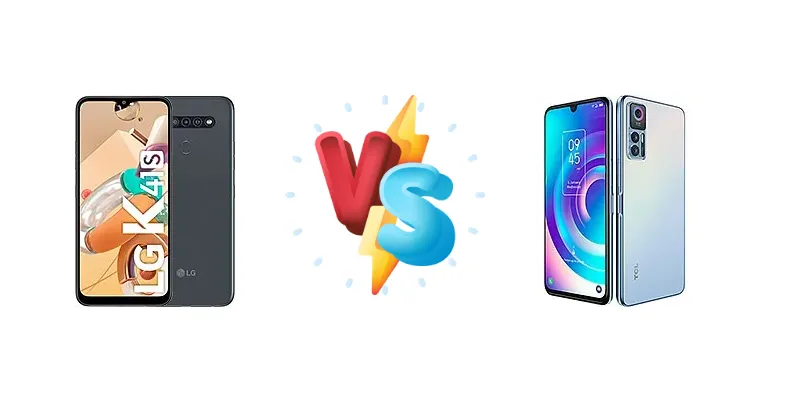
The LG K41S and TCL 30 5G represent different approaches to the budget smartphone market. The K41S, while older, aims for affordability, while the TCL 30 5G prioritizes 5G connectivity and a more modern chipset. This comparison dissects their key differences to determine which device delivers the best value.
🏆 Quick Verdict
For the average user, the TCL 30 5G is the clear winner. Its Mediatek Dimensity 700 chipset, built on a 7nm process, provides a substantial performance advantage over the LG K41S’s Helio P22, making it better suited for multitasking, gaming, and future-proofing. The 18W charging is also a welcome addition.
| Network |
|---|
| 2G bands | GSM 850 / 900 / 1800 / 1900 | GSM 850 / 900 / 1800 / 1900 |
| 3G bands | HSDPA 850 / 900 / 1900 / 2100 | HSDPA 850 / 900 / 1700(AWS) / 1900 / 2100 |
| 4G bands | 1, 3, 7, 8, 20, 38 | 1, 3, 5, 7, 8, 20, 26, 28, 32, 38, 40, 41 |
| 5G bands | - | 1, 3, 5, 7, 8, 20, 28, 40, 41, 78 SA/NSA |
| Speed | HSPA 42.2/5.76 Mbps, LTE Cat4 150/50 Mbps | HSPA 42.2/11.5 Mbps, LTE Cat13 390/150 Mbps, 5G |
| Technology | GSM / HSPA / LTE | GSM / HSPA / LTE / 5G |
| Launch |
|---|
| Announced | 2020, February 18. Released 2020, April 27 | 2022, February 27 |
| Status | Discontinued | Available. Released 2022, April 11 |
| Body |
|---|
| Build | - | Glass front, plastic frame, plastic back |
| Dimensions | 165.8 x 76.5 x 8.3 mm (6.53 x 3.01 x 0.33 in) | 164.5 x 75.2 x 7.7 mm (6.48 x 2.96 x 0.30 in) |
| SIM | · Nano-SIM· Nano-SIM + Nano-SIM | · Nano-SIM· Nano-SIM + Nano-SIM |
| Weight | 191.7 g (6.77 oz) | 184 g (6.49 oz) |
| | MIL-STD-810G compliant*
*does not guarantee ruggedness or use in extreme conditions | - |
| Display |
|---|
| Protection | Scratch-resistant glass | - |
| Resolution | 720 x 1600 pixels, 20:9 ratio (~268 ppi density) | 1080 x 2400 pixels, 20:9 ratio (~393 ppi density) |
| Size | 6.55 inches, 103.6 cm2 (~81.7% screen-to-body ratio) | 6.7 inches, 108.4 cm2 (~87.6% screen-to-body ratio) |
| Type | IPS LCD | AMOLED, 650 nits (typ), 900 nits (peak) |
| Platform |
|---|
| CPU | Octa-core 2.0 GHz Cortex-A53 | Octa-core (2x2.2 GHz Cortex-A76 & 6x2.0 GHz Cortex-A55) |
| Chipset | Mediatek MT6762 Helio P22 (12 nm) | Mediatek Dimensity 700 (7 nm) |
| GPU | PowerVR GE8320 | Mali-G57 MC2 |
| OS | Android 9.0 (Pie) | Android 12, TCL UI 4.0 |
| Memory |
|---|
| Card slot | microSDXC (dedicated slot) | microSDXC (dedicated slot) |
| Internal | 32GB 3GB RAM | 64GB 4GB RAM, 128GB 4GB RAM |
| | eMMC 5.1 | eMMC 5.1 |
| Main Camera |
|---|
| Features | LED flash, panorama, HDR | LED flash, HDR, panorama |
| Quad | 13 MP, f/2.0, 28mm (wide), PDAF
5 MP, f/2.2, 115˚, (ultrawide)
2 MP (macro)
Auxiliary lens | - |
| Single | - | 13 MP, f/2.3, 19mm (ultrawide), 1/3", 1.12µm |
| Triple | - | 50 MP, f/1.8, 28mm (wide), 1/2.76", 0.64µm, PDAF
2 MP (macro)
Auxiliary lens |
| Video | 1080p@30fps | 1080p@30fps |
| Selfie camera |
|---|
| Features | - | HDR |
| Single | 8 MP | 13 MP, f/2.3, 19mm (ultrawide), 1/3", 1.12µm |
| Video | 1080p@30fps | 1080p@30fps |
| Sound |
|---|
| 3.5mm jack | Yes | Yes |
| 35mm jack | Yes | Yes |
| Loudspeaker | Yes | Yes |
| Comms |
|---|
| Bluetooth | 5.0, A2DP, LE | 5.1, A2DP, LE |
| NFC | Yes | Yes |
| Positioning | GPS | GPS, GLONASS, GALILEO, BDS |
| Radio | No | Unspecified |
| USB | USB Type-C 2.0, OTG | USB Type-C 2.0 |
| WLAN | Wi-Fi 802.11 b/g/n, Wi-Fi Direct, DLNA | Wi-Fi 802.11 a/b/g/n/ac, dual-band, Wi-Fi Direct |
| Features |
|---|
| Sensors | Fingerprint (rear-mounted), accelerometer, proximity, compass | Fingerprint (side-mounted), accelerometer, proximity, compass |
| Battery |
|---|
| Charging | - | 18W wired |
| Type | Li-Po 4000 mAh | Li-Po 5010 mAh |
| Misc |
|---|
| Colors | Titanium, Black, White | Tech Black, Dreamy Blue |
| Models | LMK410EMW, LM-K410EMW, LM-K410 | T776H |
| Price | About 220 EUR | About 250 EUR |
LG K41S
- Potentially lower price point
- Simple and straightforward user experience
- May be more readily available in some regions
- Outdated and underpowered chipset
- Poor performance for multitasking and gaming
- Likely limited software support
TCL 30 5G
- Significantly faster performance with Dimensity 700
- 5G connectivity for faster data speeds
- 18W fast charging
- May be slightly more expensive
- LCD display quality is likely average
- Camera performance is still limited by budget sensors
Display Comparison
Neither device is known for display excellence. The LG K41S likely features a standard LCD panel, typical for its price point, with resolution details unavailable. The TCL 30 5G also utilizes an LCD, but details regarding peak brightness and color gamut are missing. However, the TCL 30 5G’s focus on modern connectivity suggests a more recent panel, potentially offering slightly improved viewing angles and color reproduction. Bezels are expected to be substantial on both devices, reflecting their budget nature.
Camera Comparison
Camera performance is likely to be a weak point on both devices. Without specific sensor details, it’s safe to assume both rely on budget sensors. The TCL 30 5G may benefit from more advanced image processing capabilities inherent in the Dimensity 700’s ISP, potentially leading to slightly better dynamic range and noise reduction. The LG K41S’s camera is likely to produce softer images with limited detail, especially in low-light conditions. Any 2MP macro or depth sensors on either device should be considered marketing features rather than genuine photographic tools.
Performance
The performance gap between these two phones is significant. The TCL 30 5G’s Mediatek Dimensity 700, fabricated on a 7nm process, boasts a more efficient architecture and faster CPU cores (2x2.2 GHz Cortex-A76 & 6x2.0 GHz Cortex-A55) compared to the LG K41S’s Mediatek Helio P22 (12nm) and its Octa-core 2.0 GHz Cortex-A53. The Dimensity 700’s Cortex-A76 cores provide a noticeable uplift in single-core performance, crucial for app launch speeds and general responsiveness. The 7nm process also translates to better thermal efficiency, reducing the likelihood of throttling during sustained workloads. The K41S will struggle with demanding apps and multitasking.
Battery Life
Battery capacity details for the LG K41S are unavailable, but it likely falls in the 3000-4000 mAh range. The TCL 30 5G’s battery capacity is also unspecified, but its 18W wired charging is a key advantage. While neither phone will offer exceptional battery life, the faster charging on the TCL 30 5G will significantly reduce downtime. The more efficient Dimensity 700 chipset may also contribute to slightly better battery endurance during typical usage.
Buying Guide
Buy the LG K41S if you need a very basic smartphone for essential tasks like calls, texts, and light social media use, and are on an extremely tight budget. Buy the TCL 30 5G if you prioritize faster performance, 5G connectivity for improved data speeds, and a more responsive user experience, even if it means spending a bit more.
Frequently Asked Questions
❓ Will the TCL 30 5G's Dimensity 700 handle popular games like PUBG Mobile?
Yes, the Mediatek Dimensity 700 is capable of running PUBG Mobile at medium settings with reasonable frame rates. While it won't deliver a flagship gaming experience, it's a significant improvement over the LG K41S's Helio P22, which would struggle with even lower settings.
❓ How much faster is 5G on the TCL 30 5G compared to 4G on the LG K41S?
5G speeds on the TCL 30 5G can be significantly faster than 4G on the LG K41S, potentially offering download speeds 10-100 times faster depending on network conditions and carrier support. This translates to quicker app downloads, smoother streaming, and faster web browsing.
❓ Is the LG K41S a good choice for someone who primarily uses their phone for calls and texts?
Yes, the LG K41S is a viable option for basic communication if budget is the absolute primary concern. However, even for these tasks, the TCL 30 5G offers a more responsive and modern experience.
❓ Does the TCL 30 5G support VoLTE and Wi-Fi calling?
The TCL 30 5G is highly likely to support VoLTE (Voice over LTE) and Wi-Fi calling, as these are standard features for 5G-enabled smartphones. However, compatibility depends on your carrier, so it's best to confirm with your provider.