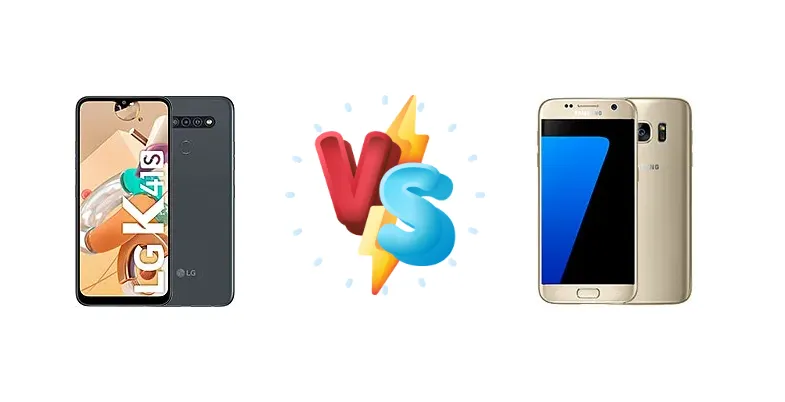
The Samsung Galaxy S7, released in 2016, represents a high point in Samsung’s flagship design and performance. Now, years later, it’s often found at bargain prices. But can it still compete with newer budget offerings like the LG K41S, released in 2019? This comparison dives deep into the specs and real-world implications to determine which phone offers the best value in today’s market.
🏆 Quick Verdict
For the average user prioritizing a modern Android experience and acceptable performance for everyday tasks, the LG K41S is the better choice. While the Galaxy S7 boasts a superior chipset, its age and potential battery degradation outweigh its performance advantages, especially considering the K41S’s lower price point.
| Network |
|---|
| 2G bands | GSM 850 / 900 / 1800 / 1900 | GSM 850 / 900 / 1800 / 1900 - SIM 1 & SIM 2 - G930FD |
| 3G bands | HSDPA 850 / 900 / 1900 / 2100 | HSDPA 850 / 900 / 1700(AWS) / 1900 / 2100 - G930F, G930FD, G930W8 |
| 4G bands | 1, 3, 7, 8, 20, 38 | 1, 2, 3, 4, 5, 7, 8, 12, 13, 17, 18, 19, 20, 25, 26, 28, 38, 39, 40, 41 - G930F, G930FD |
| Speed | HSPA 42.2/5.76 Mbps, LTE Cat4 150/50 Mbps | HSPA 42.2/5.76 Mbps, LTE (3CA) Cat9 450/50 Mbps |
| Technology | GSM / HSPA / LTE | GSM / HSPA / LTE |
| | - | 1, 2, 3, 4, 5, 7, 8, 12, 13, 17, 18, 19, 20, 25, 29, 30, 38, 39, 40, 41 - G930W8 |
| Launch |
|---|
| Announced | 2020, February 18. Released 2020, April 27 | 2016, February 21. Released 2016, March 11 |
| Status | Discontinued | Discontinued |
| Body |
|---|
| Build | - | Glass front (Gorilla Glass 4), glass back (Gorilla Glass 4), aluminum frame |
| Dimensions | 165.8 x 76.5 x 8.3 mm (6.53 x 3.01 x 0.33 in) | 142.4 x 69.6 x 7.9 mm (5.61 x 2.74 x 0.31 in) |
| SIM | · Nano-SIM· Nano-SIM + Nano-SIM | · Nano-SIM (G930F)· Nano-SIM + Nano-SIM (G930FD) |
| Weight | 191.7 g (6.77 oz) | 152 g (5.36 oz) |
| | MIL-STD-810G compliant*
*does not guarantee ruggedness or use in extreme conditions | IP68 dust/water resistant (up to 1.5m for 30 min) |
| Display |
|---|
| Protection | Scratch-resistant glass | Corning Gorilla Glass 4 |
| Resolution | 720 x 1600 pixels, 20:9 ratio (~268 ppi density) | 1440 x 2560 pixels, 16:9 ratio (~577 ppi density) |
| Size | 6.55 inches, 103.6 cm2 (~81.7% screen-to-body ratio) | 5.1 inches, 71.5 cm2 (~72.1% screen-to-body ratio) |
| Type | IPS LCD | Super AMOLED |
| | - | Always-on display |
| Platform |
|---|
| CPU | Octa-core 2.0 GHz Cortex-A53 | Octa-core (4x2.3 GHz Mongoose & 4x1.6 GHz Cortex-A53) |
| Chipset | Mediatek MT6762 Helio P22 (12 nm) | Exynos 8890 Octa (14 nm) |
| GPU | PowerVR GE8320 | Mali-T880 MP12 |
| OS | Android 9.0 (Pie) | Android 6.0 (Marshmallow), upgradable to Android 8.0 (Oreo), TouchWiz UI |
| Memory |
|---|
| Card slot | microSDXC (dedicated slot) | microSDXC (uses shared SIM slot) - dual SIM model only |
| Internal | 32GB 3GB RAM | 32GB 4GB RAM, 64GB 4GB RAM |
| | eMMC 5.1 | UFS 2.0 |
| Main Camera |
|---|
| Features | LED flash, panorama, HDR | LED flash, auto-HDR, panorama |
| Quad | 13 MP, f/2.0, 28mm (wide), PDAF
5 MP, f/2.2, 115˚, (ultrawide)
2 MP (macro)
Auxiliary lens | - |
| Single | - | 12 MP, f/1.7, 26mm (wide), 1/2.55", 1.4µm, dual pixel PDAF, OIS |
| Video | 1080p@30fps | 4K@30fps, 1080p@30fps (gyro-EIS), 1080p@60fps, 720p@240fps, HDR, stereo sound rec., OIS |
| Selfie camera |
|---|
| Features | - | HDR |
| Single | 8 MP | 5 MP, f/1.7, 22mm (wide), 1/4.1", 1.34µm |
| Video | 1080p@30fps | 1440p |
| Sound |
|---|
| 3.5mm jack | Yes | Yes |
| 35mm jack | Yes | Yes |
| Loudspeaker | Yes | Yes |
| | - | 24-bit/192kHz audio
|
| Comms |
|---|
| Bluetooth | 5.0, A2DP, LE | 4.2, A2DP, LE, aptX |
| NFC | Yes | Yes |
| Positioning | GPS | GPS, GLONASS, BDS |
| Radio | No | No |
| USB | USB Type-C 2.0, OTG | microUSB 2.0, OTG |
| WLAN | Wi-Fi 802.11 b/g/n, Wi-Fi Direct, DLNA | Wi-Fi 802.11 a/b/g/n/ac, dual-band, Wi-Fi Direct |
| Features |
|---|
| Sensors | Fingerprint (rear-mounted), accelerometer, proximity, compass | Fingerprint (front-mounted), accelerometer, gyro, proximity, compass, barometer, heart rate, SpO2 |
| | - | ANT+
S-Voice natural language commands and dictation
Samsung Pay (Visa, MasterCard certified) |
| Battery |
|---|
| Charging | - | 15W wired, QC2
Wireless (Qi) (market dependent) |
| Music play | - | Up to 62 h |
| Talk time | - | Up to 22 h (3G) |
| Type | Li-Po 4000 mAh | Li-Ion 3000 mAh, non-removable |
| Misc |
|---|
| Colors | Titanium, Black, White | Black, White, Gold, Silver, Pink Gold |
| Models | LMK410EMW, LM-K410EMW, LM-K410 | SM-G930F, SM-G930A, SM-G930P, SM-G930V, SM-G930T, SM-G930R, SM-G930F, SM-G930FD, SM-G930W8, SM-G930S, SM-G930L, SM-G930K, SM-G9300 |
| Price | About 220 EUR | About 190 EUR |
| SAR | - | 1.40 W/kg (head) 1.59 W/kg (body) |
| SAR EU | - | 0.41 W/kg (head) 0.62 W/kg (body) |
| Tests |
|---|
| Audio quality | - |
Noise -92.5dB / Crosstalk -92.7dB |
| Battery life | - |
Endurance rating 80h
|
| Camera | - |
Photo / Video |
| Display | - |
Contrast ratio: Infinite (nominal), 4.376 (sunlight) |
| Loudspeaker | - |
Voice 69dB / Noise 69dB / Ring 71dB
|
| Performance | - |
Basemark OS II 2.0: 2128Basemark X: 32345 |
LG K41S
- More affordable price point
- Newer Android OS with potential for updates
- Larger display for media consumption
- Significantly weaker processor
- Lower-quality display panel
- Less refined camera system
Samsung Galaxy S7
- More powerful processor for demanding tasks
- Superior display quality (original condition)
- Potentially better camera performance (original condition)
- Aging battery with reduced capacity
- Outdated software with limited support
- Higher risk of hardware failure due to age
Display Comparison
Both the LG K41S and Samsung Galaxy S7 share a reported contrast ratio of Infinite (nominal) and 4.376 in sunlight, suggesting similar outdoor visibility. However, the S7’s original Super AMOLED panel likely offers superior color accuracy and vibrancy compared to the K41S’s LCD. The S7’s smaller 5.1-inch display versus the K41S’s 6.1-inch screen caters to different preferences; the S7 is more pocketable, while the K41S provides a larger viewing area. The K41S’s larger size also means a lower pixel density, potentially impacting sharpness.
Camera Comparison
While both phones offer photo and video capabilities, the Samsung Galaxy S7 likely holds an advantage in image quality, assuming the camera sensor and lens haven’t degraded significantly over time. The S7’s original camera system was highly regarded for its low-light performance and dynamic range. The LG K41S’s camera specifications are less detailed, and its image processing is likely less sophisticated. The presence of a 2MP macro camera on the K41S is largely a marketing gimmick, offering limited practical benefit. The S7’s image stabilization (OIS) is a key advantage for video recording.
Performance
The Samsung Galaxy S7’s Exynos 8890 Octa (14nm) significantly outperforms the LG K41S’s MediaTek Helio P22 (12nm) in raw processing power. The S7’s CPU features a combination of high-performance Mongoose cores (2.3 GHz) and efficiency-focused Cortex-A53 cores (1.6 GHz), while the K41S relies solely on Cortex-A53 cores clocked at 2.0 GHz. This translates to smoother multitasking, faster app loading times, and better gaming performance on the S7. However, the S7’s age means its battery has likely degraded, potentially throttling performance under sustained load. The 14nm process node on the Exynos 8890, while more advanced than the K41S’s 12nm, is still older technology and may generate more heat.
Battery Life
Both devices boast an endurance rating of 80 hours, but this figure is highly dependent on usage patterns and, crucially, battery health. The Samsung Galaxy S7’s battery has likely experienced significant degradation over the years, reducing its capacity and runtime. The K41S, being newer, should have a healthier battery. The S7 supports 15W wired charging with Quick Charge 2.0 and potentially Qi wireless charging (market dependent), offering faster charging speeds than the K41S’s unspecified charging capabilities. However, even with faster charging, a degraded battery on the S7 will still limit its overall usability.
Buying Guide
Buy the LG K41S if you need a reliable, affordable smartphone for basic tasks like calling, texting, social media, and light web browsing. It’s ideal for users who prioritize a newer operating system and don’t require demanding performance. Buy the Samsung Galaxy S7 if you prefer a more premium build quality, a potentially better camera experience (depending on battery health), and are comfortable with an older device that may require battery replacement or have limited software support.
Frequently Asked Questions
❓ Does the Exynos 8890 in the Galaxy S7 overheat during prolonged gaming sessions?
The Exynos 8890 is known to generate heat under sustained load. While it was a powerful chip in its time, its age and the potential for thermal paste degradation mean it's more prone to throttling during extended gaming sessions. Battery health also plays a role; a degraded battery can exacerbate overheating.
❓ Is the 2MP macro camera on the LG K41S actually useful for taking detailed close-up photos?
Generally, no. 2MP macro cameras on budget phones often produce low-resolution, noisy images with limited detail. They are primarily a marketing feature and rarely deliver significant improvements in close-up photography compared to using the main camera in standard mode.
❓ Can the Samsung Galaxy S7 still receive software updates, including security patches?
No. Samsung officially ended software support for the Galaxy S7 in 2021. This means it no longer receives security patches, making it potentially vulnerable to security threats. Using an outdated operating system is a significant security risk.
❓ How long will the battery on a used Samsung Galaxy S7 likely last on a single charge?
This is highly variable. A Galaxy S7 battery from 2016 will likely have significantly reduced capacity. Expect anywhere from 2-6 hours of moderate use, depending on the battery's condition and usage patterns. Replacing the battery is a viable option, but adds to the overall cost.