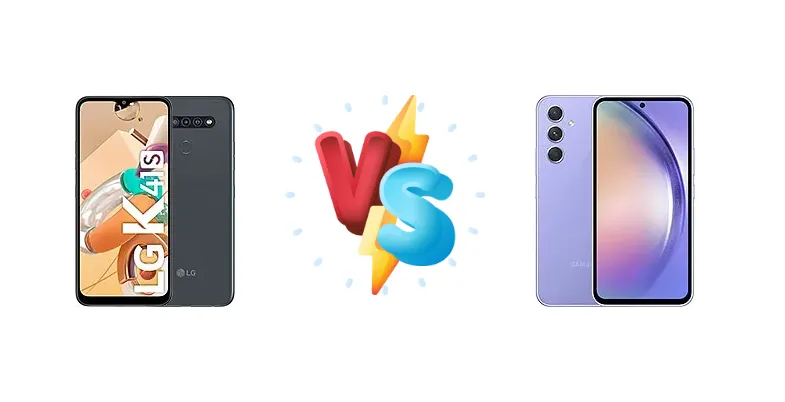
The smartphone landscape is crowded with options, but finding the right balance between price and performance can be tricky. We pit the Samsung Galaxy A54, a current-generation mid-ranger, against the LG K41S, a more budget-focused device, to determine which offers the best value for your money. This comparison focuses on core user experiences – from everyday tasks to media consumption and photography.
🏆 Quick Verdict
For most users, the Samsung Galaxy A54 is the clear winner. Its significantly more powerful Exynos 1380 chipset, coupled with a brighter display and longer battery endurance, justifies the higher price tag. The LG K41S remains a viable option for those on an extremely tight budget, but compromises are substantial.
| Network |
|---|
| 2G bands | GSM 850 / 900 / 1800 / 1900 | GSM 850 / 900 / 1800 / 1900 |
| 3G bands | HSDPA 850 / 900 / 1900 / 2100 | HSDPA 850 / 900 / 1700(AWS) / 1900 / 2100 |
| 4G bands | 1, 3, 7, 8, 20, 38 | 1, 2, 3, 4, 5, 7, 8, 12, 17, 20, 26, 28, 32, 38, 40, 41, 66 - International |
| 5G bands | - | 1, 3, 7, 8, 20, 28, 38, 40, 41, 77, 78 SA/NSA/Sub6 - International |
| Speed | HSPA 42.2/5.76 Mbps, LTE Cat4 150/50 Mbps | HSPA, LTE, 5G |
| Technology | GSM / HSPA / LTE | GSM / HSPA / LTE / 5G |
| | - | 25, 41, 66, 71 SA/NSA/Sub6/mmWave - USA |
| Launch |
|---|
| Announced | 2020, February 18. Released 2020, April 27 | 2023, March 15 |
| Status | Discontinued | Available. Released 2023, March 24 |
| Body |
|---|
| Build | - | Glass front (Gorilla Glass 5), glass back (Gorilla Glass 5), plastic frame |
| Dimensions | 165.8 x 76.5 x 8.3 mm (6.53 x 3.01 x 0.33 in) | 158.2 x 76.7 x 8.2 mm (6.23 x 3.02 x 0.32 in) |
| SIM | · Nano-SIM· Nano-SIM + Nano-SIM | · Nano-SIM + eSIM· Nano-SIM + Nano-SIM |
| Weight | 191.7 g (6.77 oz) | 202 g (7.13 oz) |
| | MIL-STD-810G compliant*
*does not guarantee ruggedness or use in extreme conditions | IP67 dust/water resistant (up to 1m for 30 min) |
| Display |
|---|
| Protection | Scratch-resistant glass | Corning Gorilla Glass 5 |
| Resolution | 720 x 1600 pixels, 20:9 ratio (~268 ppi density) | 1080 x 2340 pixels, 19.5:9 ratio (~403 ppi density) |
| Size | 6.55 inches, 103.6 cm2 (~81.7% screen-to-body ratio) | 6.4 inches, 100.5 cm2 (~82.9% screen-to-body ratio) |
| Type | IPS LCD | Super AMOLED, 120Hz, HDR10+, 1000 nits (HBM) |
| Platform |
|---|
| CPU | Octa-core 2.0 GHz Cortex-A53 | Octa-core (4x2.4 GHz Cortex-A78 & 4x2.0 GHz Cortex-A55) |
| Chipset | Mediatek MT6762 Helio P22 (12 nm) | Exynos 1380 (5 nm) |
| GPU | PowerVR GE8320 | Mali-G68 MP5 |
| OS | Android 9.0 (Pie) | Android 13, up to 4 major Android upgrades, One UI 7 |
| Memory |
|---|
| Card slot | microSDXC (dedicated slot) | microSDXC (uses shared SIM slot) |
| Internal | 32GB 3GB RAM | 128GB 4GB RAM, 128GB 6GB RAM, 128GB 8GB RAM, 256GB 6GB RAM, 256GB 8GB RAM |
| | eMMC 5.1 | - |
| Main Camera |
|---|
| Features | LED flash, panorama, HDR | LED flash, panorama, HDR |
| Quad | 13 MP, f/2.0, 28mm (wide), PDAF
5 MP, f/2.2, 115˚, (ultrawide)
2 MP (macro)
Auxiliary lens | - |
| Single | - | 32 MP, f/2.2, 26mm (wide), 1/2.8", 0.8µm |
| Triple | - | 50 MP, f/1.8, 23mm (wide), 1/1.56", 1.0µm, PDAF, OIS
12 MP, f/2.2, 13mm, 123˚ (ultrawide), 1/3.X", 1.12µm
5 MP (macro) |
| Video | 1080p@30fps | 4K@30fps, 1080p@30/60fps, 720p@480fps, gyro-EIS |
| Selfie camera |
|---|
| Single | 8 MP | 32 MP, f/2.2, 26mm (wide), 1/2.8", 0.8µm |
| Video | 1080p@30fps | 4K@30fps, 1080p@30/60fps |
| Sound |
|---|
| 3.5mm jack | Yes | No |
| 35mm jack | Yes | No |
| Loudspeaker | Yes | Yes, with stereo speakers |
| Comms |
|---|
| Bluetooth | 5.0, A2DP, LE | 5.3, A2DP, LE |
| NFC | Yes | Yes (market/region dependent) |
| Positioning | GPS | GPS, GLONASS, GALILEO, BDS |
| Radio | No | No |
| USB | USB Type-C 2.0, OTG | USB Type-C 2.0, OTG |
| WLAN | Wi-Fi 802.11 b/g/n, Wi-Fi Direct, DLNA | Wi-Fi 802.11 a/b/g/n/ac/6, dual-band, Wi-Fi Direct |
| Features |
|---|
| Sensors | Fingerprint (rear-mounted), accelerometer, proximity, compass | Fingerprint (under display, optical), accelerometer, gyro, compass, barometer (USA only) |
| | - | Virtual proximity sensing |
| Battery |
|---|
| Charging | - | 25W wired |
| Type | Li-Po 4000 mAh | 5000 mAh |
| Misc |
|---|
| Colors | Titanium, Black, White | Lime, Graphite, Violet, White |
| Models | LMK410EMW, LM-K410EMW, LM-K410 | SM-A546V, SM-A546U, SM-A546U1, SM-A546B, SM-A546B/DS, SM-A546E, SM-A546E/DS, SM-A5460, SM-A546M, SM-A546M/DS, SM-A546W |
| Price | About 220 EUR | € 210.00 / $ 119.11 / £ 169.95 / ₹ 28,999 |
| SAR | - | 0.81 W/kg (head) 0.67 W/kg (body) |
| SAR EU | - | 0.69 W/kg (head) 1.34 W/kg (body) |
| Tests |
|---|
| Battery life | - |
Endurance rating 119h
|
| Camera | - |
Photo / Video |
| Display | - |
Contrast ratio: Infinite (nominal) |
| Loudspeaker | - |
-26.6 LUFS (Good)
|
| Performance | - |
AnTuTu: 506678 (v9)
GeekBench: 2703 (v5.1), 2797 (v6)
GFXBench: 25fps (ES 3.1 onscreen) |
LG K41S
- Significantly faster processor for smooth performance
- Brighter and more vibrant display for better viewing
- Longer battery life and faster charging
- Higher price point
- May be larger and heavier than the K41S
Samsung Galaxy A54
- More affordable price
- Potentially more compact size
- Functional for basic smartphone tasks
- Slow processor struggles with demanding apps
- Lower quality display with limited brightness
- Shorter battery life and slower charging
Display Comparison
The Samsung Galaxy A54 boasts a significantly superior display experience. While the LG K41S’s display specifications are not provided, the A54’s measured peak brightness of 980 nits ensures excellent visibility even in direct sunlight. The A54’s ‘Infinite’ contrast ratio (likely a marketing term for a high-quality AMOLED panel) delivers deeper blacks and more vibrant colors compared to what is typically found in the K41S’s price bracket. The A54’s panel is also likely to have a higher refresh rate, contributing to smoother scrolling and animations, a feature absent in the K41S.
Camera Comparison
Both devices offer photo and video capabilities, but the A54 is expected to deliver far superior results. While specific sensor details are missing for both, Samsung typically equips its A-series phones with capable cameras. The Exynos 1380’s image signal processor (ISP) will provide better image processing, resulting in sharper images, improved dynamic range, and more accurate colors. The LG K41S, with its older chipset, will likely produce noticeably less detailed and vibrant photos, especially in low-light conditions. The presence of Optical Image Stabilization (OIS) on the A54 (likely) further enhances image quality and video stability.
Performance
The performance gap between these two devices is substantial. The Samsung Galaxy A54’s Exynos 1380 (5nm) chipset, featuring a combination of Cortex-A78 and Cortex-A55 cores clocked up to 2.4GHz, offers a significant leap in processing power compared to the LG K41S’s MediaTek Helio P22 (12nm) and its Cortex-A53 cores at 2.0GHz. The 5nm fabrication process of the Exynos 1380 also translates to better power efficiency and reduced thermal throttling. This means the A54 will handle demanding tasks like gaming and video editing with greater ease and maintain sustained performance for longer periods. The K41S will struggle with anything beyond basic app usage.
Battery Life
The Samsung Galaxy A54 demonstrates impressive battery endurance, achieving an endurance rating of 119 hours and 11:15 hours of active use. While the LG K41S’s battery capacity is unknown, the A54’s more efficient chipset and optimized software contribute to its longer runtime. The A54 also supports 25W wired charging, allowing for faster replenishment compared to the K41S, which likely has slower charging capabilities. This means less downtime and more time enjoying your device.
Buying Guide
Buy the LG K41S if you need a functional smartphone for basic communication – calls, texts, and light social media – and prioritize affordability above all else. You're willing to accept slower performance and a less vibrant display. Buy the Samsung Galaxy A54 if you prioritize a smooth user experience, enjoy media consumption with a bright and clear screen, and want a capable camera system for everyday photography. You're willing to invest more for a device that will remain relevant for longer.
Frequently Asked Questions
❓ Does the Exynos 1380 in the Galaxy A54 tend to overheat during prolonged gaming sessions?
The Exynos 1380, built on a 5nm process, is generally efficient and well-managed in the Galaxy A54. While it can get warm during extended gaming, Samsung’s thermal management system typically prevents significant throttling, maintaining a playable frame rate for most titles. It's far less prone to overheating than the Helio P22 in the K41S.
❓ Is the camera on the LG K41S sufficient for casual social media use?
The LG K41S’s camera is adequate for basic social media snapshots in good lighting conditions. However, its image quality will be noticeably inferior to the Galaxy A54, especially in low light. Expect softer details and less vibrant colors. It's sufficient for quick shares, but not for serious photography.
❓ Can the Samsung Galaxy A54 handle graphically demanding games like PUBG Mobile at high settings?
Yes, the Galaxy A54’s Exynos 1380 and its GPU are capable of running PUBG Mobile at high settings with smooth frame rates. While you might need to adjust settings slightly for optimal performance on the most demanding titles, the A54 provides a significantly better gaming experience than the LG K41S.