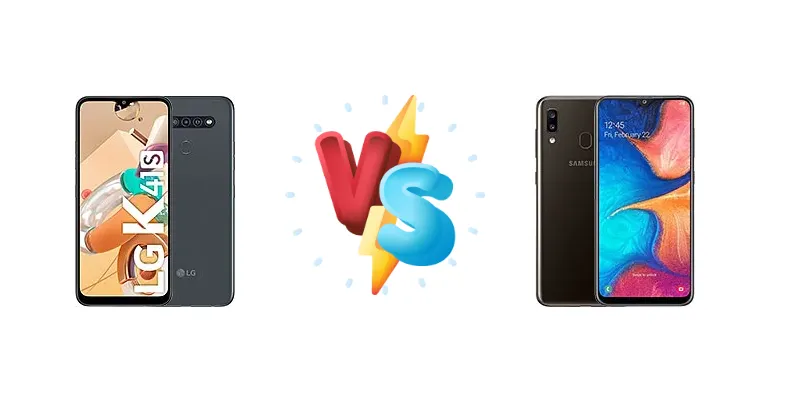
The LG K41S and Samsung Galaxy A20 represent a shrinking segment of the smartphone market: truly affordable devices. Both phones aim to deliver essential smartphone functionality without breaking the bank, but they take different approaches to achieving this. This comparison dissects their key specifications to determine which offers the best value for budget-conscious consumers.
🏆 Quick Verdict
For the average user prioritizing a slightly smoother experience and faster charging, the Samsung Galaxy A20 is the better choice. Its Exynos 7884 chipset, featuring Cortex-A73 cores, provides a noticeable performance edge over the LG K41S’s Helio P22, despite the latter’s more efficient 12nm process.
| Network |
|---|
| 2G bands | GSM 850 / 900 / 1800 / 1900 | GSM 850 / 900 / 1800 / 1900 |
| 3G bands | HSDPA 850 / 900 / 1900 / 2100 | HSDPA 850 / 900 / 1900 / 2100 |
| 4G bands | 1, 3, 7, 8, 20, 38 | 1, 3, 5, 7, 8, 20, 38, 40, 41 |
| Speed | HSPA 42.2/5.76 Mbps, LTE Cat4 150/50 Mbps | HSPA 42.2/5.76 Mbps, LTE Cat4 150/50 Mbps |
| Technology | GSM / HSPA / LTE | GSM / HSPA / LTE |
| | - | 1, 2, 3, 4, 5, 7, 8, 12, 13, 20, 25, 26, 28, 38, 39, 40, 41, 66, 71 - SM-A205U |
| Launch |
|---|
| Announced | 2020, February 18. Released 2020, April 27 | 2019, March 19. Released 2019, April 05 |
| Status | Discontinued | Discontinued |
| Body |
|---|
| Build | - | Glass front (Gorilla Glass 3), plastic back, plastic frame |
| Dimensions | 165.8 x 76.5 x 8.3 mm (6.53 x 3.01 x 0.33 in) | 158.4 x 74.7 x 7.8 mm (6.24 x 2.94 x 0.31 in) |
| SIM | · Nano-SIM· Nano-SIM + Nano-SIM | · Nano-SIM· Nano-SIM + Nano-SIM |
| Weight | 191.7 g (6.77 oz) | 169 g (5.96 oz) |
| | MIL-STD-810G compliant*
*does not guarantee ruggedness or use in extreme conditions | - |
| Display |
|---|
| Protection | Scratch-resistant glass | Corning Gorilla Glass 3 |
| Resolution | 720 x 1600 pixels, 20:9 ratio (~268 ppi density) | 720 x 1560 pixels, 19.5:9 ratio (~268 ppi density) |
| Size | 6.55 inches, 103.6 cm2 (~81.7% screen-to-body ratio) | 6.4 inches, 100.5 cm2 (~85.0% screen-to-body ratio) |
| Type | IPS LCD | Super AMOLED |
| Platform |
|---|
| CPU | Octa-core 2.0 GHz Cortex-A53 | Octa-core (2x1.6 GHz Cortex-A73 & 6x1.35 GHz Cortex-A53) |
| Chipset | Mediatek MT6762 Helio P22 (12 nm) | Exynos 7884 (14 nm) |
| GPU | PowerVR GE8320 | Mali-G71 MP2 |
| OS | Android 9.0 (Pie) | Android 9.0 (Pie), upgradable to Android 11, One UI 3.1 |
| Memory |
|---|
| Card slot | microSDXC (dedicated slot) | microSDXC (dedicated slot) |
| Internal | 32GB 3GB RAM | 32GB 3GB RAM |
| | eMMC 5.1 | eMMC 5.1 |
| Main Camera |
|---|
| Dual | - | 13 MP, f/1.9, 28mm (wide), AF
5 MP, f/2.2, 12mm (ultrawide) |
| Features | LED flash, panorama, HDR | LED flash, panorama, HDR |
| Quad | 13 MP, f/2.0, 28mm (wide), PDAF
5 MP, f/2.2, 115˚, (ultrawide)
2 MP (macro)
Auxiliary lens | - |
| Video | 1080p@30fps | 1080p@30fps |
| Selfie camera |
|---|
| Single | 8 MP | 8 MP, f/2.0 |
| Video | 1080p@30fps | 1080p@30fps |
| Sound |
|---|
| 3.5mm jack | Yes | Yes |
| 35mm jack | Yes | Yes |
| Loudspeaker | Yes | Yes |
| Comms |
|---|
| Bluetooth | 5.0, A2DP, LE | 5.0, A2DP, LE |
| NFC | Yes | Yes (market/region dependent) |
| Positioning | GPS | GPS, GLONASS, BDS |
| Radio | No | FM radio |
| USB | USB Type-C 2.0, OTG | USB Type-C 2.0, OTG |
| WLAN | Wi-Fi 802.11 b/g/n, Wi-Fi Direct, DLNA | Wi-Fi 802.11 b/g/n, Wi-Fi Direct |
| Features |
|---|
| Sensors | Fingerprint (rear-mounted), accelerometer, proximity, compass | Fingerprint (rear-mounted), accelerometer, gyro, proximity, compass |
| Battery |
|---|
| Charging | - | 15W wired |
| Type | Li-Po 4000 mAh | Li-Po 4000 mAh, non-removable |
| Misc |
|---|
| Colors | Titanium, Black, White | Black, Deep Blue, Red, Coral Orange, Gold |
| Models | LMK410EMW, LM-K410EMW, LM-K410 | SM-A205F, SM-A205FN, SM-A205GN, SM-A205YN, SM-A205G, SM-A205W, SM-A205U, SM-A205S, SM-S205DL, SM-A205U1 |
| Price | About 220 EUR | About 100 EUR |
| SAR | - | 1.09 W/kg (head) 0.60 W/kg (body) |
| SAR EU | - | 0.23 W/kg (head) 1.38 W/kg (body) |
LG K41S
- Potentially better power efficiency due to 12nm process
- May offer a slightly longer lifespan due to lower heat generation
- Competitive price point
- Less powerful processor compared to the Exynos 7884
- Slower app launch and multitasking speeds
- No fast charging support
Samsung Galaxy A20
- More powerful Exynos 7884 chipset with Cortex-A73 cores
- Faster 15W wired charging
- Smoother multitasking and app performance
- Less power-efficient 14nm process
- Potentially shorter battery life under heavy load
- Samsung’s software can be bloated
Display Comparison
Neither the LG K41S nor the Samsung Galaxy A20 are display champions. Specific display specs (resolution, brightness) are not provided, but both likely feature HD+ panels typical of this price bracket. The key difference lies in the underlying architecture impacting power draw. The lack of information prevents a detailed comparison of color accuracy or viewing angles, but both will likely suffice for casual use.
Camera Comparison
Camera performance is likely similar on both devices, given the typical sensor quality found in this price range. Without specific sensor details, it’s difficult to make a definitive judgment. However, the presence of a 2MP macro camera on both devices suggests limited utility; these sensors often produce low-quality images. Image processing will likely be the differentiating factor, with Samsung’s software generally offering more vibrant, albeit sometimes over-processed, results. The A20’s 15W charging is a significant advantage for users who frequently capture photos and videos.
Performance
The Samsung Galaxy A20’s Exynos 7884 chipset is the clear winner in terms of raw processing power. While both are octa-core CPUs, the A20 utilizes a big.LITTLE architecture with 2x 1.6 GHz Cortex-A73 cores for performance and 6x 1.35 GHz Cortex-A53 cores for efficiency. The LG K41S relies solely on 8x 2.0 GHz Cortex-A53 cores. This means the A20 will handle multitasking and app launches more smoothly. The K41S’s 12nm process *should* offer better efficiency, potentially translating to slightly longer battery life during light use, but the A20’s more powerful cores will likely negate this advantage under load.
Battery Life
Battery capacity is not specified for either device. However, the Samsung Galaxy A20’s 15W wired charging is a substantial advantage. While the LG K41S’s more efficient chipset *could* lead to slightly longer battery life during light usage, the A20’s faster charging will significantly reduce downtime. A full charge on the A20 will be considerably quicker, making it more convenient for users who need to top up their battery frequently.
Buying Guide
Buy the LG K41S if you prioritize a potentially longer lifespan due to its more efficient processor and are primarily focused on basic tasks like calling, texting, and light social media use. Buy the Samsung Galaxy A20 if you prefer a more responsive user experience, particularly when multitasking or running slightly more demanding apps, and value the convenience of 15W fast charging.
Frequently Asked Questions
❓ Does the Exynos 7884 in the Galaxy A20 tend to overheat during prolonged gaming sessions?
While the Exynos 7884 isn't a high-end gaming chip, it's unlikely to overheat significantly during moderate gaming. The 14nm process isn't the most efficient, but the phone's thermal design should be adequate for casual gaming. Expect some throttling after extended play, but not to the point of complete unplayability.
❓ Is the 2MP macro camera on either phone actually useful for taking detailed close-up photos?
Generally, 2MP macro cameras on budget phones offer limited utility. The low resolution results in images lacking detail and sharpness. They are often included as a marketing feature rather than a genuinely useful camera component. Expect soft, noisy images when attempting macro photography with either device.
❓ Can the Samsung Galaxy A20 handle popular games like PUBG Mobile at acceptable frame rates?
The Galaxy A20 can run PUBG Mobile, but you'll likely need to lower the graphics settings to medium or low to achieve a stable frame rate. Don't expect to play at the highest settings without experiencing lag or stuttering. The Exynos 7884 is capable, but it's not a dedicated gaming processor.
❓ How long does it typically take to fully charge the Samsung Galaxy A20 with the 15W charger?
With the included 15W charger, the Samsung Galaxy A20 should fully charge from 0% to 100% in approximately 2 to 2.5 hours. This is significantly faster than the LG K41S, which lacks fast charging support and will take considerably longer to reach a full charge.