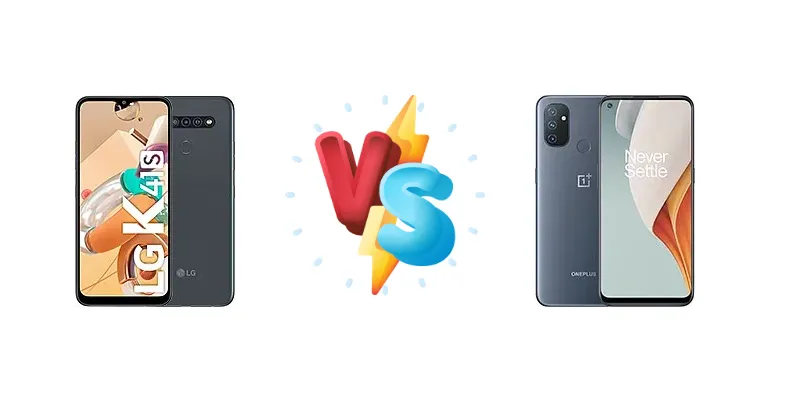
The sub-$150 smartphone market is fiercely competitive. The LG K41S and OnePlus Nord N100 represent two distinct approaches to delivering affordability. The K41S relies on MediaTek’s Helio P22, while the Nord N100 opts for Qualcomm’s Snapdragon 460. This comparison dissects their key differences to determine which offers the best experience for budget-conscious users.
🏆 Quick Verdict
For most users, the OnePlus Nord N100 is the better choice. Its Snapdragon 460, built on an 11nm process, provides a noticeable performance advantage over the LG K41S’s 12nm Helio P22. The inclusion of 18W fast charging further sweetens the deal, making it a more practical daily driver despite similar RAM configurations.
| Network |
|---|
| 2G bands | GSM 850 / 900 / 1800 / 1900 | GSM 850 / 900 / 1800 / 1900 |
| 3G bands | HSDPA 850 / 900 / 1900 / 2100 | HSDPA 850 / 900 / 1700(AWS) / 1900 / 2100 |
| 4G bands | 1, 3, 7, 8, 20, 38 | 1, 2, 3, 4, 5, 7, 8, 12, 17, 20, 28, 38, 40, 41 - International |
| Speed | HSPA 42.2/5.76 Mbps, LTE Cat4 150/50 Mbps | HSPA 42.2/5.76 Mbps, LTE Cat13 400/50 Mbps |
| Technology | GSM / HSPA / LTE | GSM / CDMA / HSPA / LTE |
| | - | 1, 2, 3, 4, 5, 7, 8, 12, 13, 17, 20, 25, 26, 28, 38, 41, 66, 71 - USA |
| Launch |
|---|
| Announced | 2020, February 18. Released 2020, April 27 | 2020, October 26 |
| Status | Discontinued | Available. Released 2020, November 11 |
| Body |
|---|
| Build | - | Glass front (Gorilla Glass 3), plastic frame |
| Dimensions | 165.8 x 76.5 x 8.3 mm (6.53 x 3.01 x 0.33 in) | 164.9 x 75.1 x 8.5 mm (6.49 x 2.96 x 0.33 in) |
| SIM | · Nano-SIM· Nano-SIM + Nano-SIM | Nano-SIM + Nano-SIM |
| Weight | 191.7 g (6.77 oz) | 188 g (6.63 oz) |
| | MIL-STD-810G compliant*
*does not guarantee ruggedness or use in extreme conditions | - |
| Display |
|---|
| Protection | Scratch-resistant glass | Corning Gorilla Glass 3 |
| Resolution | 720 x 1600 pixels, 20:9 ratio (~268 ppi density) | 720 x 1600 pixels, 20:9 ratio (~269 ppi density) |
| Size | 6.55 inches, 103.6 cm2 (~81.7% screen-to-body ratio) | 6.52 inches, 102.6 cm2 (~82.9% screen-to-body ratio) |
| Type | IPS LCD | IPS LCD, 90Hz |
| Platform |
|---|
| CPU | Octa-core 2.0 GHz Cortex-A53 | Octa-core (4x1.8 GHz Kryo 240 & 4x1.6 GHz Kryo 240) |
| Chipset | Mediatek MT6762 Helio P22 (12 nm) | Qualcomm SM4250 Snapdragon 460 (11 nm) |
| GPU | PowerVR GE8320 | Adreno 610 |
| OS | Android 9.0 (Pie) | Android 10, OxygenOS 10.5.9 |
| Memory |
|---|
| Card slot | microSDXC (dedicated slot) | microSDXC |
| Internal | 32GB 3GB RAM | 64GB 4GB RAM |
| | eMMC 5.1 | UFS 2.1 |
| Main Camera |
|---|
| Features | LED flash, panorama, HDR | LED flash, HDR, panorama |
| Quad | 13 MP, f/2.0, 28mm (wide), PDAF
5 MP, f/2.2, 115˚, (ultrawide)
2 MP (macro)
Auxiliary lens | - |
| Triple | - | 13 MP, f/2.2, (wide), PDAF
2 MP (macro)
Auxiliary lens |
| Video | 1080p@30fps | 1080p@30fps, gyro-EIS |
| Selfie camera |
|---|
| Features | - | HDR |
| Single | 8 MP | 8 MP, f/2.0 |
| Video | 1080p@30fps | 1080p@30fps |
| Sound |
|---|
| 3.5mm jack | Yes | Yes |
| 35mm jack | Yes | Yes |
| Loudspeaker | Yes | Yes, with stereo speakers |
| Comms |
|---|
| Bluetooth | 5.0, A2DP, LE | 5.0, A2DP, LE |
| NFC | Yes | - |
| Positioning | GPS | GPS, GLONASS, GALILEO, BDS |
| Radio | No | FM radio |
| USB | USB Type-C 2.0, OTG | USB Type-C 2.0, OTG |
| WLAN | Wi-Fi 802.11 b/g/n, Wi-Fi Direct, DLNA | Wi-Fi 802.11 a/b/g/n/ac, dual-band, Wi-Fi Direct |
| Features |
|---|
| Sensors | Fingerprint (rear-mounted), accelerometer, proximity, compass | Fingerprint (rear-mounted), accelerometer, gyro, proximity, compass |
| Battery |
|---|
| Charging | - | 18W wired |
| Type | Li-Po 4000 mAh | Li-Po 5000 mAh |
| Misc |
|---|
| Colors | Titanium, Black, White | Midnight Frost |
| Models | LMK410EMW, LM-K410EMW, LM-K410 | BE2013, BE2015, BE2011, BE2012 |
| Price | About 220 EUR | About 80 EUR |
| Pricing |
|---|
| 64GB 4GB RAM | - | $ 125.00 |
| RENEWED | - | $ 129.00 |
LG K41S
- Potential for longer software support (LG history)
- May be available at a slightly lower price point
- Likely similar battery capacity to Nord N100
- Inferior chipset performance (Helio P22)
- Slower charging speeds (likely 10W)
- Less efficient processor (12nm vs 11nm)
OnePlus Nord N100
- Superior chipset performance (Snapdragon 460)
- Faster 18W wired charging
- More efficient processor (11nm)
- OnePlus’s software update track record is variable
- May be slightly more expensive than K41S
Display Comparison
Neither device boasts a standout display. Both likely utilize LCD panels, common in this price bracket. The K41S’s display specifications are unavailable, but given its positioning, it’s unlikely to surpass the Nord N100 in brightness or color accuracy. The Nord N100’s display is adequate for everyday use, but neither phone will impress users accustomed to OLED or high refresh rate panels. Bezels are expected to be substantial on both devices.
Camera Comparison
Camera performance is likely to be similar, leaning towards basic functionality on both devices. Without detailed sensor information, it’s difficult to make definitive claims. However, the Snapdragon 460’s image signal processor (ISP) generally offers better image processing capabilities than the Helio P22’s. Expect acceptable results in good lighting conditions, but both phones will struggle in low-light scenarios. The prevalence of 2MP macro/depth sensors on budget phones suggests these are largely marketing features and offer minimal practical benefit.
Performance
The core difference lies in the chipsets. The OnePlus Nord N100’s Qualcomm Snapdragon 460, fabricated on an 11nm process, offers a clear architectural advantage over the LG K41S’s 12nm MediaTek Helio P22. While both are octa-core CPUs, the Snapdragon 460’s Kryo 240 cores, with a split clock speed of 1.8GHz and 1.6GHz, are more efficient and deliver better sustained performance. This translates to snappier app launches and smoother multitasking on the Nord N100. The Helio P22’s Cortex-A53 cores, clocked at 2.0GHz, will struggle with more demanding tasks. The Snapdragon 460 also benefits from a more modern GPU, providing a better gaming experience.
Battery Life
Battery capacity is not specified for the LG K41S, but it’s reasonable to assume it’s in the 4000-5000mAh range, similar to the Nord N100’s 5000mAh cell. However, the Nord N100’s 18W wired charging is a significant advantage. The K41S likely supports standard 10W charging, resulting in considerably longer charge times. This means the Nord N100 can quickly top up its battery, offering greater convenience for users who frequently use their phones throughout the day.
Buying Guide
Buy the LG K41S if you prioritize a potentially longer software support lifecycle from LG (though this is becoming less of a guarantee) and are primarily focused on basic smartphone tasks like calls, texts, and light social media. Buy the OnePlus Nord N100 if you value smoother multitasking, slightly better gaming performance, and faster charging, making it ideal for users who consume more media and occasionally play mobile games.
Frequently Asked Questions
❓ Will the Snapdragon 460 in the Nord N100 handle popular games like PUBG Mobile?
The Snapdragon 460 can run PUBG Mobile, but expect to play at lower graphics settings (balanced or low) to maintain a stable frame rate. It’s not a gaming powerhouse, but it’s significantly better than the Helio P22 for gaming.
❓ Is the software experience significantly different between LG and OnePlus?
Yes. LG’s software is more akin to stock Android with some added features, while OnePlus’s OxygenOS is heavily customized. OxygenOS is generally considered smoother and more feature-rich, but some users prefer LG’s closer-to-stock approach. Both have their pros and cons.
❓ How much does the charging speed difference between 10W and 18W actually matter?
It's substantial. 18W charging on the Nord N100 can take a phone from 0-50% in around 30-40 minutes, while 10W charging on the K41S could take over 2 hours to reach the same level. This difference is crucial for users who need a quick power boost.