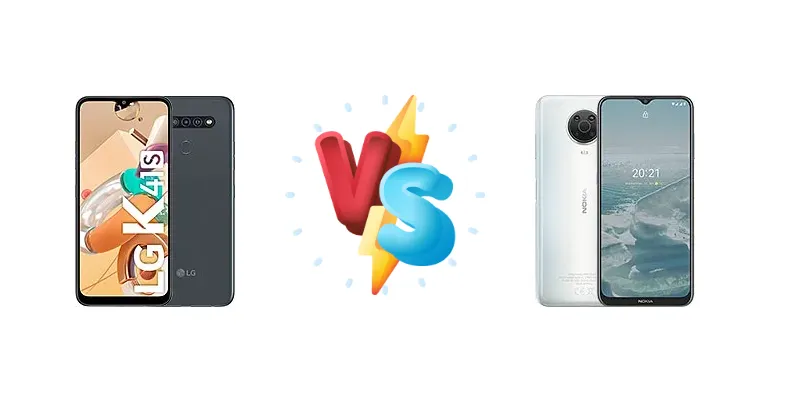
The LG K41S and Nokia G20 represent the lower end of the smartphone market, targeting users prioritizing affordability. However, despite similar price points, they diverge in key areas, particularly processing power and software experience. This comparison dissects these differences to determine which device offers the best value for budget-conscious consumers.
🏆 Quick Verdict
For most users, the Nokia G20 is the better choice. Its Mediatek Helio G35 chipset, with its higher clock speeds, provides a noticeable performance boost over the LG K41S’s Helio P22. While both offer basic functionality, the G20 handles multitasking and app loading with greater ease.
| Network |
|---|
| 2G bands | GSM 850 / 900 / 1800 / 1900 | GSM 850 / 900 / 1800 / 1900 |
| 3G bands | HSDPA 850 / 900 / 1900 / 2100 | HSDPA 850 / 900 / 1900 / 2100 - International |
| 4G bands | 1, 3, 7, 8, 20, 38 | 1, 3, 5, 7, 8, 20, 28, 38, 40, 41 - International |
| Speed | HSPA 42.2/5.76 Mbps, LTE Cat4 150/50 Mbps | HSPA 42.2/5.76 Mbps, LTE Cat4 150/50 Mbps |
| Technology | GSM / HSPA / LTE | GSM / HSPA / LTE |
| | - | 1, 2, 3, 4, 5, 7, 8, 12, 17, 28, 66 - LATAM |
| Launch |
|---|
| Announced | 2020, February 18. Released 2020, April 27 | 2021, April 08 |
| Status | Discontinued | Available. Released 2021, May 17 |
| Body |
|---|
| Dimensions | 165.8 x 76.5 x 8.3 mm (6.53 x 3.01 x 0.33 in) | 164.9 x 76 x 9.2 mm (6.49 x 2.99 x 0.36 in) |
| SIM | · Nano-SIM· Nano-SIM + Nano-SIM | · Nano-SIM· Nano-SIM + Nano-SIM |
| Weight | 191.7 g (6.77 oz) | 197 g (6.95 oz) |
| | MIL-STD-810G compliant*
*does not guarantee ruggedness or use in extreme conditions | Splash protection |
| Display |
|---|
| Protection | Scratch-resistant glass | - |
| Resolution | 720 x 1600 pixels, 20:9 ratio (~268 ppi density) | 720 x 1600 pixels, 20:9 ratio (~269 ppi density) |
| Size | 6.55 inches, 103.6 cm2 (~81.7% screen-to-body ratio) | 6.52 inches, 102.6 cm2 (~81.9% screen-to-body ratio) |
| Type | IPS LCD | IPS LCD |
| Platform |
|---|
| CPU | Octa-core 2.0 GHz Cortex-A53 | Octa-core (4x2.3 GHz Cortex-A53 & 4x1.8 GHz Cortex-A53) |
| Chipset | Mediatek MT6762 Helio P22 (12 nm) | Mediatek MT6765G Helio G35 (12 nm) |
| GPU | PowerVR GE8320 | PowerVR GE8320 |
| OS | Android 9.0 (Pie) | Android 11, upgradable to Android 13 |
| Memory |
|---|
| Card slot | microSDXC (dedicated slot) | microSDXC (dedicated slot) |
| Internal | 32GB 3GB RAM | 64GB 4GB RAM, 128GB 4GB RAM |
| | eMMC 5.1 | - |
| Main Camera |
|---|
| Features | LED flash, panorama, HDR | LED flash, HDR, panorama |
| Quad | 13 MP, f/2.0, 28mm (wide), PDAF
5 MP, f/2.2, 115˚, (ultrawide)
2 MP (macro)
Auxiliary lens | 48 MP, f/1.8, (wide), PDAF
5 MP, (ultrawide)
2 MP (macro)
Auxiliary lens |
| Single | - | 8 MP, (wide) |
| Video | 1080p@30fps | 1080p@30fps |
| Selfie camera |
|---|
| Single | 8 MP | 8 MP, (wide) |
| Video | 1080p@30fps | 1080p@30fps |
| Sound |
|---|
| 3.5mm jack | Yes | Yes |
| 35mm jack | Yes | Yes |
| Loudspeaker | Yes | Yes |
| Comms |
|---|
| Bluetooth | 5.0, A2DP, LE | 5.0, A2DP, LE |
| NFC | Yes | Yes (market/region dependent) |
| Positioning | GPS | GPS, GLONASS, BDS |
| Radio | No | FM radio |
| USB | USB Type-C 2.0, OTG | USB Type-C 2.0, OTG |
| WLAN | Wi-Fi 802.11 b/g/n, Wi-Fi Direct, DLNA | Wi-Fi 802.11 b/g/n |
| Features |
|---|
| Sensors | Fingerprint (rear-mounted), accelerometer, proximity, compass | Fingerprint (side-mounted), accelerometer, gyro, proximity |
| Battery |
|---|
| Charging | - | 10W wired |
| Type | Li-Po 4000 mAh | Li-Po 5050 mAh |
| Misc |
|---|
| Colors | Titanium, Black, White | Glacier, Night |
| Models | LMK410EMW, LM-K410EMW, LM-K410 | TA-1336, TA-1343, TA-1347, TA-1372, TA-1365 |
| Price | About 220 EUR | About 90 EUR |
| SAR | - | 1.01 W/kg (head) 1.02 W/kg (body) |
| SAR EU | - | 0.49 W/kg (head) 1.13 W/kg (body) |
LG K41S
- Potentially more compact design (speculation)
- Simple and straightforward user experience
- Affordable price point
- Underpowered Mediatek Helio P22 chipset
- Likely limited software support
- Unknown charging speed
Nokia G20
- Faster Mediatek Helio G35 processor
- Defined 10W wired charging
- Potentially better software support from Nokia
- 10W charging is relatively slow
- Basic camera system
- May be slightly larger in size
Display Comparison
Neither device boasts a standout display. Both utilize 12nm chipsets, suggesting a focus on cost reduction over display quality. Without specific display specs (resolution, panel type, brightness), it's reasonable to assume both feature basic LCD panels. The lack of information prevents a detailed comparison, but the Nokia G20's slightly higher processing power *could* translate to smoother UI animations, even on a similar display.
Camera Comparison
Without detailed camera specifications beyond the chipsets, a direct comparison is difficult. Both phones likely feature basic camera setups geared towards casual photography. The absence of information regarding sensor size, aperture, or image stabilization suggests neither device will excel in low-light conditions. It's safe to assume both will rely heavily on software processing to enhance image quality. The Nokia G20’s slightly more powerful processor *could* aid in faster image processing, but this is speculative.
Performance
The Nokia G20’s Mediatek Helio G35 is the clear winner in performance. While both chipsets are built on a 12nm process, the G35’s octa-core configuration with a split clock speed (4x2.3 GHz Cortex-A53 & 4x1.8 GHz Cortex-A53) offers a significant advantage over the K41S’s consistent 2.0 GHz Cortex-A53 cores. This means the G20 will exhibit faster app launch times, smoother multitasking, and a more responsive user experience. The G35 also includes a slightly more capable GPU, making it better suited for light gaming. The K41S will struggle with more demanding applications.
Battery Life
The Nokia G20 includes 10W wired charging, a detail absent for the LG K41S. While 10W is slow by modern standards, it provides a defined charging speed. Without knowing the battery capacity of the K41S, it’s difficult to definitively state which offers better battery life. However, the G20’s more efficient chipset, despite the higher clock speeds, could potentially offset any capacity differences, leading to comparable real-world usage times. The G20's charging speed is a known quantity, giving it an edge.
Buying Guide
Buy the LG K41S if you need a simple, no-frills device for basic communication and light tasks, and prioritize a potentially more compact form factor (though dimensions aren't provided). Buy the Nokia G20 if you prefer a phone capable of handling more demanding apps, occasional gaming, and benefit from a slightly more modern chipset and potentially longer software support due to Nokia's Android commitment.
Frequently Asked Questions
❓ Will the Nokia G20 struggle with popular apps like Facebook or WhatsApp?
While the Helio G35 isn't a powerhouse, it's sufficient for running common social media apps like Facebook and WhatsApp. You might experience occasional slowdowns with multiple apps open simultaneously, but for typical usage, it should perform adequately. The LG K41S would likely struggle more noticeably.
❓ Does the Nokia G20 support software updates, and for how long?
Nokia is known for providing relatively good software support for its budget devices. The G20 launched with Android 11 (Go Edition) and is guaranteed at least two years of security updates. While major Android version updates are less certain, this commitment is significantly better than what LG typically offers for its lower-end models, which often receive limited or no updates.
❓ Is the 10W charging on the Nokia G20 painfully slow?
Yes, 10W charging is slow compared to modern standards. Expect a full charge to take several hours (likely 3-4). However, it's a defined charging speed, and the G20's battery efficiency may mitigate the impact. The LG K41S's charging speed is unknown, making the G20's 10W a known quantity.