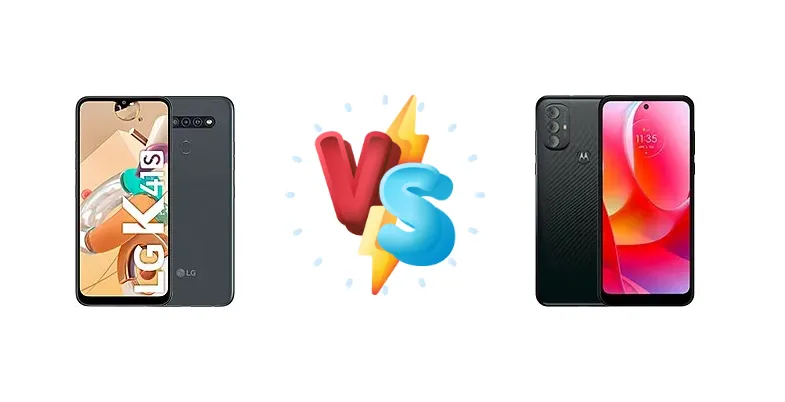
The LG K41S and Motorola Moto G Power (2022) represent two approaches to the budget smartphone market. The K41S, while older, offers a glimpse into LG’s former smartphone lineup. The Moto G Power (2022) focuses on delivering extended battery life and a slightly more modern chipset, making it a relevant contender even in today’s market. This comparison dissects their key differences to help you choose the best option for your needs.
🏆 Quick Verdict
For the average user, the Motorola Moto G Power (2022) is the better choice. While both phones target the budget segment, the Moto G Power’s Mediatek Helio G37 chipset provides a noticeable performance uplift over the LG K41S’s Helio P22, making it more responsive for everyday tasks and light gaming. The 10W charging is a drawback, but the overall experience is superior.
| Network |
|---|
| 2G bands | GSM 850 / 900 / 1800 / 1900 | GSM 850 / 900 / 1800 / 1900 |
| 3G bands | HSDPA 850 / 900 / 1900 / 2100 | HSDPA 850 / 900 / 1700(AWS) / 1900 / 2100 |
| 4G bands | 1, 3, 7, 8, 20, 38 | 1, 2, 3, 4, 5, 7, 8, 12, 13, 14, 17, 25, 26, 29, 30, 38, 41, 66, 71 - USA |
| Speed | HSPA 42.2/5.76 Mbps, LTE Cat4 150/50 Mbps | HSPA, LTE |
| Technology | GSM / HSPA / LTE | GSM / HSPA / LTE |
| Launch |
|---|
| Announced | 2020, February 18. Released 2020, April 27 | 2021, November 17 |
| Status | Discontinued | Available. Released 2022, February 22 |
| Body |
|---|
| Build | - | Glass front, plastic back, plastic frame |
| Dimensions | 165.8 x 76.5 x 8.3 mm (6.53 x 3.01 x 0.33 in) | 167.2 x 76.5 x 9.4 mm (6.58 x 3.01 x 0.37 in) |
| SIM | · Nano-SIM· Nano-SIM + Nano-SIM | Nano-SIM |
| Weight | 191.7 g (6.77 oz) | 203 g (7.16 oz) |
| | MIL-STD-810G compliant*
*does not guarantee ruggedness or use in extreme conditions | Water-repellent coating |
| Display |
|---|
| Protection | Scratch-resistant glass | - |
| Resolution | 720 x 1600 pixels, 20:9 ratio (~268 ppi density) | 720 x 1600 pixels, 20:9 ratio (~270 ppi density) |
| Size | 6.55 inches, 103.6 cm2 (~81.7% screen-to-body ratio) | 6.5 inches, 102.0 cm2 (~79.7% screen-to-body ratio) |
| Type | IPS LCD | IPS LCD, 90Hz |
| Platform |
|---|
| CPU | Octa-core 2.0 GHz Cortex-A53 | - |
| Chipset | Mediatek MT6762 Helio P22 (12 nm) | Mediatek MT6765 Helio G37 (12 nm) |
| GPU | PowerVR GE8320 | - |
| OS | Android 9.0 (Pie) | Android 11 |
| Memory |
|---|
| Card slot | microSDXC (dedicated slot) | microSDXC (dedicated slot) |
| Internal | 32GB 3GB RAM | 64GB 4GB RAM, 128GB 4GB RAM |
| | eMMC 5.1 | eMMC 5.1 |
| Main Camera |
|---|
| Features | LED flash, panorama, HDR | LED flash, HDR |
| Quad | 13 MP, f/2.0, 28mm (wide), PDAF
5 MP, f/2.2, 115˚, (ultrawide)
2 MP (macro)
Auxiliary lens | - |
| Triple | - | 50 MP, f/1.8, (wide), 0.65µm, PDAF
2 MP (macro)
Auxiliary lens |
| Video | 1080p@30fps | 1080p@30fps, gyro-EIS |
| Selfie camera |
|---|
| Single | 8 MP | 8 MP, f/2.0, 1.12µm |
| Video | 1080p@30fps | 1080p@30fps |
| Sound |
|---|
| 3.5mm jack | Yes | Yes |
| 35mm jack | Yes | Yes |
| Loudspeaker | Yes | Yes |
| Comms |
|---|
| Bluetooth | 5.0, A2DP, LE | 5.0, A2DP, LE |
| NFC | Yes | No |
| Positioning | GPS | GPS, GLONASS, GALILEO |
| Radio | No | Unspecified |
| USB | USB Type-C 2.0, OTG | USB Type-C 2.0 |
| WLAN | Wi-Fi 802.11 b/g/n, Wi-Fi Direct, DLNA | Wi-Fi 802.11 a/b/g/n/ac, dual-band, Wi-Fi Direct |
| Features |
|---|
| Sensors | Fingerprint (rear-mounted), accelerometer, proximity, compass | Fingerprint (side-mounted), accelerometer, gyro, proximity, compass, barometer |
| Battery |
|---|
| Charging | - | 10W wired |
| Type | Li-Po 4000 mAh | Li-Po 5000 mAh |
| Misc |
|---|
| Colors | Titanium, Black, White | Black |
| Models | LMK410EMW, LM-K410EMW, LM-K410 | - |
| Price | About 220 EUR | About 70 EUR |
LG K41S
- Potentially lower price point (due to age)
- Familiar LG UI (for existing LG users)
- May be available with expandable storage
- Older, less powerful chipset (Helio P22)
- Likely shorter battery life
- Slower performance in apps and games
Motorola Moto G Power (2022)
- More powerful chipset (Helio G37)
- Better overall performance
- Likely longer battery life
- Slower 10W charging
- May be slightly more expensive
- Motorola’s software can be bloated
Display Comparison
Neither device boasts a standout display. Both utilize LCD panels, and detailed specifications like resolution and brightness are unavailable. However, given the market positioning, expect 720p+ resolutions. The K41S’s age suggests a potentially lower peak brightness compared to the Moto G Power (2022). Bezels are likely to be substantial on both, reflecting their budget nature. Color accuracy will likely be standard for this price point, prioritizing power efficiency over vibrant color reproduction.
Camera Comparison
Camera performance is likely to be similar, with both phones prioritizing quantity over quality. Detailed sensor information is unavailable, but expect a primary sensor around 13MP on both devices, accompanied by auxiliary lenses of questionable utility. Image processing will be basic, focusing on contrast and saturation rather than dynamic range or detail. Low-light performance will be poor on both. The Moto G Power (2022) *might* benefit from slightly improved image signal processing (ISP) capabilities within the Helio G37 chipset, but the difference will be marginal.
Performance
The core difference lies in the chipsets. The Motorola Moto G Power (2022) features the Mediatek Helio G37, built on a 12nm process, while the LG K41S uses the older Helio P22, also on a 12nm process. While both are 12nm, the G37 represents an architectural improvement, offering better CPU and GPU performance. The K41S’s Octa-core 2.0 GHz Cortex-A53 CPU will handle basic tasks, but will struggle with multitasking or demanding applications. The G37’s CPU architecture is more efficient, leading to a snappier experience. RAM specifications are missing for both, but expect 2-4GB, further limiting multitasking capabilities. Thermal management will likely be passive on both, relying on the chassis to dissipate heat.
Battery Life
The Motorola Moto G Power (2022) is named appropriately, prioritizing battery life. While the exact capacity is unknown, Motorola’s ‘Power’ line is known for large batteries (typically 5000mAh or greater). The LG K41S likely has a smaller battery, around 3000-4000mAh. However, the Helio G37’s improved efficiency partially offsets the Moto G Power’s 10W charging limitation. The K41S’s older chipset will drain the battery faster under load. Expect the Moto G Power to easily last a full day of moderate use, while the K41S may require a midday top-up.
Buying Guide
Buy the LG K41S if you find it at a significantly lower price and prioritize a familiar LG user interface (if you've used LG phones before). It's a viable option for extremely basic smartphone needs like calls and messaging. Buy the Motorola Moto G Power (2022) if you value a smoother user experience, slightly better performance for apps and games, and a more modern chipset, even if it means sacrificing faster charging.
Frequently Asked Questions
❓ Is the Motorola Moto G Power (2022) good for playing mobile games?
The Helio G37 in the Moto G Power (2022) is capable of handling light to moderate mobile gaming. Don't expect to max out settings on demanding titles like PUBG or Genshin Impact, but it will provide a playable experience. The LG K41S’s Helio P22 will struggle with even less demanding games.
❓ Does the LG K41S still receive software updates?
Given its age, the LG K41S is unlikely to receive further software updates. LG has largely exited the smartphone market, meaning security patches and feature updates are unavailable. The Moto G Power (2022) will receive at least one major Android update and a few years of security patches.
❓ How long does it take to fully charge the Motorola Moto G Power (2022)?
With its 10W charging, the Motorola Moto G Power (2022) will take approximately 3-4 hours to fully charge from 0%. This is a significant drawback compared to phones with faster charging capabilities, but the large battery capacity compensates for the slower charging speed.