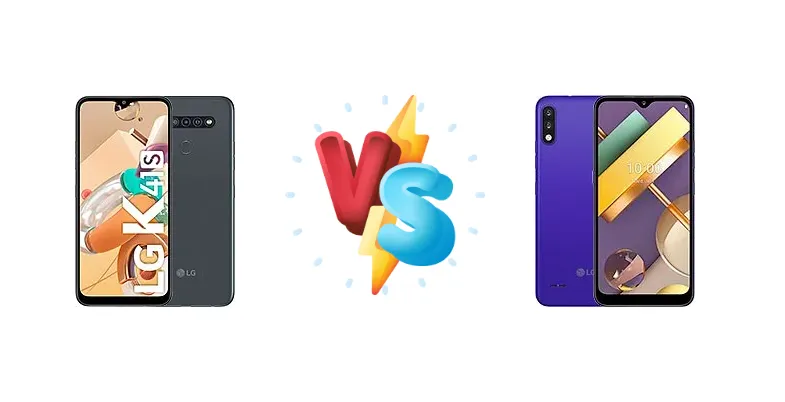
The LG K41S and K22 represent LG's attempts to capture the ultra-budget smartphone market. While both offer a basic Android experience, they diverge significantly in their underlying hardware. This comparison dissects the core differences – specifically the chipset – to determine which device delivers the best value for users prioritizing performance or efficiency.
🏆 Quick Verdict
For the average user, the LG K41S is the superior choice. Its Mediatek Helio P22 chipset, despite being older, offers a substantial performance advantage over the Snapdragon 215 in the K22, making it more responsive for everyday tasks and light multitasking. While the K22 may offer slightly better battery life due to its more efficient manufacturing process, the performance trade-off isn't worth it.
| Network |
|---|
| 2G bands | GSM 850 / 900 / 1800 / 1900 | GSM 850 / 900 / 1800 / 1900 |
| 3G bands | HSDPA 850 / 900 / 1900 / 2100 | HSDPA 850 / 900 / 1900 / 2100 - International |
| 4G bands | 1, 3, 7, 8, 20, 38 | 1, 3, 5, 7, 8, 20, 28, 38, 40 - International |
| Speed | HSPA 42.2/5.76 Mbps, LTE Cat4 150/50 Mbps | HSPA 42.2/5.76 Mbps, LTE Cat4 150/50 Mbps |
| Technology | GSM / HSPA / LTE | GSM / HSPA / LTE |
| | - | 1, 3, 5, 7, 8, 20, 28, 40 - Brazil |
| Launch |
|---|
| Announced | 2020, February 18. Released 2020, April 27 | 2020, September 12. Released 2020, September 12 |
| Status | Discontinued | Discontinued |
| Body |
|---|
| Build | - | Glass front, plastic frame, plastic back |
| Dimensions | 165.8 x 76.5 x 8.3 mm (6.53 x 3.01 x 0.33 in) | 155.7 x 75.4 x 8.4 mm (6.13 x 2.97 x 0.33 in) |
| SIM | · Nano-SIM· Nano-SIM + Nano-SIM | Nano-SIM + Nano-SIM |
| Weight | 191.7 g (6.77 oz) | 169.5 g (6.00 oz) |
| | MIL-STD-810G compliant*
*does not guarantee ruggedness or use in extreme conditions | MIL-STD-810G compliant*
*does not guarantee ruggedness or use in extreme conditions |
| Display |
|---|
| Protection | Scratch-resistant glass | - |
| Resolution | 720 x 1600 pixels, 20:9 ratio (~268 ppi density) | 720 x 1520 pixels, 19:9 ratio (~271 ppi density) |
| Size | 6.55 inches, 103.6 cm2 (~81.7% screen-to-body ratio) | 6.2 inches, 95.9 cm2 (~81.7% screen-to-body ratio) |
| Type | IPS LCD | IPS LCD, 400 nits (typ) |
| Platform |
|---|
| CPU | Octa-core 2.0 GHz Cortex-A53 | Quad-core 1.3 GHz Cortex-A53 |
| Chipset | Mediatek MT6762 Helio P22 (12 nm) | Qualcomm QM215 Snapdragon 215 (28 nm) |
| GPU | PowerVR GE8320 | Adreno 308 |
| OS | Android 9.0 (Pie) | Android 10 |
| Memory |
|---|
| Card slot | microSDXC (dedicated slot) | microSDXC |
| Internal | 32GB 3GB RAM | 32GB 2GB RAM, 64GB 3GB RAM |
| | eMMC 5.1 | eMMC 5.1 |
| Main Camera |
|---|
| Dual | - | 13 MP, 27mm (wide), 1/3.1", 1.12µm, PDAF
2 MP (macro) |
| Features | LED flash, panorama, HDR | LED flash, HDR |
| Quad | 13 MP, f/2.0, 28mm (wide), PDAF
5 MP, f/2.2, 115˚, (ultrawide)
2 MP (macro)
Auxiliary lens | - |
| Video | 1080p@30fps | 1080p@30fps |
| Selfie camera |
|---|
| Single | 8 MP | 5 MP, f/2.2, 24mm (wide), 1/5.0", 1.12µm |
| Video | 1080p@30fps | 1080p@30fps |
| Sound |
|---|
| 3.5mm jack | Yes | Yes |
| 35mm jack | Yes | Yes |
| Loudspeaker | Yes | Yes |
| Comms |
|---|
| Bluetooth | 5.0, A2DP, LE | 5.0, A2DP, LE |
| NFC | Yes | No |
| Positioning | GPS | GPS, GLONASS |
| Radio | No | FM radio (market/operator dependent) |
| USB | USB Type-C 2.0, OTG | microUSB 2.0, OTG |
| WLAN | Wi-Fi 802.11 b/g/n, Wi-Fi Direct, DLNA | Wi-Fi 802.11 b/g/n, Wi-Fi Direct |
| Features |
|---|
| Sensors | Fingerprint (rear-mounted), accelerometer, proximity, compass | Accelerometer, proximity, compass |
| Battery |
|---|
| Type | Li-Po 4000 mAh | Li-Po 3000 mAh |
| Misc |
|---|
| Colors | Titanium, Black, White | Titan, Blue |
| Models | LMK410EMW, LM-K410EMW, LM-K410 | LMK200Z, LMK200E, LMK200B, LM-K200 |
| Price | About 220 EUR | About 140 EUR |
LG K41S
- Significantly faster processor for smoother performance
- More responsive user experience
- Potentially better image processing
- Potentially shorter battery life compared to K22
- May generate slightly more heat under load
LG K22
- Potentially longer battery life due to efficient chipset
- Lower cost (likely)
- Sufficient for very basic smartphone tasks
- Slow processor and sluggish performance
- Struggles with multitasking and demanding apps
- Limited responsiveness
Display Comparison
Neither LG provides detailed display specifications beyond resolution. However, given their market positioning, both likely utilize IPS LCD panels. The K41S's more powerful chipset *could* support a slightly higher refresh rate, though this is unconfirmed. The K22's older chipset is unlikely to support anything beyond the standard 60Hz. Bezels are expected to be substantial on both devices, reflecting their budget nature. Color accuracy is likely to be standard for this price point, with neither phone offering exceptional color calibration.
Camera Comparison
Detailed camera specs are unavailable, but both phones likely feature a primary camera and potentially a depth sensor. Given the price bracket, image quality will be limited. The K41S’s more powerful ISP (Image Signal Processor) within the Helio P22 chipset *may* offer slightly better image processing, resulting in marginally improved photos in good lighting conditions. However, low-light performance will likely be poor on both devices. Any secondary cameras (often 2MP macro lenses) are unlikely to provide significant value.
Performance
The core difference lies in the chipsets. The LG K41S boasts a Mediatek Helio P22, an octa-core processor clocked at 2.0 GHz, built on a 12nm process. This contrasts sharply with the LG K22’s Qualcomm Snapdragon 215, a quad-core processor running at 1.3 GHz, fabricated on a significantly older 28nm node. The 12nm process of the Helio P22 is more efficient, but the core count advantage and higher clock speed translate to noticeably faster application loading times and smoother multitasking on the K41S. The Snapdragon 215 is geared towards extremely basic tasks and will struggle with anything beyond simple app usage. The K41S will be more responsive for web browsing and social media.
Battery Life
While battery capacity isn't specified, the Snapdragon 215 in the K22, built on a 28nm process, is inherently more power-efficient than the Helio P22 (12nm). This *could* translate to longer battery life for the K22, especially during standby. However, the K41S’s faster processing speeds mean tasks are completed quicker, potentially reducing overall energy consumption during active use. Charging speeds are likely to be slow on both devices, given their budget positioning.
Buying Guide
Buy the LG K41S if you need a smartphone capable of handling more than just basic calling and texting. It's suitable for users who occasionally browse the web, use social media, or play simple games. Buy the LG K22 if your primary need is a very basic, long-lasting phone for essential communication and you prioritize maximizing battery life above all else, and are willing to accept significantly slower performance.
Frequently Asked Questions
❓ Will the LG K41S handle popular social media apps like Facebook and Instagram smoothly?
Yes, the Helio P22 chipset in the K41S provides enough processing power to run Facebook and Instagram without significant lag. While it won't offer a flagship-level experience, it will be a usable and reasonably responsive experience for casual social media browsing.
❓ Is the Snapdragon 215 in the LG K22 powerful enough for basic web browsing?
The Snapdragon 215 can handle basic web browsing, but expect slower page loading times and potential stuttering when navigating complex websites. It's best suited for simple web pages with minimal graphics and scripting.
❓ Can either of these phones run modern mobile games?
Neither phone is well-suited for modern, graphically demanding mobile games. The K41S might be able to run very simple games at low settings, but the K22 will struggle even with the least demanding titles. Expect low frame rates and significant lag.
❓ Which phone is better for someone who primarily uses their phone for calls and texts?
The LG K22 is the better choice for users who primarily need a phone for calls and texts. Its more efficient chipset will maximize battery life, ensuring the phone lasts longer between charges for essential communication.