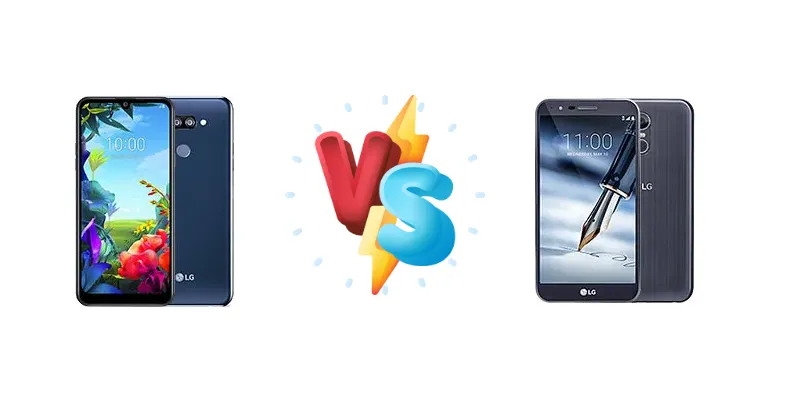
The LG K40S and Stylo 3 Plus represent LG’s attempts to capture the budget smartphone market. While both offer a similar overall experience, key differences in their chipsets and charging capabilities create distinct advantages for different users. This comparison dissects these differences to determine which device delivers the best value.
🏆 Quick Verdict
For most users, the LG Stylo 3 Plus is the better choice. Its Qualcomm Snapdragon 435, while older, offers a more refined experience and crucially, supports 22.5W fast charging and 5W reverse charging – features absent on the K40S. The K40S’s Helio P22 is more power efficient, but the charging disparity is a significant drawback.
| Network |
|---|
| 2G bands | GSM 850 / 900 / 1800 / 1900 | GSM 850 / 900 / 1800 / 1900 |
| 3G bands | HSDPA 850 / 900 / 1900 / 2100 | HSDPA 850 / 1700(AWS) / 1900 / 2100 |
| 4G bands | 1, 3, 7, 8, 20 | 2, 4, 5, 12, 66 |
| Speed | HSPA 42.2/5.76 Mbps, LTE (2CA) Cat6 300/50 Mbps | HSPA 42.2/5.76 Mbps, LTE (2CA) Cat6 300/50 Mbps |
| Technology | GSM / HSPA / LTE | GSM / HSPA / LTE |
| Launch |
|---|
| Announced | 2019, August. Released 2019, September | 2017, May. Released 2017, May |
| Status | Discontinued | Discontinued |
| Body |
|---|
| Build | - | Glass front, plastic back, plastic frame |
| Dimensions | 156.3 x 73.9 x 8.6 mm (6.15 x 2.91 x 0.34 in) | 155.7 x 79.8 x 7.4 mm (6.13 x 3.14 x 0.29 in) |
| SIM | · Nano-SIM· Nano-SIM + Nano-SIM | Nano-SIM |
| Weight | 186 g (6.56 oz) | 150 g (5.29 oz) |
| | MIL-STD-810G compliant*
*does not guarantee ruggedness or use in extreme conditions | - |
| Display |
|---|
| Resolution | 720 x 1520 pixels, 19:9 ratio (~276 ppi density) | 1080 x 1920 pixels, 16:9 ratio (~386 ppi density) |
| Size | 6.1 inches, 92.9 cm2 (~80.4% screen-to-body ratio) | 5.7 inches, 89.6 cm2 (~72.1% screen-to-body ratio) |
| Type | IPS LCD | IPS LCD |
| | - | Always-on display |
| Platform |
|---|
| CPU | Octa-core 2.0 GHz Cortex-A53 | Octa-core 1.4 GHz Cortex-A53 |
| Chipset | Mediatek MT6762 Helio P22 (12 nm) | Qualcomm MSM8940 Snapdragon 435 (28 nm) |
| GPU | PowerVR GE8320 | Adreno 505 |
| OS | Android 9.0 (Pie), upgradable to Android 10 | Android 7.0 (Nougat) |
| Memory |
|---|
| Card slot | microSDXC (dedicated slot) | microSDXC (dedicated slot) |
| Internal | 32GB 2GB RAM, 32GB 3GB RAM | 32GB 2GB RAM |
| | eMMC 5.1 | UFS 2.1 |
| Main Camera |
|---|
| Dual | 13 MP, f/2.2, 26mm (wide), PDAF
5 MP, (ultrawide) | - |
| Features | LED flash, panorama, HDR | LED flash |
| Single | - | 13 MP, 1/3.1", 1.12µm, AF |
| Triple | - | 48 MP, f/1.8, (wide), 1/2.0", 0.8µm, PDAF
8 MP, f/2.2, 13mm (ultrawide)
2 MP, f/2.4, (depth) |
| Video | 1080p@30fps | 1080p@30fps |
| Selfie camera |
|---|
| Features | - | LED flash |
| Single | 13 MP, f/2.0, 1/3.1", 1.12µm | 5 MP |
| Video | 1080p@30fps | 1080p@30fps |
| Sound |
|---|
| 3.5mm jack | Yes | Yes |
| 35mm jack | Yes | Yes |
| Loudspeaker | Yes | Yes |
| Comms |
|---|
| Bluetooth | 5.0, A2DP, LE | 4.2, A2DP, LE |
| NFC | Yes (market/region dependent) | Yes |
| Positioning | GPS, GLONASS | GPS |
| Radio | No | FM radio |
| USB | microUSB 2.0, OTG | microUSB 2.0 |
| WLAN | Wi-Fi 802.11 a/b/g/n/ac, dual-band, Wi-Fi Direct, DLNA | Wi-Fi 802.11 b/g/n, Wi-Fi Direct |
| Features |
|---|
| Sensors | Fingerprint (rear-mounted), accelerometer, proximity | Fingerprint (rear-mounted), accelerometer, gyro, proximity, compass |
| Battery |
|---|
| Charging | - | 22.5W wired
5W reverse wired |
| Stand-by | - | Up to 456 h (3G) |
| Talk time | - | Up to 14 h (3G) |
| Type | Li-Po 3500 mAh, non-removable | Li-Ion 3080 mAh, removable |
| Misc |
|---|
| Colors | New Aurora Black, New Moroccan Blue | Titan |
| Models | LMX430HM, LM-X430 | TP450, M470 |
| Price | About 160 EUR | About 170 EUR |
| SAR | - | 1.03 W/kg (head) 0.55 W/kg (body) |
LG K40S
- Potentially better thermal management due to 12nm process
- More power-efficient chipset (Helio P22)
- Likely lower price point
- Lacks fast charging support
- Less responsive overall performance
- No reverse charging capability
LG Stylo 3 Plus
- 22.5W fast charging support
- 5W reverse wired charging
- More refined performance with Snapdragon 435
- Less power-efficient chipset (Snapdragon 435)
- Larger process node (28nm)
- Potentially higher price
Display Comparison
Neither device boasts a standout display. Both likely feature LCD panels, typical for this price point. Without specific data on brightness or color accuracy, it’s safe to assume both offer adequate, but not exceptional, viewing experiences. The focus here isn’t on visual fidelity, but on core functionality.
Camera Comparison
Without detailed camera specs beyond the chipsets, a direct comparison is difficult. Both phones likely feature basic camera setups geared towards casual photography. The image signal processor (ISP) within the Snapdragon 435 is generally considered more advanced than Mediatek’s equivalent in the Helio P22, potentially leading to better image processing and dynamic range. However, the quality will heavily depend on the sensor and lens used, which are unknown.
Performance
The core difference lies in the chipsets. The LG K40S utilizes the Mediatek MT6762 Helio P22, a 12nm process node chip with an octa-core 2.0 GHz Cortex-A53 CPU. The Stylo 3 Plus features the Qualcomm MSM8940 Snapdragon 435, built on a larger 28nm process. While the K40S’s CPU clock speed is higher, the Snapdragon 435 benefits from Qualcomm’s optimized architecture and GPU, resulting in a smoother, more responsive experience in everyday tasks. The 28nm node of the Snapdragon 435 is less power efficient, but the difference is likely marginal given the typical usage patterns of these devices. The K40S’s 12nm node *should* translate to better thermal efficiency, potentially reducing throttling during sustained loads, but the Snapdragon 435’s GPU is likely more capable overall.
Battery Life
The LG Stylo 3 Plus’s 22.5W wired charging is a game-changer in this segment. This allows for significantly faster top-ups compared to the K40S, which lacks fast charging support. The inclusion of 5W reverse wired charging on the Stylo 3 Plus adds a unique convenience, allowing it to charge smaller accessories. While the K40S’s Helio P22 is more power-efficient, the Stylo 3 Plus’s faster charging mitigates the impact of a potentially slightly smaller battery capacity (assuming similar battery sizes).
Buying Guide
Buy the LG K40S if you prioritize maximizing battery life and are willing to sacrifice charging speed and overall performance. It’s ideal for users who primarily use their phone for basic tasks like calls, texts, and light social media. Buy the LG Stylo 3 Plus if you value faster charging, a slightly more responsive user experience, and the convenience of reverse wireless charging, even if it means slightly reduced battery longevity.
Frequently Asked Questions
❓ Does the LG Stylo 3 Plus’s Snapdragon 435 struggle with multitasking compared to the K40S?
While the K40S has a higher CPU clock speed, the Snapdragon 435’s architecture and GPU are optimized for smoother multitasking. You’ll likely experience fewer stutters and delays when switching between apps on the Stylo 3 Plus, even with a similar amount of RAM.
❓ How long does it take to fully charge the LG Stylo 3 Plus with the 22.5W charger?
While a precise time requires testing, the LG Stylo 3 Plus should charge from 0-100% in approximately 1 hour 30 minutes to 2 hours with a compatible 22.5W charger. This is a substantial improvement over the K40S, which will take considerably longer with a standard 5W charger.
❓ Is the reverse charging feature on the Stylo 3 Plus useful for everyday use?
The 5W reverse charging is ideal for topping up accessories like Bluetooth earbuds or a smartwatch in a pinch. It won’t rapidly charge larger devices, but it provides a convenient emergency power source when an outlet isn’t available.