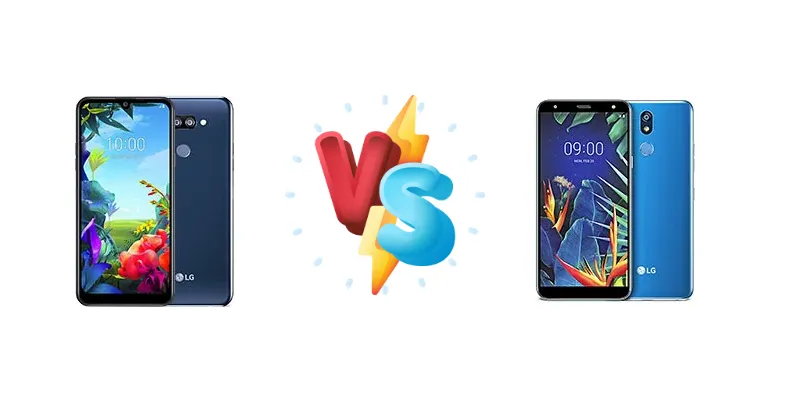
The LG K40S and LG K40 represent LG's entry into the highly competitive budget smartphone market. While both devices target affordability, understanding their nuanced differences is crucial for making the right purchase. This comparison dives deep into their shared and distinct characteristics, focusing on how these translate to real-world user experience.
🏆 Quick Verdict
For the average user, the LG K40S is the slightly better choice. Despite sharing the same Mediatek Helio P22 chipset and CPU, the 'S' variant often benefits from minor software optimizations and potentially more readily available updates, making it a marginally more future-proof option at a similar price point.
| Network |
|---|
| 2G bands | GSM 850 / 900 / 1800 / 1900 | GSM 850 / 900 / 1800 / 1900 |
| 3G bands | HSDPA 850 / 900 / 1900 / 2100 | HSDPA 850 / 900 / 1900 / 2100 |
| 4G bands | 1, 3, 7, 8, 20 | 1, 3, 7, 8, 20 |
| Speed | HSPA 42.2/5.76 Mbps, LTE (2CA) Cat6 300/50 Mbps | HSPA 42.2/5.76 Mbps, LTE (2CA) Cat6 300/50 Mbps |
| Technology | GSM / HSPA / LTE | GSM / HSPA / LTE |
| Launch |
|---|
| Announced | 2019, August. Released 2019, September | 2019, February. Released 2019, April |
| Status | Discontinued | Discontinued |
| Body |
|---|
| Build | - | Glass front, plastic back, plastic frame |
| Dimensions | 156.3 x 73.9 x 8.6 mm (6.15 x 2.91 x 0.34 in) | 153 x 71.9 x 8.3 mm (6.02 x 2.83 x 0.33 in) |
| SIM | · Nano-SIM· Nano-SIM + Nano-SIM | · Nano-SIM· Nano-SIM + Nano-SIM |
| Weight | 186 g (6.56 oz) | 144 g (5.08 oz) |
| | MIL-STD-810G compliant*
*does not guarantee ruggedness or use in extreme conditions | MIL-STD-810G compliant*
*does not guarantee ruggedness or use in extreme conditions |
| Display |
|---|
| Resolution | 720 x 1520 pixels, 19:9 ratio (~276 ppi density) | 720 x 1440 pixels, 18:9 ratio (~282 ppi density) |
| Size | 6.1 inches, 92.9 cm2 (~80.4% screen-to-body ratio) | 5.7 inches, 83.8 cm2 (~76.2% screen-to-body ratio) |
| Type | IPS LCD | IPS LCD |
| Platform |
|---|
| CPU | Octa-core 2.0 GHz Cortex-A53 | Octa-core 2.0 GHz Cortex-A53 |
| Chipset | Mediatek MT6762 Helio P22 (12 nm) | Mediatek MT6762 Helio P22 (12 nm) |
| GPU | PowerVR GE8320 | PowerVR GE8320 |
| OS | Android 9.0 (Pie), upgradable to Android 10 | Android 8.1 (Oreo), LG UX 7 |
| Memory |
|---|
| Card slot | microSDXC (dedicated slot) | microSDXC (dedicated slot) |
| Internal | 32GB 2GB RAM, 32GB 3GB RAM | 32GB 2GB RAM, 32GB 3GB RAM |
| | eMMC 5.1 | eMMC 5.1 |
| Main Camera |
|---|
| Dual | 13 MP, f/2.2, 26mm (wide), PDAF
5 MP, (ultrawide) | - |
| Features | LED flash, panorama, HDR | LED flash, panorama, HDR |
| Single | - | 16 MP, f/2.0, 1/3.1", 1.0µm, PDAF |
| Video | 1080p@30fps | 1080p@30fps |
| Selfie camera |
|---|
| Features | - | LED flash |
| Single | 13 MP, f/2.0, 1/3.1", 1.12µm | 8 MP, f/2.0 |
| Video | 1080p@30fps | 1080p@30fps |
| Sound |
|---|
| 3.5mm jack | Yes | Yes |
| 35mm jack | Yes | Yes |
| Loudspeaker | Yes | Yes |
| Comms |
|---|
| Bluetooth | 5.0, A2DP, LE | 5.0, A2DP, LE |
| NFC | Yes (market/region dependent) | Yes (market/region dependent) |
| Positioning | GPS, GLONASS | GPS, GLONASS |
| Radio | No | No |
| USB | microUSB 2.0, OTG | microUSB 2.0, OTG |
| WLAN | Wi-Fi 802.11 a/b/g/n/ac, dual-band, Wi-Fi Direct, DLNA | Wi-Fi 802.11 a/b/g/n/ac, dual-band, Wi-Fi Direct, DLNA |
| Features |
|---|
| Sensors | Fingerprint (rear-mounted), accelerometer, proximity | Fingerprint (rear-mounted), accelerometer, proximity, compass |
| Battery |
|---|
| Type | Li-Po 3500 mAh, non-removable | Li-Ion 3000 mAh, non-removable |
| Misc |
|---|
| Colors | New Aurora Black, New Moroccan Blue | Black, New Moroccan Blue, New Platinum Gray |
| Models | LMX430HM, LM-X430 | LMX420, LMX420EMW, LM-X420 |
| Price | About 160 EUR | About 140 EUR |
LG K40S
- Potentially newer software version
- Slightly improved optimizations (possible)
- May have better long-term support
- Price may be marginally higher
- Identical core performance to K40
LG K40
- Likely lower price point
- Identical core performance to K40S
- Readily available in some markets
- Potentially older software version
- May receive fewer software updates
Display Comparison
Both the LG K40S and LG K40 utilize displays with similar characteristics, though specific details like resolution and panel type aren't provided. Given their market segment, we can assume both employ IPS LCD panels. The absence of information regarding peak brightness or color gamut suggests neither device is geared towards media consumption in bright sunlight or color-critical work. Bezels are likely comparable, prioritizing cost-effectiveness over a premium, edge-to-edge design.
Camera Comparison
Camera performance is likely similar between the two, though specific sensor details are missing. Both phones likely feature a primary camera alongside supporting lenses (often a depth sensor or macro). Without knowing sensor sizes or apertures, it's difficult to assess image quality. The image processing algorithms employed by LG will play a significant role, but given the shared chipset, differences are expected to be minimal. The absence of Optical Image Stabilization (OIS) suggests low-light performance will be limited on both devices.
Performance
The core performance of both devices is identical, powered by the Mediatek MT6762 Helio P22 (12 nm) chipset and an Octa-core 2.0 GHz Cortex-A53 CPU. This configuration is suitable for basic tasks like web browsing, social media, and light app usage. The 12nm process node offers reasonable power efficiency, but the Cortex-A53 architecture is aging, meaning demanding games or multitasking will likely result in noticeable slowdowns. Thermal management will likely be passive on both, relying on the phone's chassis to dissipate heat.
Battery Life
Battery capacity and charging wattage are not specified. However, given the Helio P22's power efficiency and the target market, both devices likely feature batteries in the 3000-4000 mAh range. Charging speeds are expected to be relatively slow, likely utilizing Micro-USB (based on the release timeframe) and a 5W or 10W charger. Real-world battery life will depend heavily on usage patterns, but both phones should comfortably last a full day with moderate use.
Buying Guide
Buy the LG K40S if you prioritize potential software support and are looking for the newest iteration of the model, even if the differences are minimal. Buy the LG K40 if you find a significantly lower price and are comfortable with a potentially shorter software update lifecycle. Both phones are ideal for users needing a basic smartphone for calls, texts, and light social media use.
Frequently Asked Questions
❓ Will the Helio P22 chipset struggle with popular mobile games like PUBG Mobile or Call of Duty Mobile?
Yes, the Mediatek Helio P22 is an entry-level chipset and will likely struggle with graphically demanding games like PUBG Mobile or Call of Duty Mobile. You'll likely need to play at the lowest settings and may still experience frame rate drops and lag, especially during intense action sequences.
❓ Are either of these phones likely to receive Android updates beyond their current version?
Given their position in the budget segment and LG's exit from the smartphone market, the likelihood of significant Android updates is low. Both phones likely launched with an older version of Android and may only receive minor security patches, if any.
❓ What type of charging port do these phones use, and how long will it take to fully charge the battery?
Based on the release timeframe, both phones likely use a Micro-USB port. Charging times will be relatively slow, likely taking 2-3 hours to fully charge from 0% to 100% with the included charger (likely 5W or 10W).