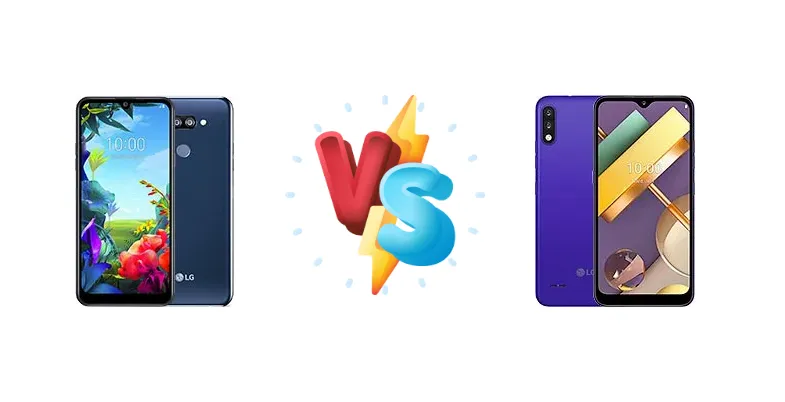
The LG K40S and K22 represent LG's attempts to capture the ultra-budget smartphone market. While both aim for affordability, they diverge significantly in their core hardware, particularly the chipset. This comparison dissects those differences, focusing on how they impact real-world performance and user experience.
🏆 Quick Verdict
For most users, the LG K40S is the superior choice. Its Mediatek Helio P22 chipset, despite being older, offers a substantial performance advantage over the Snapdragon 215 in the K22, making it better suited for multitasking and app responsiveness. While the K22 may offer slightly better battery efficiency, the performance trade-off isn't worth it.
| Network |
|---|
| 2G bands | GSM 850 / 900 / 1800 / 1900 | GSM 850 / 900 / 1800 / 1900 |
| 3G bands | HSDPA 850 / 900 / 1900 / 2100 | HSDPA 850 / 900 / 1900 / 2100 - International |
| 4G bands | 1, 3, 7, 8, 20 | 1, 3, 5, 7, 8, 20, 28, 38, 40 - International |
| Speed | HSPA 42.2/5.76 Mbps, LTE (2CA) Cat6 300/50 Mbps | HSPA 42.2/5.76 Mbps, LTE Cat4 150/50 Mbps |
| Technology | GSM / HSPA / LTE | GSM / HSPA / LTE |
| | - | 1, 3, 5, 7, 8, 20, 28, 40 - Brazil |
| Launch |
|---|
| Announced | 2019, August. Released 2019, September | 2020, September 12. Released 2020, September 12 |
| Status | Discontinued | Discontinued |
| Body |
|---|
| Build | - | Glass front, plastic frame, plastic back |
| Dimensions | 156.3 x 73.9 x 8.6 mm (6.15 x 2.91 x 0.34 in) | 155.7 x 75.4 x 8.4 mm (6.13 x 2.97 x 0.33 in) |
| SIM | · Nano-SIM· Nano-SIM + Nano-SIM | Nano-SIM + Nano-SIM |
| Weight | 186 g (6.56 oz) | 169.5 g (6.00 oz) |
| | MIL-STD-810G compliant*
*does not guarantee ruggedness or use in extreme conditions | MIL-STD-810G compliant*
*does not guarantee ruggedness or use in extreme conditions |
| Display |
|---|
| Resolution | 720 x 1520 pixels, 19:9 ratio (~276 ppi density) | 720 x 1520 pixels, 19:9 ratio (~271 ppi density) |
| Size | 6.1 inches, 92.9 cm2 (~80.4% screen-to-body ratio) | 6.2 inches, 95.9 cm2 (~81.7% screen-to-body ratio) |
| Type | IPS LCD | IPS LCD, 400 nits (typ) |
| Platform |
|---|
| CPU | Octa-core 2.0 GHz Cortex-A53 | Quad-core 1.3 GHz Cortex-A53 |
| Chipset | Mediatek MT6762 Helio P22 (12 nm) | Qualcomm QM215 Snapdragon 215 (28 nm) |
| GPU | PowerVR GE8320 | Adreno 308 |
| OS | Android 9.0 (Pie), upgradable to Android 10 | Android 10 |
| Memory |
|---|
| Card slot | microSDXC (dedicated slot) | microSDXC |
| Internal | 32GB 2GB RAM, 32GB 3GB RAM | 32GB 2GB RAM, 64GB 3GB RAM |
| | eMMC 5.1 | eMMC 5.1 |
| Main Camera |
|---|
| Dual | 13 MP, f/2.2, 26mm (wide), PDAF
5 MP, (ultrawide) | 13 MP, 27mm (wide), 1/3.1", 1.12µm, PDAF
2 MP (macro) |
| Features | LED flash, panorama, HDR | LED flash, HDR |
| Video | 1080p@30fps | 1080p@30fps |
| Selfie camera |
|---|
| Single | 13 MP, f/2.0, 1/3.1", 1.12µm | 5 MP, f/2.2, 24mm (wide), 1/5.0", 1.12µm |
| Video | 1080p@30fps | 1080p@30fps |
| Sound |
|---|
| 3.5mm jack | Yes | Yes |
| 35mm jack | Yes | Yes |
| Loudspeaker | Yes | Yes |
| Comms |
|---|
| Bluetooth | 5.0, A2DP, LE | 5.0, A2DP, LE |
| NFC | Yes (market/region dependent) | No |
| Positioning | GPS, GLONASS | GPS, GLONASS |
| Radio | No | FM radio (market/operator dependent) |
| USB | microUSB 2.0, OTG | microUSB 2.0, OTG |
| WLAN | Wi-Fi 802.11 a/b/g/n/ac, dual-band, Wi-Fi Direct, DLNA | Wi-Fi 802.11 b/g/n, Wi-Fi Direct |
| Features |
|---|
| Sensors | Fingerprint (rear-mounted), accelerometer, proximity | Accelerometer, proximity, compass |
| Battery |
|---|
| Type | Li-Po 3500 mAh, non-removable | Li-Po 3000 mAh |
| Misc |
|---|
| Colors | New Aurora Black, New Moroccan Blue | Titan, Blue |
| Models | LMX430HM, LM-X430 | LMK200Z, LMK200E, LMK200B, LM-K200 |
| Price | About 160 EUR | About 140 EUR |
LG K40S
- Significantly faster processor for smoother performance
- More efficient 12nm chipset
- Potentially better image processing capabilities
- May have slightly shorter battery life under heavy use
- Potentially higher price point
LG K22
- Potentially longer standby battery life
- Lower price point
- Simpler user experience for basic tasks
- Slow processor struggles with multitasking
- Inefficient 28nm chipset
- Limited performance for modern apps
Display Comparison
Neither LG provides detailed display specifications beyond resolution. However, given their market positioning, both likely utilize IPS LCD panels. The K40S's more powerful chipset *could* support a slightly higher refresh rate, though this is unconfirmed. The real difference lies in the processing power available to drive the display; the K40S will handle animations and transitions more fluidly.
Camera Comparison
Without detailed camera specs, a direct comparison is difficult. Both phones likely feature basic camera setups geared towards casual photography. However, the K40S’s more powerful ISP (Image Signal Processor) within the Helio P22 chipset will likely result in better image processing, particularly in low-light conditions. The K22’s Snapdragon 215 will likely produce images with more noise and less detail. The presence of a 2MP macro lens on either device is largely marketing fluff and shouldn't be a deciding factor.
Performance
The core difference between these phones is the chipset. The LG K40S boasts the Mediatek MT6762 Helio P22, an octa-core processor clocked at 2.0 GHz, built on a 12nm process. This contrasts sharply with the LG K22’s Qualcomm Snapdragon 215, a quad-core processor running at 1.3 GHz, fabricated on a significantly older 28nm node. The 12nm process of the Helio P22 is far more efficient, and the eight cores provide a substantial advantage in multi-threaded tasks. The K40S will exhibit faster app loading times, smoother multitasking, and a more responsive overall experience. The Snapdragon 215, while adequate for basic tasks, will struggle with anything beyond simple operations.
Battery Life
Battery capacity is not specified in the provided data. However, the Snapdragon 215’s 28nm process *should* theoretically offer better power efficiency than the Helio P22’s 12nm process. However, the K40S’s more efficient software handling due to its processing power could offset this. Real-world battery life will depend heavily on usage patterns, but the K22 might eke out slightly longer standby times, while the K40S will likely perform better under load.
Buying Guide
Buy the LG K40S if you prioritize a smoother, more responsive user experience and occasionally run multiple apps or light games. The extra processing power will be noticeable. Buy the LG K22 if your primary use case is extremely basic – calls, texts, and very light web browsing – and you absolutely need to maximize battery life, even at the cost of performance. This phone is best suited for first-time smartphone users or those on a severely restricted budget.
Frequently Asked Questions
❓ Will the LG K40S handle popular social media apps like Facebook and Instagram without lag?
Yes, the Helio P22 chipset in the K40S has sufficient processing power to run social media apps smoothly. While it won't offer a flagship-level experience, you shouldn't encounter significant lag or slowdowns during typical usage.
❓ Is the LG K22 suitable for someone who primarily uses their phone for making calls and sending text messages?
Absolutely. The Snapdragon 215 is perfectly adequate for basic communication tasks like calls and texts. If your phone usage is limited to these functions, the K22 will provide a functional and affordable experience.
❓ Can I play basic games on the LG K40S?
Yes, the K40S can handle less demanding mobile games. While it won't run graphically intensive titles at high settings, you should be able to play games like Candy Crush or simple puzzle games without major issues. The K22 will struggle even with these titles.
❓ Does either phone support fast charging?
Neither LG provides fast charging information for these models. Given their budget nature, it's unlikely either phone supports fast charging technologies. Expect standard 5W or 10W charging speeds.