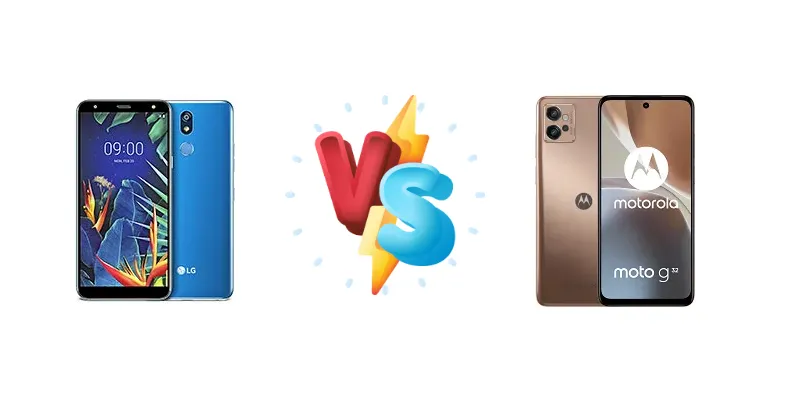
The LG K40 and Motorola Moto G32 represent distinct approaches to the budget smartphone market. The K40, an older model, relies on Mediatek's Helio P22, while the Moto G32 leverages Qualcomm's newer, more efficient Snapdragon 680. This comparison dissects the core differences to determine which device offers the best value for users prioritizing performance, battery life, and charging convenience.
🏆 Quick Verdict
For the average user, the Motorola Moto G32 is the superior choice. Its Snapdragon 680 chipset, built on a 6nm process, delivers significantly better performance and efficiency than the LG K40’s Helio P22. The addition of 30W charging further solidifies its advantage, making it a more future-proof and user-friendly option.
| Network |
|---|
| 2G bands | GSM 850 / 900 / 1800 / 1900 | GSM 850 / 900 / 1800 / 1900 |
| 3G bands | HSDPA 850 / 900 / 1900 / 2100 | HSDPA 850 / 900 / 1900 / 2100 |
| 4G bands | 1, 3, 7, 8, 20 | 1, 3, 5, 7, 8, 20, 28, 38, 40, 41 |
| Speed | HSPA 42.2/5.76 Mbps, LTE (2CA) Cat6 300/50 Mbps | HSPA, LTE |
| Technology | GSM / HSPA / LTE | GSM / HSPA / LTE |
| Launch |
|---|
| Announced | 2019, February. Released 2019, April | 2022, July 28 |
| Status | Discontinued | Available. Released 2022, August 16 |
| Body |
|---|
| Build | Glass front, plastic back, plastic frame | Glass front, plastic frame, plastic back |
| Dimensions | 153 x 71.9 x 8.3 mm (6.02 x 2.83 x 0.33 in) | 161.8 x 73.8 x 8.5 mm (6.37 x 2.91 x 0.33 in) |
| SIM | · Nano-SIM· Nano-SIM + Nano-SIM | · Nano-SIM· Nano-SIM + Nano-SIM |
| Weight | 144 g (5.08 oz) | 184 g (6.49 oz) |
| | MIL-STD-810G compliant*
*does not guarantee ruggedness or use in extreme conditions | Water-repellent design |
| Display |
|---|
| Resolution | 720 x 1440 pixels, 18:9 ratio (~282 ppi density) | 1080 x 2400 pixels, 20:9 ratio (~405 ppi density) |
| Size | 5.7 inches, 83.8 cm2 (~76.2% screen-to-body ratio) | 6.5 inches, 102.0 cm2 (~85.4% screen-to-body ratio) |
| Type | IPS LCD | IPS LCD, 90Hz |
| Platform |
|---|
| CPU | Octa-core 2.0 GHz Cortex-A53 | Octa-core (4x2.4 GHz Kryo 265 Gold & 4x1.9 GHz Kryo 265 Silver) |
| Chipset | Mediatek MT6762 Helio P22 (12 nm) | Qualcomm SM6225 Snapdragon 680 4G (6 nm) |
| GPU | PowerVR GE8320 | Adreno 610 |
| OS | Android 8.1 (Oreo), LG UX 7 | Android 12, upgradable to Android 13 |
| Memory |
|---|
| Card slot | microSDXC (dedicated slot) | microSDXC (dedicated slot) |
| Internal | 32GB 2GB RAM, 32GB 3GB RAM | 64GB 4GB RAM, 128GB 4GB RAM, 128GB 6GB RAM, 128GB 8GB RAM, 256GB 8GB RAM |
| | eMMC 5.1 | - |
| Main Camera |
|---|
| Features | LED flash, panorama, HDR | LED flash, HDR, panorama |
| Single | 16 MP, f/2.0, 1/3.1", 1.0µm, PDAF | - |
| Triple | - | 50 MP, f/1.8 (wide), 1/2.76", 0.64µm, PDAF
8 MP, f/2.2, 118˚ (ultrawide), 1/4.0", 1.12µm
2 MP, f/2.4, (macro/depth) |
| Video | 1080p@30fps | 1080p@30fps |
| Selfie camera |
|---|
| Features | LED flash | - |
| Single | 8 MP, f/2.0 | 16 MP, f/2.4, (wide), 1.0µm |
| Video | 1080p@30fps | 1080p@30fps |
| Sound |
|---|
| 3.5mm jack | Yes | Yes |
| 35mm jack | Yes | Yes |
| Loudspeaker | Yes | Yes, with stereo speakers |
| Comms |
|---|
| Bluetooth | 5.0, A2DP, LE | 5.2, A2DP, LE |
| NFC | Yes (market/region dependent) | Yes (market/region dependent) |
| Positioning | GPS, GLONASS | GPS, GLONASS, GALILEO |
| Radio | No | FM radio |
| USB | microUSB 2.0, OTG | USB Type-C 2.0 |
| WLAN | Wi-Fi 802.11 a/b/g/n/ac, dual-band, Wi-Fi Direct, DLNA | Wi-Fi 802.11 a/b/g/n/ac, dual-band, Wi-Fi Direct |
| Features |
|---|
| Sensors | Fingerprint (rear-mounted), accelerometer, proximity, compass | Fingerprint (side-mounted), accelerometer, gyro, proximity, compass |
| Battery |
|---|
| Charging | - | 30W wired |
| Type | Li-Ion 3000 mAh, non-removable | Li-Po 5000 mAh |
| Misc |
|---|
| Colors | Black, New Moroccan Blue, New Platinum Gray | Mineral Grey, Satin Silver, Rose Gold |
| Models | LMX420, LMX420EMW, LM-X420 | XT2235-2, XT2235-3 |
| Price | About 140 EUR | ₹ 8,990 |
LG K40
- Potentially lower price point (due to age)
- Simple and straightforward user experience
- May be readily available in some markets
- Outdated Helio P22 chipset
- Slow charging speeds
- Likely limited software support
Motorola Moto G32
- More powerful and efficient Snapdragon 680
- 30W fast charging
- Likely longer software support
- Improved camera processing
- May be slightly more expensive than the K40
- LCD display isn't premium
- Basic design
Display Comparison
Neither device is known for a standout display. While specific display specs (resolution, panel type) are not provided for the LG K40, it's likely a 720p LCD panel typical of its price bracket. The Moto G32 also utilizes an LCD panel. The key difference lies in the underlying chipset's ability to efficiently drive the display; the Snapdragon 680 will likely offer a more responsive visual experience. Bezels are expected to be substantial on both devices, reflecting their budget positioning.
Camera Comparison
Without detailed camera specifications, a direct comparison is challenging. However, given the market segment, both phones likely feature a primary camera supplemented by basic depth or macro sensors. The Snapdragon 680’s image signal processor (ISP) is more advanced than the Helio P22’s, enabling better image processing, noise reduction, and dynamic range. While sensor size and aperture are unknown, the Moto G32’s superior chipset gives it an edge in image quality, particularly in low-light conditions. The LG K40 will likely struggle with more demanding photographic tasks.
Performance
The Motorola Moto G32’s Snapdragon 680 represents a substantial leap in performance over the LG K40’s Helio P22. The 6nm fabrication process of the Snapdragon 680 is significantly more efficient than the 12nm process of the Helio P22, resulting in lower power consumption and reduced thermal throttling. The Snapdragon 680’s CPU configuration – 4x2.4 GHz Kryo 265 Gold & 4x1.9 GHz Kryo 265 Silver – provides a more balanced and powerful processing capability compared to the K40’s Octa-core 2.0 GHz Cortex-A53. This translates to faster app loading times, smoother multitasking, and a more enjoyable overall user experience on the Moto G32.
Battery Life
Battery capacity is not specified for either device. However, the Moto G32’s 30W wired charging is a significant advantage. The LG K40 likely supports standard 10W or 15W charging, resulting in considerably longer charge times. The Snapdragon 680’s superior power efficiency also contributes to potentially longer battery life on the Moto G32, even if the battery capacity is similar to the K40. The faster charging allows for quick top-ups, minimizing downtime.
Buying Guide
Buy the LG K40 if you need a very basic smartphone for essential tasks like calls, texts, and light social media, and are constrained by an extremely tight budget. Buy the Motorola Moto G32 if you prioritize smoother multitasking, occasional gaming, faster charging, and a more modern chipset that will likely receive longer software support.
Frequently Asked Questions
❓ Will the Snapdragon 680 in the Moto G32 handle popular games like PUBG Mobile?
The Snapdragon 680 is capable of running PUBG Mobile, but likely at medium settings to maintain a stable frame rate. While not a gaming powerhouse, it offers a significantly better gaming experience than the Helio P22 in the LG K40, which would struggle with even lower settings.
❓ How much faster is the charging on the Motorola Moto G32 compared to the LG K40?
The Moto G32’s 30W charging will dramatically reduce charging times. While exact figures depend on the battery capacity, expect a full charge in around 60-90 minutes. The LG K40, with its likely 10-15W charging, could take 3-4 hours or more to fully charge.
❓ Is the software experience significantly different between these two phones?
Yes. Motorola generally provides a cleaner, near-stock Android experience with minimal bloatware. LG’s software, while functional, historically included more pre-installed apps and customizations. The Moto G32 is also more likely to receive timely security updates.
❓ Does the Moto G32 support VoLTE and VoWiFi?
The Moto G32, being a more recent device, is highly likely to support both VoLTE (Voice over LTE) and VoWiFi (Voice over Wi-Fi), ensuring better call quality and connectivity in areas with poor cellular reception. The LG K40’s support for these features may be limited depending on the region and carrier.