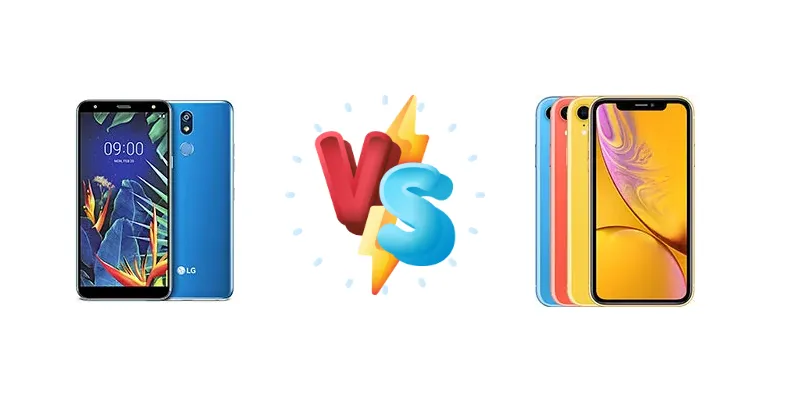
The Apple iPhone XR, while no longer the latest model, remains a popular choice due to its continued software support and brand recognition. The LG K40, on the other hand, represents a modern budget Android option. This comparison dissects their key differences, focusing on where each phone excels and who will benefit most from its strengths.
🏆 Quick Verdict
For the average user prioritizing long-term software support and a smoother overall experience, the Apple iPhone XR is the better choice, despite its age. The A12 Bionic chip provides significantly more processing power than the Helio P22, justifying the price difference for those who value performance.
| Network |
|---|
| 2G bands | GSM 850 / 900 / 1800 / 1900 | GSM 850 / 900 / 1800 / 1900 |
| 3G bands | HSDPA 850 / 900 / 1900 / 2100 | HSDPA 850 / 900 / 1700(AWS) / 1900 / 2100 |
| 4G bands | 1, 3, 7, 8, 20 | 1, 2, 3, 4, 5, 7, 8, 12, 13, 14, 17, 18, 19, 20, 25, 26, 29, 30, 32, 34, 38, 39, 40, 41, 66, 71 |
| Speed | HSPA 42.2/5.76 Mbps, LTE (2CA) Cat6 300/50 Mbps | HSPA, LTE, EV-DO Rev.A 3.1 Mbps |
| Technology | GSM / HSPA / LTE | GSM / CDMA / HSPA / EVDO / LTE |
| | - | CDMA2000 1xEV-DO |
| Launch |
|---|
| Announced | 2019, February. Released 2019, April | 2018, September 12. Released 2018, October 26 |
| Status | Discontinued | Discontinued |
| Body |
|---|
| Build | Glass front, plastic back, plastic frame | Glass front (Corning-made glass), glass back (Corning-made glass), aluminum frame (7000 series) |
| Dimensions | 153 x 71.9 x 8.3 mm (6.02 x 2.83 x 0.33 in) | 150.9 x 75.7 x 8.3 mm (5.94 x 2.98 x 0.33 in) |
| SIM | · Nano-SIM· Nano-SIM + Nano-SIM | · Nano-SIM + eSIM· Nano-SIM + Nano-SIM (China) |
| Weight | 144 g (5.08 oz) | 194 g (6.84 oz) |
| | MIL-STD-810G compliant*
*does not guarantee ruggedness or use in extreme conditions | IP67 dust/water resistant (up to 1m for 30 min)
Apple Pay (Visa, MasterCard, AMEX certified) |
| Display |
|---|
| Protection | - | Scratch-resistant glass |
| Resolution | 720 x 1440 pixels, 18:9 ratio (~282 ppi density) | 828 x 1792 pixels, 19.5:9 ratio (~326 ppi density) |
| Size | 5.7 inches, 83.8 cm2 (~76.2% screen-to-body ratio) | 6.1 inches, 90.3 cm2 (~79.0% screen-to-body ratio) |
| Type | IPS LCD | Liquid Retina IPS LCD, 625 nits (HBM) |
| Platform |
|---|
| CPU | Octa-core 2.0 GHz Cortex-A53 | Hexa-core (2x2.5 GHz Vortex + 4x1.6 GHz Tempest) |
| Chipset | Mediatek MT6762 Helio P22 (12 nm) | Apple A12 Bionic (7 nm) |
| GPU | PowerVR GE8320 | Apple GPU (4-core graphics) |
| OS | Android 8.1 (Oreo), LG UX 7 | iOS 12, upgradable to iOS 18.7 |
| Memory |
|---|
| Card slot | microSDXC (dedicated slot) | No |
| Internal | 32GB 2GB RAM, 32GB 3GB RAM | 64GB 3GB RAM, 128GB 3GB RAM, 256GB 3GB RAM |
| | eMMC 5.1 | NVMe |
| Main Camera |
|---|
| Features | LED flash, panorama, HDR | Quad-LED dual-tone flash, HDR (photo/panorama) |
| Single | 16 MP, f/2.0, 1/3.1", 1.0µm, PDAF | 12 MP, f/1.8, 26mm (wide), 1/2.55", 1.4µm, PDAF, OIS |
| Video | 1080p@30fps | 4K@24/30/60fps, 1080p@30/60/120/240fps, HDR, stereo sound rec. |
| Selfie camera |
|---|
| Features | LED flash | HDR |
| Single | 8 MP, f/2.0 | 7 MP, f/2.2, 32mm (standard)
SL 3D, (depth/biometrics sensor) |
| Video | 1080p@30fps | 1080p@60fps |
| Sound |
|---|
| 3.5mm jack | Yes | No |
| 35mm jack | Yes | No |
| Loudspeaker | Yes | Yes, with stereo speakers |
| Comms |
|---|
| Bluetooth | 5.0, A2DP, LE | 5.0, A2DP, LE |
| NFC | Yes (market/region dependent) | Yes |
| Positioning | GPS, GLONASS | GPS, GLONASS, GALILEO, QZSS |
| Radio | No | No |
| USB | microUSB 2.0, OTG | Lightning, USB 2.0 |
| WLAN | Wi-Fi 802.11 a/b/g/n/ac, dual-band, Wi-Fi Direct, DLNA | Wi-Fi 802.11 a/b/g/n/ac, dual-band, hotspot |
| Features |
|---|
| Sensors | Fingerprint (rear-mounted), accelerometer, proximity, compass | Face ID, accelerometer, gyro, proximity, compass, barometer |
| Battery |
|---|
| Charging | - | 15W wired, PD2.0, 50% in 30 min
Wireless (Qi) |
| Type | Li-Ion 3000 mAh, non-removable | Li-Ion 2942 mAh, non-removable (11.16 Wh) |
| Misc |
|---|
| Colors | Black, New Moroccan Blue, New Platinum Gray | Black, Red, Yellow, Blue, Coral, White |
| Models | LMX420, LMX420EMW, LM-X420 | A2105, A1984, A2107, A2108, A2106, iPhone11,8 |
| Price | About 140 EUR | About 150 EUR |
| SAR | - | 1.13 W/kg (head) 1.16 W/kg (body) |
| SAR EU | - | 0.99 W/kg (head) 0.99 W/kg (body) |
| Tests |
|---|
| Battery life | - |
Endurance rating 78h
|
| Performance | - |
AnTuTu: 341196 (v7), 422465 (v8)
GeekBench: 11437 (v4.4), 2690 (v5.1)
GFXBench: 58fps (ES 3.1 onscreen) |
LG K40
- Significantly lower price point
- Android's customization options
- Potentially expandable storage (via microSD, though not confirmed)
- Substantially slower performance
- Inferior camera quality
- Likely shorter software support lifespan
Apple iPhone XR
- Powerful A12 Bionic chip for smooth performance
- Excellent camera quality and image processing
- Long-term software support from Apple
- Higher price tag
- Less customizable operating system (iOS)
- No expandable storage
Display Comparison
Neither device boasts a cutting-edge display. The iPhone XR features a 6.1-inch Liquid Retina LCD, while the LG K40’s display size and technology are not specified. However, the iPhone XR’s display is known for its accurate color reproduction and good brightness. The LG K40, being a budget device, likely utilizes a lower-quality panel with narrower viewing angles and less accurate colors. The iPhone XR’s display is also protected by a more durable glass, offering better scratch resistance.
Camera Comparison
While megapixel counts aren't everything, the iPhone XR generally delivers superior image quality. The iPhone XR’s 12MP main camera benefits from Apple’s image processing algorithms, resulting in more natural colors, better dynamic range, and improved low-light performance. The LG K40’s camera specifications are not detailed enough to make a direct comparison, but budget phones often compromise on sensor size and image processing capabilities. The iPhone XR also offers features like Portrait mode and Cinematic video stabilization, which are unlikely to be found on the LG K40. The iPhone XR’s video recording capabilities are also significantly better.
Performance
The performance gap is substantial. The Apple A12 Bionic (7nm) is a hexa-core chip with a focus on both performance and efficiency, featuring two high-performance Vortex cores clocked at 2.5 GHz and four efficiency cores at 1.6 GHz. This contrasts sharply with the LG K40’s MediaTek Helio P22 (12nm), an octa-core processor clocked at 2.0 GHz using Cortex-A53 cores. The A12 Bionic’s 7nm process node allows for significantly higher transistor density and improved power efficiency, translating to faster app loading times, smoother multitasking, and better gaming performance. The iPhone XR’s GPU is also far superior, enabling more demanding games to run at higher settings. The Helio P22 is adequate for basic tasks but will struggle with resource-intensive applications.
Battery Life
Both phones have an endurance rating of 78 hours, suggesting comparable battery life under similar usage conditions. However, the iPhone XR’s 15W wired charging with PD2.0 and Qi wireless charging provides more convenient charging options. The LG K40’s charging specifications are not provided, but it likely supports slower charging speeds. While both offer similar endurance, the iPhone XR’s faster charging allows for quicker top-ups when needed.
Buying Guide
Buy the LG K40 if you need a highly affordable Android phone for basic tasks like calling, texting, and light social media use, and prefer the customization options of Android. Buy the Apple iPhone XR if you prioritize a premium user experience, long-term software updates, a more capable camera, and smoother performance for demanding apps and games, even if it means paying a premium.
Frequently Asked Questions
❓ Is the iPhone XR still receiving software updates?
Yes, the iPhone XR continues to receive iOS updates from Apple, ensuring access to the latest features and security patches for several years to come. This is a significant advantage over the LG K40, which will likely have a shorter software support lifespan.
❓ Will the LG K40 struggle with modern mobile games?
Yes, the MediaTek Helio P22 processor in the LG K40 is not powerful enough to run demanding mobile games at high settings. You may experience lag, stuttering, and reduced frame rates, even on less graphically intensive titles.
❓ Does the iPhone XR support 5G?
No, the iPhone XR is a 4G LTE device and does not support 5G connectivity. This is a limitation compared to some newer budget Android phones, but 5G coverage is still not ubiquitous.
❓ How does the iPhone XR's resale value compare to the LG K40?
The iPhone XR holds its value significantly better than the LG K40. If you plan to upgrade in the future, you'll likely recoup a larger portion of your initial investment with the iPhone XR.