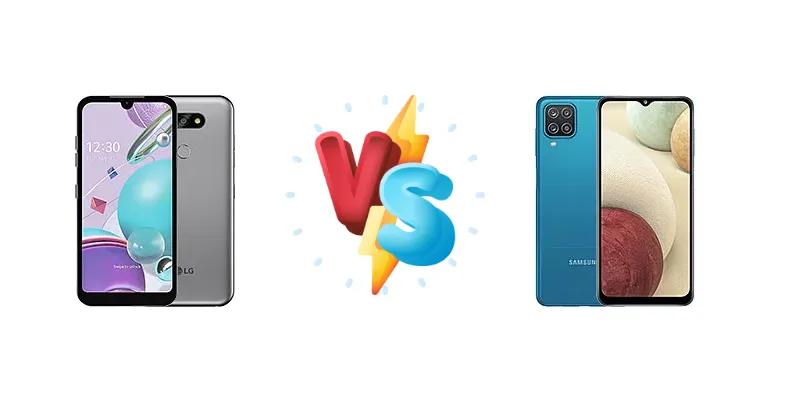
The sub-₹15,000 (approximately $180 USD) smartphone market in India is fiercely competitive. Both the LG K31 and the Samsung Galaxy A12 (India variant) aim to deliver essential smartphone functionality at an accessible price. However, they take different approaches to achieving this, primarily through their chipset choices. This comparison dives deep into the architectural differences and real-world implications of the Mediatek Helio P22 in the K31 versus the Samsung Exynos 850 in the A12.
🏆 Quick Verdict
For the average user prioritizing overall performance and future-proofing, the Samsung Galaxy A12 (India) is the better choice. Its Exynos 850, built on an 8nm process, offers a significant performance advantage over the LG K31’s 12nm Helio P22, translating to smoother multitasking and a more responsive user experience. While the K31 may offer slightly better battery life due to the less powerful chip, the A12’s 15W charging mitigates this.
| Network |
|---|
| 2G bands | GSM 850 / 900 / 1800 / 1900 | GSM 850 / 900 / 1800 / 1900 |
| 3G bands | HSDPA 850 / 900 / 1700(AWS) / 1900 / 2100 | HSDPA 850 / 900 / 2100 |
| 4G bands | 2, 4, 5, 12, 13, 25, 26, 41, 66, 71 | 1, 3, 5, 7, 8, 20, 28, 38, 40, 41 |
| Speed | HSPA, LTE | HSPA 42.2/5.76 Mbps, LTE Cat4 150/50 Mbps |
| Technology | GSM / CDMA / HSPA / LTE | GSM / HSPA / LTE |
| | CDMA 800 / 1900 | - |
| Launch |
|---|
| Announced | 2020, August 21. Released 2020, August 21 | 2021, August 12 |
| Status | Discontinued | Available. Released 2021, August 12 |
| Body |
|---|
| Build | - | Glass front, plastic back, plastic frame |
| Dimensions | 147.8 x 71.1 x 8.6 mm (5.82 x 2.80 x 0.34 in) | 164 x 75.8 x 8.9 mm (6.46 x 2.98 x 0.35 in) |
| SIM | Nano-SIM + Nano-SIM | · Nano-SIM· Nano-SIM + Nano-SIM |
| Weight | 146 g (5.15 oz) | 205 g (7.23 oz) |
| | MIL-STD-810G compliant*
*does not guarantee ruggedness or use in extreme conditions | - |
| Display |
|---|
| Resolution | 720 x 1520 pixels, 19:9 ratio (~295 ppi density) | 720 x 1600 pixels, 20:9 ratio (~270 ppi density) |
| Size | 5.7 inches, 81.1 cm2 (~77.2% screen-to-body ratio) | 6.5 inches, 102.0 cm2 (~82.1% screen-to-body ratio) |
| Type | IPS LCD | PLS LCD |
| Platform |
|---|
| CPU | Octa-core 2.0 GHz Cortex-A53 | Octa-core (4x2.0 GHz Cortex-A55 & 4x2.0 GHz Cortex-A55) |
| Chipset | Mediatek MT6762 Helio P22 (12 nm) | Exynos 850 (8 nm) |
| GPU | PowerVR GE8320 | Mali-G52 |
| OS | Android 10, LG UX 9.1 | Android 11, upgradable to Android 13, One UI 5.1 |
| Memory |
|---|
| Card slot | microSDXC | microSDXC (dedicated slot) |
| Internal | 32GB 2GB RAM | 64GB 4GB RAM, 128GB 4GB RAM, 128GB 6GB RAM |
| | eMMC 5.1 | eMMC 5.1 |
| Main Camera |
|---|
| Dual | 13 MP, f/1.8, 27mm (wide), 1/3.1", 1.12µm, PDAF
5 MP, f/2.2, 120˚ (ultrawide), 1/5.0", 1.12µm | - |
| Features | LED flash, panorama, HDR | LED flash, panorama, HDR |
| Quad | - | 48 MP, f/2.0, 26mm (wide), AF
5 MP, f/2.2, 123˚ (ultrawide)
2 MP (macro)
Auxiliary lens |
| Video | 1080p@30fps | 1080p@30fps |
| Selfie camera |
|---|
| Single | 5 MP, f/2.2, 24mm (wide), 1/5.0", 1.12µm | 8 MP, f/2.2 |
| Video | 1080p@30fps | 1080p@30fps |
| Sound |
|---|
| 3.5mm jack | Yes | Yes |
| 35mm jack | Yes | Yes |
| Loudspeaker | Yes | Yes |
| Comms |
|---|
| Bluetooth | 5.0, A2DP, LE | 5.0, A2DP, LE |
| NFC | No | No |
| Positioning | GPS | GPS, GLONASS, GALILEO, BDS |
| Radio | No | FM radio, RDS, recording |
| USB | microUSB 2.0 | USB Type-C 2.0 |
| WLAN | Wi-Fi 802.11 b/g/n, Wi-Fi Direct | Wi-Fi 802.11 b/g/n, Wi-Fi Direct |
| Features |
|---|
| Sensors | Fingerprint (rear-mounted), accelerometer | Fingerprint (side-mounted), accelerometer |
| | - | Virtual proximity sensing |
| Battery |
|---|
| Charging | - | 15W wired |
| Type | Li-Ion 3000 mAh | Li-Po 5000 mAh |
| Misc |
|---|
| Colors | Gray | Black, Blue, White |
| Models | LM-K300Q, LMK300, LGL355DL | SM-A127F, SM-A127F/DS |
| Price | About 130 EUR | About 160 EUR |
| SAR | - | 0.79 W/kg (head) |
LG K31
- More powerful Exynos 850 chipset
- Faster 15W charging
- Potentially better image processing
- May be slightly more expensive
- Battery life may be marginally shorter than K31
Samsung Galaxy A12 (India)
- Lower upfront cost
- Potentially longer battery life
- Simple and straightforward user experience
- Significantly weaker Helio P22 chipset
- Slower charging speeds
- May struggle with demanding apps
Display Comparison
Neither device boasts a particularly impressive display. Specifics like brightness nits and color accuracy are unavailable, but both likely utilize LCD panels common in this price bracket. The key difference lies in the processing power needed to drive the display, where the Exynos 850 in the A12 has a clear advantage. This could translate to slightly smoother scrolling and animations, even if the raw panel specs are similar. Bezels are expected to be substantial on both devices, reflecting their budget positioning.
Camera Comparison
Camera performance is likely to be similar in real-world usage, given the focus on budget components. Both phones likely feature a primary camera alongside several lower-resolution sensors. The LG K31’s camera specs are unavailable, but the A12’s likely includes a 13MP main sensor. The Exynos 850’s image signal processor (ISP) will likely offer slightly better image processing capabilities, potentially resulting in more detailed and vibrant photos, especially in challenging lighting conditions. The inclusion of a 2MP macro camera on both devices is largely a marketing tactic, offering limited practical benefit due to the low resolution and lack of optical image stabilization (OIS).
Performance
The core of the difference lies in the chipsets. The Samsung Galaxy A12’s Exynos 850, fabricated on an 8nm process, is significantly more efficient than the LG K31’s 12nm Mediatek Helio P22. While both CPUs feature octa-core configurations clocked at 2.0 GHz, the Exynos 850 utilizes newer Cortex-A55 cores across all eight, offering improved instructions per clock (IPC) compared to the K31’s Cortex-A53 cores. This architectural advantage, combined with the smaller fabrication node, results in demonstrably better performance in CPU-intensive tasks and improved thermal management. The A12 is likely to exhibit less throttling under sustained load.
Battery Life
The LG K31, with its less power-hungry Helio P22, will likely offer slightly longer battery life on a single charge. However, the Samsung Galaxy A12 compensates with 15W wired charging, allowing for faster replenishment. While specific 0-100% charging times are unavailable, the A12 will likely charge significantly faster than the K31, mitigating the potential battery life difference. The Exynos 850’s efficiency also contributes to reasonable battery consumption despite its higher performance.
Buying Guide
Buy the LG K31 if you absolutely need the lowest possible upfront cost and primarily use your phone for basic tasks like calls, texts, and light social media. Battery life will be a slight advantage. Buy the Samsung Galaxy A12 (India) if you value a smoother, more responsive experience, plan to use more demanding apps, or anticipate keeping the phone for more than a year. The Exynos 850 provides a noticeable performance boost and better long-term usability.
Frequently Asked Questions
❓ Does the Exynos 850 in the Galaxy A12 overheat during prolonged gaming sessions?
While the Exynos 850 isn't a flagship-level chip, its 8nm fabrication process and efficient design minimize thermal throttling. It's unlikely to overheat significantly during moderate gaming, but extended, high-graphics sessions may lead to some performance reduction. The K31's Helio P22 will likely throttle sooner due to its less efficient architecture.
❓ Is the 2MP macro camera on either phone worth using?
Generally, no. 2MP macro cameras on budget phones offer limited detail and often produce blurry, underwhelming results. The small sensor size and lack of autofocus severely restrict their usefulness. You're better off using the main camera and cropping for close-up shots.
❓ Can the Samsung Galaxy A12 (India) handle games like PUBG Mobile at reasonable frame rates?
The Galaxy A12 can run PUBG Mobile, but expect to play at medium graphics settings and potentially with frame rate caps to maintain a stable experience. The Exynos 850 is capable, but it's not designed for ultra-high settings. The LG K31 will likely struggle to provide a consistently smooth PUBG experience.
❓ What type of storage does each phone use, and is it expandable?
Specific storage types (e.g., eMMC vs. UFS) are unavailable. However, both phones likely utilize expandable storage via microSD card, allowing you to increase the internal storage capacity. This is a crucial feature for budget phones, as base storage options are often limited.