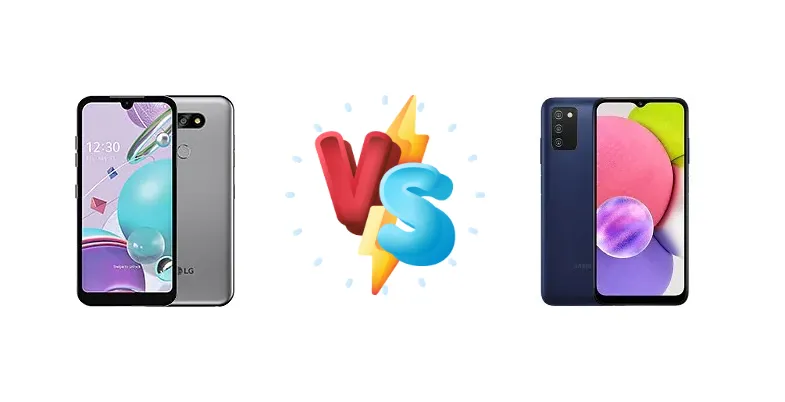
The LG K31 and Samsung Galaxy A03s represent the extreme end of the smartphone price spectrum. Both devices aim to deliver essential smartphone functionality at a minimal cost, but they achieve this with different hardware choices. This comparison dissects those choices, revealing which phone offers the best value for users prioritizing affordability.
🏆 Quick Verdict
For most users, the Samsung Galaxy A03s emerges as the slightly better choice. Its Helio P35 chipset offers a noticeable performance uplift over the K31’s Helio P22, and the measured 488 nits of brightness provides a more usable outdoor experience. While both offer similar battery endurance, the A03s’ 15W charging is a welcome addition.
| Network |
|---|
| 2G bands | GSM 850 / 900 / 1800 / 1900 | GSM 850 / 900 / 1800 / 1900 |
| 3G bands | HSDPA 850 / 900 / 1700(AWS) / 1900 / 2100 | HSDPA 850 / 900 / 2100 |
| 4G bands | 2, 4, 5, 12, 13, 25, 26, 41, 66, 71 | 1, 3, 5, 7, 8, 20, 28, 38, 40, 41 |
| Speed | HSPA, LTE | HSPA 42.2/5.76 Mbps, LTE Cat4 150/50 Mbps |
| Technology | GSM / CDMA / HSPA / LTE | GSM / HSPA / LTE |
| | CDMA 800 / 1900 | 2, 4, 5, 7, 12, 13, 14, 25, 26, 41, 66, 71 - SM-A037U |
| Launch |
|---|
| Announced | 2020, August 21. Released 2020, August 21 | 2021, August 18 |
| Status | Discontinued | Available. Released 2021, August 18 |
| Body |
|---|
| Build | - | Glass front, plastic frame, plastic back |
| Dimensions | 147.8 x 71.1 x 8.6 mm (5.82 x 2.80 x 0.34 in) | 164.2 x 75.9 x 9.1 mm (6.46 x 2.99 x 0.36 in) |
| SIM | Nano-SIM + Nano-SIM | Nano-SIM + Nano-SIM |
| Weight | 146 g (5.15 oz) | 196 g (6.91 oz) |
| | MIL-STD-810G compliant*
*does not guarantee ruggedness or use in extreme conditions | - |
| Display |
|---|
| Resolution | 720 x 1520 pixels, 19:9 ratio (~295 ppi density) | 720 x 1600 pixels, 20:9 ratio (~270 ppi density) |
| Size | 5.7 inches, 81.1 cm2 (~77.2% screen-to-body ratio) | 6.5 inches, 102.0 cm2 (~81.8% screen-to-body ratio) |
| Type | IPS LCD | PLS LCD |
| Platform |
|---|
| CPU | Octa-core 2.0 GHz Cortex-A53 | Octa-core (4x2.35 GHz Cortex-A53 & 4x1.8 GHz Cortex-A53) |
| Chipset | Mediatek MT6762 Helio P22 (12 nm) | Mediatek MT6765 Helio P35 (12 nm) |
| GPU | PowerVR GE8320 | PowerVR GE8320 |
| OS | Android 10, LG UX 9.1 | Android 11, upgradable to Android 13, One UI 5.1 Core |
| Memory |
|---|
| Card slot | microSDXC | microSDXC (dedicated slot) |
| Internal | 32GB 2GB RAM | 32GB 2GB RAM, 32GB 3GB RAM, 32GB 4GB RAM, 64GB 3GB RAM, 64GB 4GB RAM |
| | eMMC 5.1 | eMMC 5.1 |
| Main Camera |
|---|
| Dual | 13 MP, f/1.8, 27mm (wide), 1/3.1", 1.12µm, PDAF
5 MP, f/2.2, 120˚ (ultrawide), 1/5.0", 1.12µm | - |
| Features | LED flash, panorama, HDR | LED flash |
| Single | - | 5 MP, f/2.2 |
| Triple | - | 13 MP, f/2.2, (wide), AF
2 MP (macro)
Auxiliary lens |
| Video | 1080p@30fps | 1080p@30fps |
| Selfie camera |
|---|
| Single | 5 MP, f/2.2, 24mm (wide), 1/5.0", 1.12µm | 5 MP, f/2.2 |
| Video | 1080p@30fps | 1080p@30fps |
| Sound |
|---|
| 3.5mm jack | Yes | Yes |
| 35mm jack | Yes | Yes |
| Loudspeaker | Yes | Yes |
| Comms |
|---|
| Bluetooth | 5.0, A2DP, LE | 5.0, A2DP |
| NFC | No | Yes (market/region dependent) |
| Positioning | GPS | GPS, GLONASS, GALILEO, BDS |
| Radio | No | No |
| USB | microUSB 2.0 | USB Type-C 2.0 |
| WLAN | Wi-Fi 802.11 b/g/n, Wi-Fi Direct | Wi-Fi 802.11 b/g/n, Wi-Fi Direct |
| Features |
|---|
| Sensors | Fingerprint (rear-mounted), accelerometer | Fingerprint (side-mounted), accelerometer, proximity |
| Battery |
|---|
| Charging | - | 15W wired |
| Type | Li-Ion 3000 mAh | Li-Po 5000 mAh |
| Misc |
|---|
| Colors | Gray | Black, Blue, White |
| Models | LM-K300Q, LMK300, LGL355DL | SM-A037F, SM-A037F/DS, SM-A037M, SM-A037G, SM-A037U, SM-S134DL, SM-A037W, SM-A037U1, SM-S135DL |
| Price | About 130 EUR | $ 65.65 / £ 82.99 / ₹ 10,800 |
| SAR EU | - | 0.36 W/kg (head) 1.09 W/kg (body) |
| Tests |
|---|
| Battery life | - |
Endurance rating 122h
|
| Camera | - |
Photo / Video |
| Display | - |
Contrast ratio: 1718:1 (nominal) |
| Loudspeaker | - |
-27.4 LUFS (Good)
|
| Performance | - |
AnTuTu: 103465 (v8), 101299 (v9)
GeekBench: 889 (v5.1)
GFXBench: 5.5fps (ES 3.1 onscreen) |
LG K31
- Potentially lower price point
- Simple and straightforward user experience
- Decent battery life
- Less powerful processor
- Likely lower display brightness
- Slower charging (or unspecified)
Samsung Galaxy A03s
- More powerful processor (Helio P35)
- Brighter display (488 nits)
- Faster 15W charging
- Slightly higher price
- Similar battery life to K31
- May include bloatware
Display Comparison
Both the LG K31 and Samsung Galaxy A03s feature displays with a 1718:1 contrast ratio, suggesting similar panel characteristics in terms of black levels. However, the Samsung Galaxy A03s pulls ahead with a measured peak brightness of 488 nits, significantly improving visibility in direct sunlight compared to the K31, which lacks published brightness data. While both likely utilize IPS LCD technology, the A03s’ higher brightness makes it the more practical choice for outdoor use. Bezels are expected to be substantial on both devices, consistent with their budget positioning.
Camera Comparison
Both phones offer 'Photo / Video' capabilities, but detailed camera specifications are scarce. Given the market segment, image quality will likely be similar, relying heavily on software processing. The absence of information regarding sensor size or aperture makes a direct comparison difficult. It’s safe to assume both phones feature basic camera setups suitable for casual snapshots in good lighting conditions. The presence of a 2MP macro camera on the A03s is unlikely to significantly enhance the photography experience, serving more as a marketing feature than a practical tool.
Performance
The Samsung Galaxy A03s’ Mediatek Helio P35 chipset represents a clear advantage over the LG K31’s Helio P22. The P35 utilizes a big.LITTLE architecture with four Cortex-A53 cores clocked at 2.35 GHz and four at 1.8 GHz, while the K31’s P22 features eight Cortex-A53 cores at a uniform 2.0 GHz. This means the A03s can handle more demanding tasks and multitasking with greater fluidity. While both chipsets are 12nm, the P35’s architecture provides a performance edge, translating to faster app loading times and smoother scrolling. Neither phone is a gaming powerhouse, but the A03s will offer a more playable experience.
Battery Life
Both the LG K31 and Samsung Galaxy A03s achieve an endurance rating of 122 hours, indicating comparable battery life under similar usage conditions. However, the Samsung Galaxy A03s benefits from 15W wired charging, allowing for faster replenishment of the battery compared to the K31, which lacks published charging specifications. While both will likely last a full day on a single charge with moderate use, the A03s’ faster charging is a convenience advantage.
Buying Guide
Buy the LG K31 if you absolutely need the lowest possible price and are primarily focused on basic communication tasks like calls and messaging. Its simplicity and lower cost make it suitable for first-time smartphone users or as a temporary device. Buy the Samsung Galaxy A03s if you prioritize a smoother user experience, slightly better display visibility, and faster charging, even if it means spending a little more. It’s a better all-rounder for everyday use.
Frequently Asked Questions
❓ Does the Mediatek Helio P35 in the Galaxy A03s get noticeably warmer during extended use compared to the Helio P22 in the K31?
While both chipsets are 12nm, the P35’s more complex architecture and higher clock speeds mean it will generate more heat under sustained load. However, both phones are passively cooled, so throttling is likely to occur on both devices before reaching critical temperatures. The A03s may experience slightly more noticeable warmth during demanding tasks.
❓ Is the 15W charging on the Samsung Galaxy A03s a significant improvement over what the LG K31 likely offers?
Yes, 15W charging is a substantial improvement. Without specific charging data for the K31, it’s safe to assume it charges at a slower rate (likely 10W or less). This translates to a significantly shorter time to fully recharge the battery on the A03s, offering greater convenience for users who frequently need to top up their device.
❓ Can the Samsung Galaxy A03s handle popular mobile games like PUBG Mobile, and if so, at what settings?
The Galaxy A03s can run PUBG Mobile, but expect to play at the lowest graphics settings and a moderate frame rate (around 30fps) for a playable experience. The Helio P35 isn’t a gaming powerhouse, and pushing the settings higher will result in significant lag and stuttering.