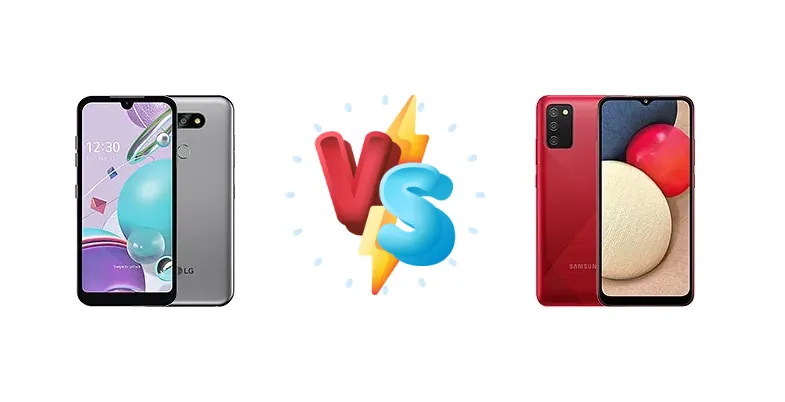
The LG K31 and Samsung Galaxy A02s represent the extreme end of the smartphone price spectrum. Both aim to deliver essential smartphone functionality at a minimal cost, but they achieve this with different hardware choices. This comparison dissects those choices, focusing on performance, display quality, and battery endurance to determine which device offers the best value.
🏆 Quick Verdict
For the average user prioritizing consistent performance and a slightly brighter display, the Samsung Galaxy A02s emerges as the better choice. While both phones share an identical 114-hour endurance rating, the Snapdragon 450’s 14nm process offers a slight edge in efficiency and sustained performance over the K31’s Helio P22.
| Network |
|---|
| 2G bands | GSM 850 / 900 / 1800 / 1900 | GSM 850 / 900 / 1800 / 1900 |
| 3G bands | HSDPA 850 / 900 / 1700(AWS) / 1900 / 2100 | HSDPA 850 / 900 / 2100 |
| 4G bands | 2, 4, 5, 12, 13, 25, 26, 41, 66, 71 | 1, 3, 5, 7, 8, 20, 28, 38, 40, 41 |
| Speed | HSPA, LTE | HSPA 42.2/5.76 Mbps, LTE Cat4 150/50 Mbps |
| Technology | GSM / CDMA / HSPA / LTE | GSM / HSPA / LTE |
| | CDMA 800 / 1900 | - |
| Launch |
|---|
| Announced | 2020, August 21. Released 2020, August 21 | 2020, November 24. Released 2021, January 04 |
| Status | Discontinued | Discontinued |
| Body |
|---|
| Build | - | Glass front, plastic back, plastic frame |
| Dimensions | 147.8 x 71.1 x 8.6 mm (5.82 x 2.80 x 0.34 in) | 164.2 x 75.9 x 9.1 mm (6.46 x 2.99 x 0.36 in) |
| SIM | Nano-SIM + Nano-SIM | · Nano-SIM· Nano-SIM + Nano-SIM |
| Weight | 146 g (5.15 oz) | 196 g (6.91 oz) |
| | MIL-STD-810G compliant*
*does not guarantee ruggedness or use in extreme conditions | - |
| Display |
|---|
| Protection | - | Scratch-resistant glass |
| Resolution | 720 x 1520 pixels, 19:9 ratio (~295 ppi density) | 720 x 1600 pixels, 20:9 ratio (~270 ppi density) |
| Size | 5.7 inches, 81.1 cm2 (~77.2% screen-to-body ratio) | 6.5 inches, 102.0 cm2 (~81.8% screen-to-body ratio) |
| Type | IPS LCD | PLS LCD |
| Platform |
|---|
| CPU | Octa-core 2.0 GHz Cortex-A53 | Octa-core 1.8 GHz Cortex-A53 |
| Chipset | Mediatek MT6762 Helio P22 (12 nm) | Qualcomm SDM450 Snapdragon 450 (14 nm) |
| GPU | PowerVR GE8320 | Adreno 506 |
| OS | Android 10, LG UX 9.1 | Android 10, upgradable to Android 12, One UI 4.1 |
| Memory |
|---|
| Card slot | microSDXC | microSDXC (dedicated slot) |
| Internal | 32GB 2GB RAM | 16GB 1GB RAM, 32GB 2GB RAM, 32GB 3GB RAM, 32GB 4GB RAM, 64GB 3GB RAM, 64GB 4GB RAM |
| | eMMC 5.1 | eMMC 5.1 |
| Main Camera |
|---|
| Dual | 13 MP, f/1.8, 27mm (wide), 1/3.1", 1.12µm, PDAF
5 MP, f/2.2, 120˚ (ultrawide), 1/5.0", 1.12µm | - |
| Features | LED flash, panorama, HDR | LED flash |
| Single | - | 3.15 MP |
| Triple | - | 13 MP, f/2.2, (wide), AF
2 MP (macro)
Auxiliary lens |
| Video | 1080p@30fps | 1080p@30fps |
| Selfie camera |
|---|
| Single | 5 MP, f/2.2, 24mm (wide), 1/5.0", 1.12µm | 5 MP, f/2.2 |
| Video | 1080p@30fps | - |
| Sound |
|---|
| 3.5mm jack | Yes | Yes |
| 35mm jack | Yes | Yes |
| Loudspeaker | Yes | Yes |
| Comms |
|---|
| Bluetooth | 5.0, A2DP, LE | 4.2, A2DP |
| NFC | No | No |
| Positioning | GPS | GPS, GLONASS, GALILEO, BDS |
| Radio | No | Unspecified |
| USB | microUSB 2.0 | USB Type-C 2.0 |
| WLAN | Wi-Fi 802.11 b/g/n, Wi-Fi Direct | Wi-Fi 802.11 b/g/n, Wi-Fi Direct |
| Features |
|---|
| Sensors | Fingerprint (rear-mounted), accelerometer | Accelerometer, proximity |
| Battery |
|---|
| Charging | - | 15W wired |
| Stand-by | - | Up to 530 h (2G) / Up to 530 h (3G) |
| Talk time | - | Up to 6 h 12 min (2G) / Up to 6 h 18 min (3G) |
| Type | Li-Ion 3000 mAh | Li-Po 5000 mAh |
| Misc |
|---|
| Colors | Gray | Black, White, Red, Blue |
| Models | LM-K300Q, LMK300, LGL355DL | SM-A025F, SM-A025F/DS, SM-A025G, SM-A025G/DS, SM-A025M, SM-A025M/DS, SM-A025U, SM-A025V, SM-A025A, SM-A025U1, SM-A025AZ, SM-S124DL |
| Price | About 130 EUR | About 110 EUR |
| SAR | - | 1.15 W/kg (head) 0.79 W/kg (body) |
| SAR EU | - | 0.40 W/kg (head) 1.37 W/kg (body) |
| Tests |
|---|
| Audio quality | - |
Noise -81.4dB / Crosstalk -80.5dB |
| Battery life | - |
Endurance rating 114h
|
| Camera | - |
Photo / Video |
| Display | - |
Contrast ratio: 1765:1 (nominal) |
| Loudspeaker | - |
-29.8 LUFS (Average)
|
| Performance | - |
AnTuTu: 90811 (v8)
GeekBench: 495 (v5.1)
GFXBench: 6.1fps (ES 3.1 onscreen) |
LG K31
- Potentially lower price point
- Mediatek Helio P22 offers decent performance for basic tasks
- Identical battery endurance to the A02s
- Helio P22 may throttle under sustained load
- Lack of published display brightness data
- Unspecified charging speed
Samsung Galaxy A02s
- Brighter display (406 nits)
- Snapdragon 450 offers better thermal efficiency
- 15W fast charging support
- Slightly lower CPU clock speed
- May be slightly more expensive than the K31
- Limited software update support
Display Comparison
The Samsung Galaxy A02s boasts a measured peak brightness of 406 nits, a significant advantage over the LG K31, which lacks published brightness data. Both displays share a 1765:1 contrast ratio, suggesting similar black levels and color depth. However, the A02s’ higher brightness translates to better visibility in direct sunlight. While neither phone is expected to offer exceptional color accuracy, the brighter panel on the A02s provides a more pleasant viewing experience overall.
Camera Comparison
Both devices feature basic photo and video capabilities, but detailed camera specifications are limited. Without sensor size or aperture information, a direct comparison is difficult. It’s safe to assume both phones rely on budget sensors and image processing. The presence of a camera is more for basic documentation than serious photography. The marketing materials for both devices highlight the camera, but users should temper expectations given the price point and lack of advanced features like OIS.
Performance
The core difference lies in the chipsets: the LG K31 utilizes the Mediatek Helio P22 (12nm) with an octa-core 2.0 GHz Cortex-A53 CPU, while the Samsung Galaxy A02s features the Qualcomm Snapdragon 450 (14nm) with an octa-core 1.8 GHz Cortex-A53 CPU. Despite the slightly lower clock speed, the Snapdragon 450’s 14nm process generally provides better thermal efficiency, reducing the likelihood of performance throttling during sustained tasks. Both CPUs utilize the same Cortex-A53 architecture, meaning the performance difference will be noticeable but not dramatic. The K31’s 12nm process *should* offer some efficiency gains, but the Snapdragon 450’s architecture and optimization often outweigh this.
Battery Life
Both the LG K31 and Samsung Galaxy A02s achieve an impressive endurance rating of 114 hours, indicating similar battery life under typical usage. The A02s supports 15W wired charging, while the K31’s charging speed is unspecified. The 15W charging on the A02s will result in faster 0-100% charge times, a convenience factor that the K31 likely lacks. The identical endurance ratings suggest that despite the different chipsets, power consumption is relatively balanced.
Buying Guide
Buy the LG K31 if you prioritize a potentially lower price point and are primarily focused on basic tasks like calling, texting, and light social media use. Buy the Samsung Galaxy A02s if you prefer a slightly more responsive user experience, a brighter display for outdoor visibility, and a more established brand reputation for software updates (though limited).
Frequently Asked Questions
❓ Will the Snapdragon 450 in the Galaxy A02s handle basic gaming like PUBG Mobile?
The Snapdragon 450 can run PUBG Mobile, but expect to play at the lowest graphics settings and potentially experience frame drops during intense action. It's not a gaming-focused chipset, but it's capable of handling less demanding titles.
❓ How significant is the difference in charging speed between the A02s' 15W charging and the K31's unknown charging speed?
The 15W charging on the A02s will noticeably reduce charging times compared to a standard 5W or 10W charger, which the K31 likely uses. Expect a faster top-up, especially useful for quick power boosts throughout the day.
❓ Are software updates a concern with either of these phones?
Yes. Both the LG K31 and Samsung Galaxy A02s are entry-level devices and are unlikely to receive frequent or long-term software updates. Expect limited security patches and potentially no major Android version upgrades.
❓ Which phone is better for someone who primarily uses their phone for calls, texts, and social media?
Both phones are adequate for these basic tasks. However, the Samsung Galaxy A02s’ slightly smoother performance and brighter display will provide a more enjoyable experience, even for simple usage.