
LG K31 vs. Motorola Moto G Stylus 5G: A Detailed Comparison for Budget 5G Buyers
| Phones Images | |||||
|---|---|---|---|---|---|
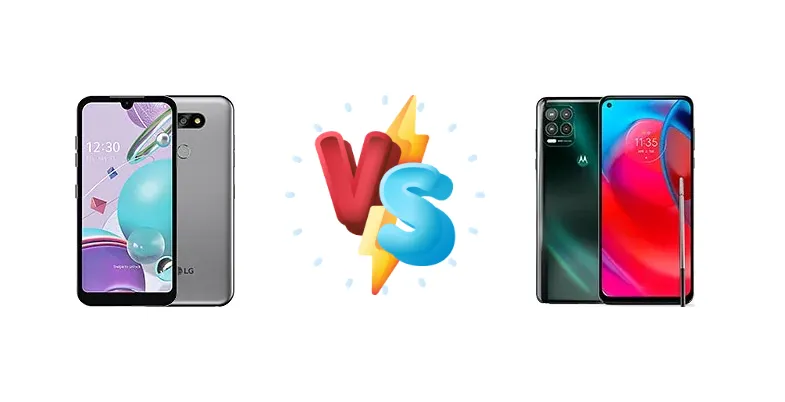
|
🏆 Quick Verdict
For most users, the Motorola Moto G Stylus 5G is the superior choice. Its Snapdragon 480 chipset, built on an 8nm process, delivers significantly better performance and 5G capabilities than the LG K31’s older Helio P22. While the K31 is cheaper, the G Stylus 5G’s improved efficiency and future-proofing justify the price difference.
| PHONES | ||
|---|---|---|
| Phone Names | LG K31 | Motorola Moto G Stylus 5G |
| Network | ||
|---|---|---|
| 2G bands | GSM 850 / 900 / 1800 / 1900 | GSM 850 / 900 / 1800 / 1900 |
| 3G bands | HSDPA 850 / 900 / 1700(AWS) / 1900 / 2100 | HSDPA 850 / 900 / 1700(AWS) / 1900 / 2100 |
| 4G bands | 2, 4, 5, 12, 13, 25, 26, 41, 66, 71 | 1, 2, 3, 4, 5, 7, 8, 12, 13, 14, 17, 18, 19, 20, 25, 26, 29, 30, 38, 39, 40, 41, 48, 66, 71 |
| 5G bands | - | 2, 5, 25, 26, 41, 66, 71, 77, 78 SA/NSA |
| Speed | HSPA, LTE | HSPA, LTE, 5G |
| Technology | GSM / CDMA / HSPA / LTE | GSM / HSPA / LTE / 5G |
| CDMA 800 / 1900 | - | |
| Launch | ||
|---|---|---|
| Announced | 2020, August 21. Released 2020, August 21 | 2021, June 09 |
| Status | Discontinued | Available. Released 2021, June 14 |
| Body | ||
|---|---|---|
| Build | - | Glass front, plastic frame, plastic back |
| Dimensions | 147.8 x 71.1 x 8.6 mm (5.82 x 2.80 x 0.34 in) | 169.5 x 77.5 x 9.4 mm (6.67 x 3.05 x 0.37 in) |
| SIM | Nano-SIM + Nano-SIM | Nano-SIM |
| Weight | 146 g (5.15 oz) | 217.5 g (7.69 oz) |
| MIL-STD-810G compliant* *does not guarantee ruggedness or use in extreme conditions | Stylus Water-repellent design | |
| Display | ||
|---|---|---|
| Resolution | 720 x 1520 pixels, 19:9 ratio (~295 ppi density) | 1080 x 2400 pixels, 20:9 ratio (~387 ppi density) |
| Size | 5.7 inches, 81.1 cm2 (~77.2% screen-to-body ratio) | 6.8 inches, 111.6 cm2 (~85.0% screen-to-body ratio) |
| Type | IPS LCD | IPS LCD |
| Platform | ||
|---|---|---|
| CPU | Octa-core 2.0 GHz Cortex-A53 | Octa-core (2x2.0 GHz Kryo 460 & 6x1.8 GHz Kryo 460) |
| Chipset | Mediatek MT6762 Helio P22 (12 nm) | Qualcomm SM4350 Snapdragon 480 5G (8 nm) |
| GPU | PowerVR GE8320 | Adreno 619 |
| OS | Android 10, LG UX 9.1 | Android 11, upgradable to Android 12 |
| Memory | ||
|---|---|---|
| Card slot | microSDXC | microSDXC (dedicated slot) |
| Internal | 32GB 2GB RAM | 128GB 4GB RAM, 256GB 6GB RAM |
| eMMC 5.1 | - | |
| Main Camera | ||
|---|---|---|
| Dual | 13 MP, f/1.8, 27mm (wide), 1/3.1", 1.12µm, PDAF 5 MP, f/2.2, 120˚ (ultrawide), 1/5.0", 1.12µm | - |
| Features | LED flash, panorama, HDR | LED flash, HDR, panorama |
| Quad | - | 48 MP, f/1.7, 26mm (wide), 1/2.0", 0.8µm, PDAF 8 MP, f/2.2, 118˚ (ultrawide), 1/4.0, 1.12µm 5 MP (macro) Auxiliary lens |
| Video | 1080p@30fps | 1080p@30/60fps |
| Selfie camera | ||
|---|---|---|
| Features | - | HDR |
| Single | 5 MP, f/2.2, 24mm (wide), 1/5.0", 1.12µm | 16 MP, f/2.0, (wide), 1/3.06", 1.0µm |
| Video | 1080p@30fps | 1080p@30fps |
| Sound | ||
|---|---|---|
| 3.5mm jack | Yes | Yes |
| 35mm jack | Yes | Yes |
| Loudspeaker | Yes | Yes |
| Comms | ||
|---|---|---|
| Bluetooth | 5.0, A2DP, LE | 5.0, A2DP, LE |
| NFC | No | No |
| Positioning | GPS | GPS, GLONASS, BDS, GALILEO |
| Radio | No | Unspecified |
| USB | microUSB 2.0 | USB Type-C 2.0 |
| WLAN | Wi-Fi 802.11 b/g/n, Wi-Fi Direct | Wi-Fi 802.11 a/b/g/n/ac, dual-band, Wi-Fi Direct |
| Features | ||
|---|---|---|
| Sensors | Fingerprint (rear-mounted), accelerometer | Fingerprint (rear-mounted), accelerometer, gyro, proximity |
| Battery | ||
|---|---|---|
| Charging | - | 10W wired |
| Type | Li-Ion 3000 mAh | Li-Po 5000 mAh |
| Misc | ||
|---|---|---|
| Colors | Gray | Cosmic Emerald |
| Models | LM-K300Q, LMK300, LGL355DL | XT2131, XT2131DL, XT2131-1, XT2131-3, XT2131-4 |
| Price | About 130 EUR | € 189.97 / $ 74.98 / £ 179.95 |
LG K31
- Lowest possible price point
- Simple and straightforward user experience
- Potentially longer standby time due to less demanding hardware
- Outdated chipset with limited performance
- No 5G connectivity
- Likely poor gaming performance
Motorola Moto G Stylus 5G
- 5G connectivity for faster data speeds
- More powerful and efficient Snapdragon 480 chipset
- Built-in stylus for added functionality
- Slow 10W charging
- Higher price than the LG K31
- May not compete with higher-end phones in camera quality
Display Comparison
Neither device boasts a standout display. Both likely utilize LCD panels, common in this price bracket. However, the lack of detailed display specs for the K31 makes a direct comparison difficult. The Moto G Stylus 5G benefits from a larger screen size, which is advantageous for media consumption. The K31’s display resolution is likely 720p, while the Moto G Stylus 5G is 1080p, resulting in a sharper image on the Motorola device. The 8nm Snapdragon 480 in the Moto G Stylus 5G allows for more efficient display power management.
Camera Comparison
Camera performance is likely similar in real-world scenarios, given the focus on affordability for both devices. Detailed camera specs are missing for the LG K31, but it likely features a basic sensor setup. The Moto G Stylus 5G’s camera system, while not flagship-level, benefits from Qualcomm’s image signal processor (ISP) within the Snapdragon 480, offering improved image processing capabilities. The Moto G Stylus 5G likely has a larger main sensor, resulting in better low-light performance. The inclusion of 5G connectivity on the Motorola device also allows for faster uploads of photos and videos.
Performance
The performance gap is substantial. The Motorola Moto G Stylus 5G’s Qualcomm Snapdragon 480 5G (8nm) is a clear upgrade over the LG K31’s MediaTek Helio P22 (12nm). The 8nm process node of the Snapdragon 480 translates to better power efficiency and reduced thermal throttling under sustained loads. The Snapdragon 480’s Kryo 460 cores, with their 2x2.0 GHz and 6x1.8 GHz configuration, offer a more sophisticated architecture than the K31’s Octa-core 2.0 GHz Cortex-A53 setup. This means faster app loading times, smoother multitasking, and a more responsive user experience on the Motorola device. Gamers will find the Moto G Stylus 5G capable of handling less demanding titles, while the K31 will struggle with anything beyond basic games.
Battery Life
The Moto G Stylus 5G’s 10W charging is slow by modern standards, but the Snapdragon 480’s efficiency helps offset this. The Helio P22 in the K31, being a less efficient chip, will likely drain the battery faster under similar usage. While battery capacity isn’t specified for either device, the Moto G Stylus 5G’s more efficient chipset will likely provide comparable or better real-world battery life despite potentially having a similar capacity. The 8nm process node of the Snapdragon 480 contributes significantly to this improved efficiency.
Buying Guide
Buy the LG K31 if you absolutely need the lowest possible upfront cost and 5G isn't a priority. It's suitable for basic tasks like calls, texts, and light social media. Buy the Motorola Moto G Stylus 5G if you want a more responsive experience, 5G connectivity for faster data speeds, and the added functionality of a stylus for note-taking and creative tasks. It’s the better long-term investment.