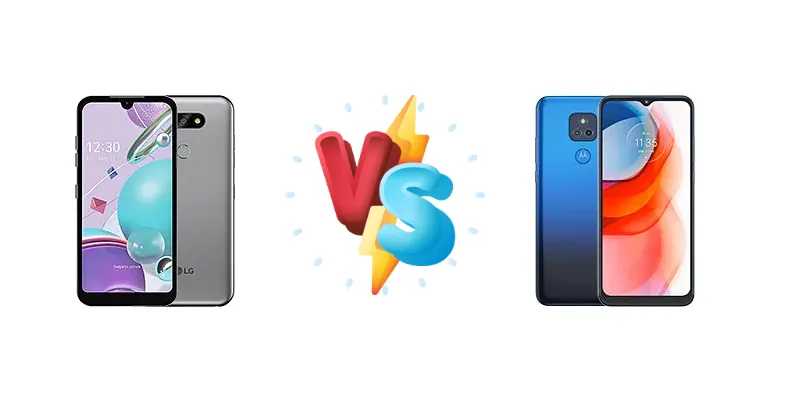
The LG K31 and Motorola Moto G Play (2021) represent the lower end of the smartphone market, targeting users prioritizing affordability. However, despite similar price points, they diverge significantly in their internal hardware, particularly in their chipsets. This comparison dissects these differences to determine which device delivers the best experience for everyday tasks and light usage.
🏆 Quick Verdict
For the average user, the Motorola Moto G Play (2021) is the better choice. Its Qualcomm Snapdragon 460, built on an 11nm process, offers a noticeable performance advantage over the LG K31’s MediaTek Helio P22, resulting in smoother multitasking and app loading, despite the K31's slightly larger screen.
| Network |
|---|
| 2G bands | GSM 850 / 900 / 1800 / 1900 | GSM 850 / 900 / 1800 / 1900 |
| 3G bands | HSDPA 850 / 900 / 1700(AWS) / 1900 / 2100 | HSDPA 850 / 900 / 1700(AWS) / 1900 / 2100 |
| 4G bands | 2, 4, 5, 12, 13, 25, 26, 41, 66, 71 | 1, 2, 3, 4, 5, 7, 8, 12, 13, 17, 25, 26, 38, 41, 66, 71 |
| Speed | HSPA, LTE | HSPA, LTE |
| Technology | GSM / CDMA / HSPA / LTE | GSM / CDMA / HSPA / LTE |
| | CDMA 800 / 1900 | 2, 4, 5, 12, 14, 30, 66 |
| Launch |
|---|
| Announced | 2020, August 21. Released 2020, August 21 | 2021, January 08 |
| Status | Discontinued | Available. Released 2021, January 14 |
| Body |
|---|
| Build | - | Plastic frame, plastic back |
| Dimensions | 147.8 x 71.1 x 8.6 mm (5.82 x 2.80 x 0.34 in) | 166.6 x 76 x 9.4 mm (6.56 x 2.99 x 0.37 in) |
| SIM | Nano-SIM + Nano-SIM | Nano-SIM |
| Weight | 146 g (5.15 oz) | 204 g (7.20 oz) |
| | MIL-STD-810G compliant*
*does not guarantee ruggedness or use in extreme conditions | Water-repellent coating |
| Display |
|---|
| Resolution | 720 x 1520 pixels, 19:9 ratio (~295 ppi density) | 720 x 1600 pixels, 20:9 ratio (~270 ppi density) |
| Size | 5.7 inches, 81.1 cm2 (~77.2% screen-to-body ratio) | 6.5 inches, 102.0 cm2 (~80.6% screen-to-body ratio) |
| Type | IPS LCD | IPS LCD |
| Platform |
|---|
| CPU | Octa-core 2.0 GHz Cortex-A53 | Octa-core (4x1.8 GHz Kryo 240 & 4x1.6 GHz Kryo 240) |
| Chipset | Mediatek MT6762 Helio P22 (12 nm) | Qualcomm SM4250 Snapdragon 460 (11 nm) |
| GPU | PowerVR GE8320 | Adreno 610 |
| OS | Android 10, LG UX 9.1 | Android 10 |
| Memory |
|---|
| Card slot | microSDXC | microSDXC (dedicated slot) |
| Internal | 32GB 2GB RAM | 32GB 3GB RAM |
| | eMMC 5.1 | eMMC 5.1 |
| Main Camera |
|---|
| Dual | 13 MP, f/1.8, 27mm (wide), 1/3.1", 1.12µm, PDAF
5 MP, f/2.2, 120˚ (ultrawide), 1/5.0", 1.12µm | 13 MP, f/2.0, (wide), 1/3.1", 1.12µm, PDAF
Auxiliary lens |
| Features | LED flash, panorama, HDR | LED flash, HDR, panorama |
| Video | 1080p@30fps | 1080p@30/60fps |
| Selfie camera |
|---|
| Features | - | HDR |
| Single | 5 MP, f/2.2, 24mm (wide), 1/5.0", 1.12µm | 5 MP, f/2.2, (wide), 1.12µm |
| Video | 1080p@30fps | 1080p@30fps |
| Sound |
|---|
| 3.5mm jack | Yes | Yes |
| 35mm jack | Yes | Yes |
| Loudspeaker | Yes | Yes |
| Comms |
|---|
| Bluetooth | 5.0, A2DP, LE | 5.0, A2DP, LE |
| NFC | No | No |
| Positioning | GPS | GPS, GLONASS, GALILEO |
| Radio | No | Unspecified |
| USB | microUSB 2.0 | USB Type-C 2.0 |
| WLAN | Wi-Fi 802.11 b/g/n, Wi-Fi Direct | Wi-Fi 802.11 a/b/g/n/ac, dual-band, Wi-Fi Direct |
| Features |
|---|
| Sensors | Fingerprint (rear-mounted), accelerometer | Fingerprint (rear-mounted), accelerometer, proximity |
| Battery |
|---|
| Charging | - | 10W wired |
| Type | Li-Ion 3000 mAh | Li-Po 5000 mAh |
| Misc |
|---|
| Colors | Gray | Misty Blue |
| Models | LM-K300Q, LMK300, LGL355DL | XT2093-3, XT2093-7, XT2093-DL, XT2093DL |
| Price | About 130 EUR | About 60 EUR |
LG K31
- Potentially larger display size (unconfirmed)
- May offer more storage options (depending on variant)
- LG’s software experience (preference-based)
- Older, less efficient MediaTek Helio P22 chipset
- Likely slower app loading and multitasking
- Uncertain battery charging speed
Motorola Moto G Play (2021)
- More efficient Qualcomm Snapdragon 460 chipset
- Larger 5000mAh battery for longer runtime
- Faster and smoother user experience
- Slightly smaller display size
- Slower 10W charging
- Motorola’s software bloatware (can be mitigated)
Display Comparison
Neither device boasts a standout display. The LG K31’s screen size is not specified, but generally, K-series LG phones target larger screens. The Moto G Play (2021) features a 6.5-inch 720p+ display. While resolution is similar, the lack of information on the K31’s panel technology makes direct comparison difficult. Both likely utilize IPS LCDs, offering acceptable viewing angles but limited color accuracy. Expect similar brightness levels, adequate for indoor use but potentially washed out in direct sunlight.
Camera Comparison
Camera performance on both devices is expected to be basic. Neither phone is positioned as a photography powerhouse. Details on sensor sizes and apertures are unavailable, but given the price point, expect 13MP or lower main sensors. The LG K31 likely includes multiple rear cameras, potentially including a depth sensor, but these are often of limited utility. The Moto G Play (2021) also features a multi-camera setup. Image processing will be the key differentiator, and Qualcomm’s image signal processor (ISP) within the Snapdragon 460 generally offers better noise reduction and dynamic range compared to MediaTek’s ISP in the Helio P22.
Performance
The core difference lies in the chipsets. The Motorola Moto G Play (2021) utilizes the Qualcomm Snapdragon 460 (11nm), an octa-core processor with a split core configuration (4x1.8 GHz Kryo 240 & 4x1.6 GHz Kryo 240). This 11nm fabrication process is more efficient than the LG K31’s MediaTek Helio P22 (12nm). The Helio P22’s octa-core 2.0 GHz Cortex-A53 CPU, while offering a higher clock speed, is based on an older architecture. The Snapdragon 460’s Kryo cores, even at lower clock speeds, provide superior per-core performance and better multi-tasking capabilities. This translates to faster app launches and smoother scrolling on the Moto G Play.
Battery Life
Battery capacity is not specified for the LG K31, but typical LG K-series phones feature around 4000mAh. The Motorola Moto G Play (2021) packs a 5000mAh battery. While the K31 might have a slightly larger battery, the Snapdragon 460’s 11nm efficiency gives the Moto G Play a significant advantage in battery life. Furthermore, the Moto G Play supports 10W wired charging, while the K31’s charging speed is unknown but likely similar or slower. The combination of a larger battery and more efficient chipset means the Moto G Play will likely last longer on a single charge.
Buying Guide
Buy the LG K31 if you prioritize a slightly larger display and are primarily focused on very basic smartphone functions like calls, texts, and light social media browsing. Buy the Motorola Moto G Play (2021) if you value a more responsive user experience, better app performance, and a more modern chipset architecture, even if it means a slightly smaller screen and slower charging.
Frequently Asked Questions
❓ Will the Motorola Moto G Play (2021) struggle with demanding games like PUBG Mobile?
While the Snapdragon 460 isn't a gaming powerhouse, it can handle PUBG Mobile at lower settings (balanced graphics, medium frame rate). Expect occasional frame drops during intense action. The LG K31’s Helio P22 will likely struggle even more, requiring significantly lower settings and potentially resulting in a less enjoyable gaming experience.
❓ How does Motorola’s software affect the Moto G Play (2021) user experience?
Motorola’s software includes some pre-installed apps (bloatware), but it’s relatively lightweight and doesn’t significantly impact performance. Motorola also offers useful features like gesture controls and a customizable UI. The software is closer to stock Android than LG’s heavily customized UI, which some users may prefer.
❓ Is the LG K31 a good option for someone who primarily uses their phone for calls and texts?
Yes, the LG K31 is a viable option for basic usage. Its Helio P22 chipset is sufficient for calls, texts, and light social media browsing. However, the Motorola Moto G Play (2021) offers a more responsive experience even for these basic tasks, making it a better overall choice even for minimal smartphone users.