
LG V40 ThinQ vs LG K31: A Detailed Comparison of Performance and Value
| Phones Images | |||||
|---|---|---|---|---|---|
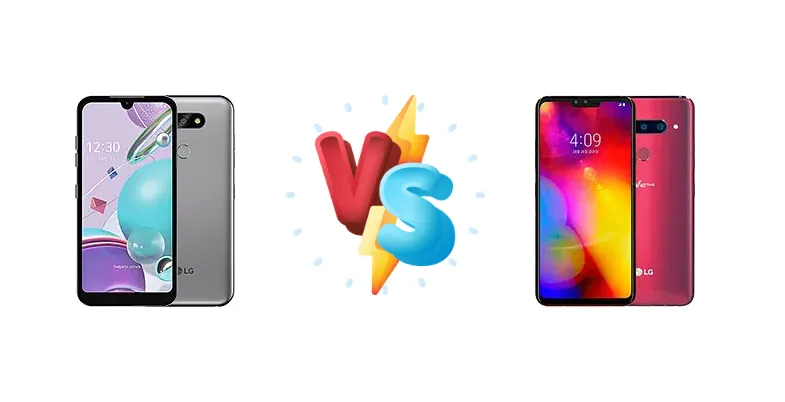
|
🏆 Quick Verdict
For the average user prioritizing smooth performance and a capable camera, the LG V40 ThinQ remains the superior choice despite its age. The Snapdragon 845 offers a significant performance leap over the K31’s Helio P22, making it better suited for demanding tasks and gaming. However, the K31 is a viable option for basic use cases.
| PHONES | ||
|---|---|---|
| Phone Names | LG K31 | LG V40 ThinQ |
| Network | ||
|---|---|---|
| 2G bands | GSM 850 / 900 / 1800 / 1900 | GSM 850 / 900 / 1800 / 1900 |
| 3G bands | HSDPA 850 / 900 / 1700(AWS) / 1900 / 2100 | HSDPA 850 / 900 / 1700(AWS) / 1900 / 2100 - V405QA7 |
| 4G bands | 2, 4, 5, 12, 13, 25, 26, 41, 66, 71 | 1, 2, 3, 4, 5, 7, 8, 12, 13, 14, 17, 20, 25, 26, 28, 29, 30, 38, 39, 40, 41, 46, 66, 71 - V405QA7 |
| Speed | HSPA, LTE | HSPA 42.2/5.76 Mbps, LTE (4CA) Cat16 1024/150 Mbps |
| Technology | GSM / CDMA / HSPA / LTE | GSM / CDMA / HSPA / EVDO / LTE |
| CDMA 800 / 1900 | CDMA2000 1xEV-DO - V405QA7 | |
| Launch | ||
|---|---|---|
| Announced | 2020, August 21. Released 2020, August 21 | 2018, October 03. Released 2018, October 16 |
| Status | Discontinued | Discontinued |
| Body | ||
|---|---|---|
| Build | - | Glass front (Gorilla Glass 5), glass back (Gorilla Glass 5), aluminum frame |
| Dimensions | 147.8 x 71.1 x 8.6 mm (5.82 x 2.80 x 0.34 in) | 158.8 x 75.7 x 7.6 mm (6.25 x 2.98 x 0.30 in) |
| SIM | Nano-SIM + Nano-SIM | · Nano-SIM· Nano-SIM + Nano-SIM |
| Weight | 146 g (5.15 oz) | 169 g (5.96 oz) |
| MIL-STD-810G compliant* *does not guarantee ruggedness or use in extreme conditions | IP68 dust/water resistant (up to 1.5m for 30 min) MIL-STD-810G compliant* *does not guarantee ruggedness or use in extreme conditions | |
| Display | ||
|---|---|---|
| Protection | - | Corning Gorilla Glass 5 |
| Resolution | 720 x 1520 pixels, 19:9 ratio (~295 ppi density) | 1440 x 3120 pixels, 19.5:9 ratio (~537 ppi density) |
| Size | 5.7 inches, 81.1 cm2 (~77.2% screen-to-body ratio) | 6.4 inches, 100.5 cm2 (~83.6% screen-to-body ratio) |
| Type | IPS LCD | P-OLED, HDR10 |
| - | Always-on display | |
| Platform | ||
|---|---|---|
| CPU | Octa-core 2.0 GHz Cortex-A53 | Octa-core (4x2.8 GHz Kryo 385 Gold & 4x1.7 GHz Kryo 385 Silver) |
| Chipset | Mediatek MT6762 Helio P22 (12 nm) | Qualcomm SDM845 Snapdragon 845 (10 nm) |
| GPU | PowerVR GE8320 | Adreno 630 |
| OS | Android 10, LG UX 9.1 | Android 8.1 (Oreo), upgradable to Android 10 |
| Memory | ||
|---|---|---|
| Card slot | microSDXC | microSDXC (uses shared SIM slot) |
| Internal | 32GB 2GB RAM | 64GB 6GB RAM, 128GB 6GB RAM |
| eMMC 5.1 | UFS 2.1 | |
| Main Camera | ||
|---|---|---|
| Dual | 13 MP, f/1.8, 27mm (wide), 1/3.1", 1.12µm, PDAF 5 MP, f/2.2, 120˚ (ultrawide), 1/5.0", 1.12µm | - |
| Features | LED flash, panorama, HDR | LED flash, HDR, panorama |
| Triple | - | 12 MP, 27mm (standard), f/1.5, 1/2.55", 1.4µm, dual pixel PDAF, 3-axis OIS 12 MP, 52mm (telephoto), f/2.4, 1.0µm, 2x optical zoom, PDAF, OIS 16 MP, 16mm (ultrawide), f/1.9, 1/3.1", 1.0µm, no AF |
| Video | 1080p@30fps | 4K@30/60fps, 1080p@30/60/240fps, 24-bit/192kHz stereo sound rec., HDR video, gyro-EIS |
| Selfie camera | ||
|---|---|---|
| Dual | - | 8 MP, f/1.9, 26mm (standard), 1/3.2", 1.4µm 5 MP, 21mm (wide), f/2.2, 1.4µm |
| Features | - | HDR |
| Single | 5 MP, f/2.2, 24mm (wide), 1/5.0", 1.12µm | - |
| Video | 1080p@30fps | 1080p@30fps |
| Sound | ||
|---|---|---|
| 3.5mm jack | Yes | Yes |
| 35mm jack | Yes | Yes |
| Loudspeaker | Yes | Yes |
| - | 32-bit/192kHz audio 24-bit/48kHz audio recording Tuned with Meridian Audio | |
| Comms | ||
|---|---|---|
| Bluetooth | 5.0, A2DP, LE | 5.0, A2DP, LE, aptX HD |
| NFC | No | Yes |
| Positioning | GPS | GPS, GLONASS, GALILEO |
| Radio | No | FM radio (market/region dependent) |
| USB | microUSB 2.0 | USB Type-C 2.0 |
| WLAN | Wi-Fi 802.11 b/g/n, Wi-Fi Direct | Wi-Fi 802.11 a/b/g/n/ac, dual-band, Wi-Fi Direct, DLNA |
| Features | ||
|---|---|---|
| Sensors | Fingerprint (rear-mounted), accelerometer | Fingerprint (rear-mounted), accelerometer, gyro, proximity, compass, barometer |
| Battery | ||
|---|---|---|
| Charging | - | 18W wired, PD2.0, QC3, 50% in 36 min 10W wireless (Qi) |
| Type | Li-Ion 3000 mAh | Li-Po 3300 mAh, non-removable |
| Misc | ||
|---|---|---|
| Colors | Gray | New Platinum Gray, Carmine Red, New Aurora Black, New Moroccan Blue |
| Models | LM-K300Q, LMK300, LGL355DL | V405, LM-V405, LM-V409N |
| Price | About 130 EUR | About 330 EUR |
| Tests | ||
|---|---|---|
| Audio quality | - | Noise -93.3dB / Crosstalk -94.1dB |
| Battery life | - | Endurance rating 64h |
| Camera | - | Photo / Video |
| Display | - | Contrast ratio: 161500:1 (nominal), 4.256 (sunlight) |
| Loudspeaker | - | Voice 68dB / Noise 74dB / Ring 77dB |
| Performance | - | AnTuTu: 254304 (v7) GeekBench: 8568 (v4.4) GFXBench: 16fps (ES 3.1 onscreen) |
LG K31
- Significantly more affordable
- Acceptable battery life for basic use
- Functional for essential smartphone tasks
- Weak processor struggles with demanding apps
- Camera quality is likely limited
- Slower charging speeds (assumed)
LG V40 ThinQ
- Powerful Snapdragon 845 processor
- Faster charging with wired and wireless options
- Likely superior camera system
- Older device, potentially limited software updates
- Higher price point
- Battery has degraded over time (if used)
Display Comparison
Both the LG K31 and V40 ThinQ share a contrast ratio of 161500:1 (nominal) and 4.256 (sunlight), suggesting similar display quality in terms of contrast. However, the V40’s original flagship status likely translates to better color accuracy and potentially higher peak brightness, though specific nit values for the K31 are unavailable. The V40’s panel technology, while not specified, would have been more advanced at its launch, offering a more premium viewing experience. The K31’s display is likely a standard IPS LCD, adequate for everyday use but lacking the vibrancy of potentially OLED or higher-end IPS panels found in the V40.
Camera Comparison
While both phones feature photo/video capabilities, the V40 ThinQ’s camera system was a key selling point at its release. Although specific sensor details are missing, the V40 likely boasts a larger main sensor and more sophisticated image processing algorithms than the K31. The K31’s camera is likely geared towards basic photography, while the V40 would have offered features like optical image stabilization (OIS) and a wider range of shooting modes. The presence of a 2MP macro camera on the K31 is unlikely to provide significant benefit due to its low resolution and limited sensor size.
Performance
The performance gap between these devices is substantial. The LG V40 ThinQ’s Qualcomm Snapdragon 845 (10nm) features an octa-core CPU with Kryo 385 Gold (2.8 GHz) and Silver (1.7 GHz) cores, designed for both performance and efficiency. This contrasts sharply with the LG K31’s MediaTek Helio P22 (12nm) and its octa-core 2.0 GHz Cortex-A53 CPU. The Snapdragon 845’s smaller 10nm process node allows for greater transistor density and improved thermal efficiency, resulting in sustained performance under load. The V40 will handle multitasking, demanding apps, and gaming with significantly more ease than the K31, which will struggle with resource-intensive tasks.
Battery Life
Both devices share an endurance rating of 64 hours, suggesting comparable battery life under similar usage conditions. However, the V40 ThinQ offers significantly faster charging capabilities with 18W wired charging (PD2.0, QC3) reaching 50% in 36 minutes, and 10W wireless charging (Qi). The K31’s charging speed is not specified, but is likely considerably slower. The V40’s faster charging is a significant convenience factor, allowing for quicker top-ups when needed, despite both phones having similar overall endurance.
Buying Guide
Buy the LG K31 if you need a functional smartphone for essential tasks like calls, texts, and light social media browsing, and your budget is extremely limited. Buy the LG V40 ThinQ if you prioritize a smoother user experience, better camera capabilities, and the ability to handle more demanding applications and games, and are willing to spend a bit more for a more refined experience.