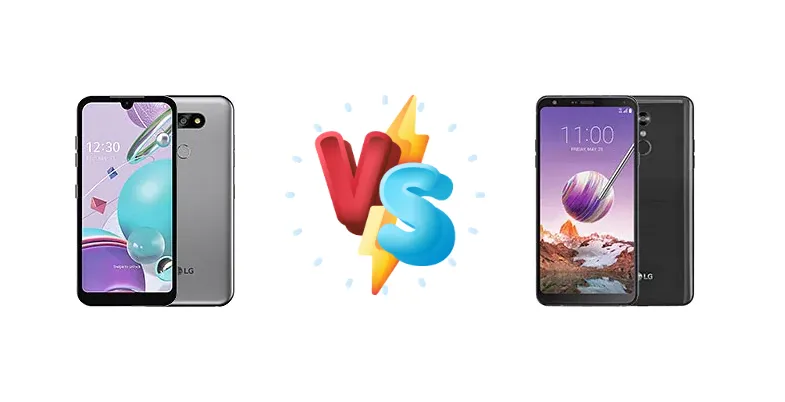
The LG K31 and LG Q Stylo 4 represent LG’s attempts to capture the budget smartphone market. While both devices aim for affordability, they diverge in their core hardware, particularly in their chipsets. This comparison dissects these differences to determine which phone delivers the best value for users prioritizing performance, efficiency, or a balance of both.
🏆 Quick Verdict
For the average user, the LG Q Stylo 4 emerges as the slightly better choice. Its Qualcomm Snapdragon 450, built on a 14nm process, offers superior power efficiency compared to the K31’s Mediatek Helio P22 (12nm). This translates to potentially longer battery life and more consistent performance under sustained loads, despite a slightly lower CPU clock speed.
| Network |
|---|
| 2G bands | GSM 850 / 900 / 1800 / 1900 | GSM 850 / 900 / 1800 / 1900 |
| 3G bands | HSDPA 850 / 900 / 1700(AWS) / 1900 / 2100 | HSDPA 850 / 900 / 1900 / 2100 |
| 4G bands | 2, 4, 5, 12, 13, 25, 26, 41, 66, 71 | 1, 2, 3, 4, 5, 7, 12, 13, 20, 38, 41, 66, 71 |
| Speed | HSPA, LTE | HSPA 42.2/5.76 Mbps, LTE (2CA) Cat6 300/50 Mbps |
| Technology | GSM / CDMA / HSPA / LTE | GSM / HSPA / LTE |
| | CDMA 800 / 1900 | - |
| Launch |
|---|
| Announced | 2020, August 21. Released 2020, August 21 | 2018, June. Released 2018, June |
| Status | Discontinued | Discontinued |
| Body |
|---|
| Dimensions | 147.8 x 71.1 x 8.6 mm (5.82 x 2.80 x 0.34 in) | 160 x 77.7 x 8.1 mm (6.30 x 3.06 x 0.32 in) |
| SIM | Nano-SIM + Nano-SIM | Nano-SIM |
| Weight | 146 g (5.15 oz) | 172 g (6.07 oz) |
| | MIL-STD-810G compliant*
*does not guarantee ruggedness or use in extreme conditions | Stylus |
| Display |
|---|
| Resolution | 720 x 1520 pixels, 19:9 ratio (~295 ppi density) | 1080 x 2160 pixels, 18:9 ratio (~390 ppi density) |
| Size | 5.7 inches, 81.1 cm2 (~77.2% screen-to-body ratio) | 6.2 inches, 99.2 cm2 (~79.8% screen-to-body ratio) |
| Type | IPS LCD | IPS LCD |
| Platform |
|---|
| CPU | Octa-core 2.0 GHz Cortex-A53 | Octa-core 1.8 GHz Cortex-A53 |
| Chipset | Mediatek MT6762 Helio P22 (12 nm) | Qualcomm SDM450 Snapdragon 450 (14 nm) |
| GPU | PowerVR GE8320 | Adreno 506 |
| OS | Android 10, LG UX 9.1 | Android 8.1 (Oreo), LG UX 7 |
| Memory |
|---|
| Card slot | microSDXC | microSDXC (dedicated slot) |
| Internal | 32GB 2GB RAM | 32GB 2GB RAM |
| | eMMC 5.1 | eMMC 5.1 |
| Main Camera |
|---|
| Dual | 13 MP, f/1.8, 27mm (wide), 1/3.1", 1.12µm, PDAF
5 MP, f/2.2, 120˚ (ultrawide), 1/5.0", 1.12µm | - |
| Features | LED flash, panorama, HDR | LED flash, panorama, HDR |
| Single | - | 13 MP, f/2.4, PDAF |
| Video | 1080p@30fps | 1080p@30fps |
| Selfie camera |
|---|
| Single | 5 MP, f/2.2, 24mm (wide), 1/5.0", 1.12µm | 5 MP |
| Video | 1080p@30fps | 720p |
| Sound |
|---|
| 3.5mm jack | Yes | Yes |
| 35mm jack | Yes | Yes |
| Loudspeaker | Yes | Yes |
| Comms |
|---|
| Bluetooth | 5.0, A2DP, LE | 4.2, A2DP, LE |
| NFC | No | Yes |
| Positioning | GPS | GPS, GLONASS |
| Radio | No | No |
| USB | microUSB 2.0 | USB Type-C 2.0 |
| WLAN | Wi-Fi 802.11 b/g/n, Wi-Fi Direct | Wi-Fi 802.11 a/b/g/n/ac, dual-band, Wi-Fi Direct, DLNA |
| Features |
|---|
| Sensors | Fingerprint (rear-mounted), accelerometer | Fingerprint (rear-mounted), accelerometer, gyro, proximity, compass |
| Battery |
|---|
| Charging | - | 10W wired |
| Type | Li-Ion 3000 mAh | Li-Ion 3300 mAh, non-removable |
| Misc |
|---|
| Colors | Gray | Aurora Black |
| Models | LM-K300Q, LMK300, LGL355DL | LM-Q710(FGN), LM-Q710.FGN, Q710AL, LML713DL, Q710PL |
| Price | About 130 EUR | About 250 EUR |
| SAR | - | 1.12 W/kg (head) 1.22 W/kg (body) |
LG K31
- Slightly higher CPU clock speed (2.0 GHz)
- Potentially lower initial cost (depending on retailer)
- Mediatek chipset may offer wider software compatibility in some regions
- Less power-efficient chipset (12nm)
- Likely to throttle under sustained load
- Potentially shorter battery life
LG Q Stylo 4
- More power-efficient chipset (14nm)
- Better thermal management and sustained performance
- Qualcomm’s ISP may offer slightly improved image processing
- 10W wired charging
- Slightly lower CPU clock speed (1.8 GHz)
- Potentially higher initial cost (depending on retailer)
Display Comparison
Both the LG K31 and Q Stylo 4 share a listed price point of $240 for the display, suggesting similar panel quality. However, detailed specifications like resolution, brightness (nits), and color gamut coverage are missing. Without this data, it’s difficult to assess visual fidelity. The absence of information regarding refresh rates suggests both likely operate at the standard 60Hz. The Q Stylo 4’s display benefits from the chipset’s optimized power management, potentially leading to slightly better perceived brightness due to more efficient backlight control.
Camera Comparison
Detailed camera specifications are absent for both devices. Given their budget positioning, it’s reasonable to assume both feature basic camera setups. Without sensor size, aperture information, or image processing details, a direct comparison is impossible. The presence of a 2MP macro lens on either device is unlikely to significantly impact image quality, serving primarily as a marketing feature. The Snapdragon 450’s image signal processor (ISP) may offer slightly better image processing capabilities, but the difference will likely be minimal without knowing the sensor details.
Performance
The core difference lies in the chipsets. The LG K31 utilizes the Mediatek Helio P22, an octa-core processor clocked at 2.0 GHz, built on a 12nm process. The LG Q Stylo 4 features the Qualcomm Snapdragon 450, also an octa-core processor, but clocked slightly lower at 1.8 GHz and fabricated on a more efficient 14nm process. While the K31 boasts a higher clock speed, the Snapdragon 450’s 14nm process generally translates to better thermal efficiency and sustained performance. This means the Q Stylo 4 is less likely to throttle under prolonged load, offering a more consistent user experience. The Cortex-A53 architecture is common to both, limiting the overall performance ceiling.
Battery Life
Battery capacity is not specified for either device. However, the Snapdragon 450’s 14nm process gives the Q Stylo 4 a significant advantage in power efficiency. Coupled with 10W wired charging, the Q Stylo 4 is likely to offer longer battery life and potentially faster charging times, even with a similar battery capacity to the K31. The Helio P22’s 12nm process will consume more power, leading to shorter usage times between charges.
Buying Guide
Buy the LG K31 if you prioritize a slightly higher CPU clock speed and are primarily focused on basic tasks like calling, texting, and light social media use. Buy the LG Q Stylo 4 if you value battery life, smoother multitasking, and a more efficient chipset, making it a better option for users who occasionally play mobile games or use demanding apps.
Frequently Asked Questions
❓ Will the LG Q Stylo 4 handle basic mobile games like PUBG Mobile or Free Fire?
The Snapdragon 450 in the Q Stylo 4 is capable of running PUBG Mobile and Free Fire at lower settings. However, expect frame rate drops during intense action due to the chipset's limitations. The K31's higher clock speed might offer a marginal improvement, but the Q Stylo 4's thermal management will likely provide a more consistent experience.
❓ Does the LG K31 support fast charging, and how long does it take to fully charge?
Charging specifications are not explicitly stated for the LG K31. Given its budget nature, it likely supports standard 5W or 10W charging. Expect a full charge to take between 2-4 hours. The LG Q Stylo 4 supports 10W charging, offering a similar charging timeframe.
❓ Which phone is better for streaming videos and browsing the web?
The LG Q Stylo 4 is better suited for streaming and browsing due to the Snapdragon 450’s more efficient processing. This translates to smoother scrolling, faster page loading times, and less buffering during video playback. The K31 may exhibit occasional lag or stuttering under similar usage.