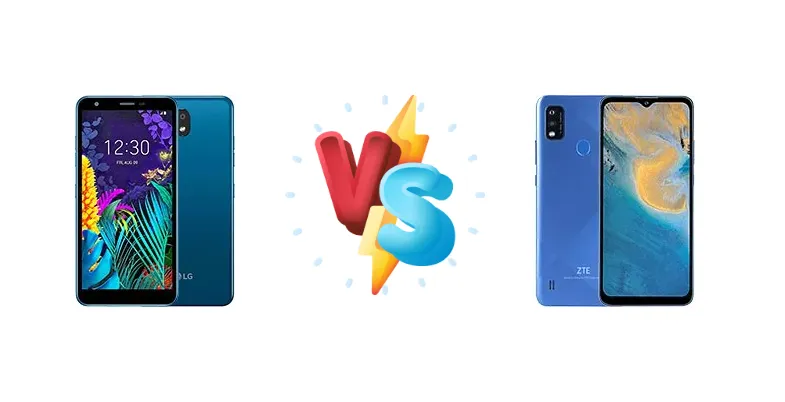
The LG K30 (2019) and ZTE Blade A51 represent the lower end of the smartphone market, often sought by first-time smartphone buyers or those needing a reliable secondary device. Both phones aim for affordability, but they take different approaches to achieving it, primarily through their chipset choices. This comparison dissects the key differences between the Qualcomm Snapdragon 425 and the Unisoc SC9863A to determine which phone offers the best value.
🏆 Quick Verdict
For the average user prioritizing multitasking and smoother app navigation, the ZTE Blade A51 emerges as the better choice. Its octa-core Unisoc SC9863A, despite sharing a 28nm process with the K30’s Snapdragon 425, offers a significant performance advantage due to its core count and newer Cortex-A55 architecture. However, the K30 may appeal to those seeking a simpler, potentially more stable software experience.
| Network |
|---|
| 2G bands | GSM 850 / 900 / 1800 / 1900 | GSM 850 / 900 / 1800 / 1900 |
| 3G bands | HSDPA 850 / 900 / 1900 / 2100 | HSDPA 850 / 900 / 1900 / 2100 |
| 4G bands | 1, 3, 7, 8, 20, 38 | 1, 3, 5, 7, 8, 20, 28, 38, 40, 41 |
| Speed | HSPA 42.2/5.76 Mbps, LTE Cat4 150/50 Mbps | HSPA, LTE |
| Technology | GSM / HSPA / LTE | GSM / HSPA / LTE |
| Launch |
|---|
| Announced | 2019, August. Released 2019, September | 2021, May 08 |
| Status | Discontinued | Available. Released 2021, May 08 |
| Body |
|---|
| Build | Glass front, plastic back, plastic frame | - |
| Dimensions | 146.9 x 71.5 x 8.5 mm (5.78 x 2.81 x 0.33 in) | 166.5 x 75.6 x 8.5 mm (6.56 x 2.98 x 0.33 in) |
| SIM | · Nano-SIM· Nano-SIM + Nano-SIM | Nano-SIM + Nano-SIM |
| Weight | 148 g (5.22 oz) | 173.7 g (6.14 oz) |
| | MIL-STD-810G compliant*
*does not guarantee ruggedness or use in extreme conditions | - |
| Display |
|---|
| Resolution | 720 x 1440 pixels, 18:9 ratio (~295 ppi density) | 720 x 1600 pixels, 20:9 ratio (~269 ppi density) |
| Size | 5.45 inches, 76.7 cm2 (~73.0% screen-to-body ratio) | 6.52 inches, 102.6 cm2 (~81.5% screen-to-body ratio) |
| Type | IPS LCD | IPS LCD |
| Platform |
|---|
| CPU | Quad-core 1.4 GHz Cortex-A53 | Octa-core (4x1.6 GHz Cortex-A55 & 4x1.2 GHz Cortex-A55) |
| Chipset | Qualcomm MSM8917 Snapdragon 425 (28 nm) | Unisoc SC9863A (28 nm) |
| GPU | Adreno 308 | IMG8322 |
| OS | Android 9.0 (Pie) | Android 11 (Go edition) |
| Memory |
|---|
| Card slot | microSDHC (uses shared SIM slot) | microSDXC |
| Internal | 16GB 2GB RAM | 32GB 2GB RAM, 64GB 2GB RAM |
| | eMMC 5.1 | eMMC 5.1 |
| Main Camera |
|---|
| Dual | - | 13 MP, AF
2 MP |
| Features | LED flash, panorama, HDR | LED flash, HDR |
| Single | 8 MP, f/2.0, 27mm (wide), 1/4.0", 1.12µm, AF | - |
| Video | 1080p@30fps | 1080p@30fps |
| Selfie camera |
|---|
| Features | LED flash | - |
| Single | 5 MP, f/2.2, 24mm (wide), 1/5.0", 1.12µm | 5 MP |
| Sound |
|---|
| 3.5mm jack | Yes | Yes |
| 35mm jack | Yes | Yes |
| Loudspeaker | Yes | Yes |
| Comms |
|---|
| Bluetooth | 5.0, A2DP, LE | 4.2, A2DP, LE |
| NFC | Yes (market/region dependent) | Yes |
| Positioning | GPS | GPS, GLONASS |
| Radio | No | FM radio |
| USB | microUSB 2.0 | USB Type-C 2.0, OTG |
| WLAN | Wi-Fi 802.11 b/g/n | Wi-Fi 802.11 b/g/n |
| Features |
|---|
| Sensors | Accelerometer, proximity | Fingerprint (rear-mounted), accelerometer, proximity |
| Battery |
|---|
| Talk time | Up to 10 h (3G) | - |
| Type | Li-Ion 3000 mAh, non-removable | Li-Ion 3200 mAh |
| Misc |
|---|
| Colors | New Aurora Black, New Moroccan Blue | Blue, Gray |
| Models | LM-X320EMW, LMX320EMW, LMX320ZMW, LM-X320ZMW | - |
| Price | About 140 EUR | - |
LG K30 (2019)
- Potentially more stable software experience (LG's software history)
- Simpler user interface for basic users
- May be available at a slightly lower price point
- Significantly weaker performance compared to the ZTE Blade A51
- Quad-core processor struggles with multitasking
- Older Cortex-A53 architecture
ZTE Blade A51
- Octa-core processor provides superior performance
- More efficient Cortex-A55 architecture
- Smoother multitasking and app navigation
- Unisoc processors sometimes have less software support
- Potential for more bloatware
- May be slightly more expensive than the LG K30
Display Comparison
Neither the LG K30 nor the ZTE Blade A51 are known for exceptional displays. Specific display specs (resolution, brightness) are not provided, but given their market segment, both likely feature 720p LCD panels. The focus here is on performance, not visual fidelity. The absence of details prevents a direct comparison of color accuracy or viewing angles, but it’s safe to assume both displays are adequate for basic usage.
Camera Comparison
Camera details are limited, but both phones likely feature basic camera setups geared towards casual photography. Without sensor size or aperture information, a detailed comparison is difficult. It’s reasonable to assume both phones include a primary camera and potentially a secondary depth sensor. The ZTE Blade A51’s processor may offer slightly better image processing capabilities due to its more powerful CPU, potentially resulting in marginally improved image quality, but this is speculative. The presence of a 2MP macro camera on either device is unlikely to significantly impact the overall camera experience.
Performance
The core difference lies in the chipsets. The LG K30 utilizes the Qualcomm MSM8917 Snapdragon 425, a quad-core processor based on the Cortex-A53 architecture. The ZTE Blade A51, however, features the Unisoc SC9863A, an octa-core processor with four Cortex-A55 cores clocked at 1.6 GHz and another four at 1.2 GHz. While both are fabricated on a 28nm process, the A55 architecture is more efficient and offers improved performance per clock cycle compared to the older A53. This translates to faster app loading times and smoother multitasking on the Blade A51. The octa-core configuration further enhances its ability to handle multiple processes concurrently. The K30 will likely struggle with more than a few apps open at once.
Battery Life
Battery capacity details are unavailable for both devices. However, given their similar chipsets and display technologies, battery life is likely comparable. The 28nm process node used by both chipsets isn’t particularly power-efficient, so neither phone is expected to deliver exceptional battery endurance. Charging wattage is also unknown, meaning we can’t assess how quickly either phone can be recharged. Real-world battery performance will heavily depend on usage patterns.
Buying Guide
Buy the LG K30 (2019) if you need a basic smartphone for calls, texts, and light social media use, and prioritize potential software stability over raw performance. Buy the ZTE Blade A51 if you prefer a phone capable of handling more demanding tasks like multiple apps running simultaneously, or if you occasionally play less intensive mobile games. The A51’s octa-core processor provides a noticeable boost in responsiveness.
Frequently Asked Questions
❓ Will the ZTE Blade A51 handle popular games like PUBG Mobile?
While the ZTE Blade A51 won't deliver a high-end gaming experience, its octa-core processor should allow for playable frame rates in PUBG Mobile at lower graphics settings. Expect some stuttering and frame drops during intense action. The LG K30's Snapdragon 425 will likely struggle significantly with this title.
❓ Is the Unisoc SC9863A processor reliable? Are there concerns about software updates?
Unisoc processors have historically faced concerns regarding software updates and long-term support compared to Qualcomm. However, ZTE has been improving its software update track record. It's crucial to check ZTE's official website or forums for the latest software update information for the Blade A51 before purchasing. The LG K30 may receive fewer updates overall, but potentially more consistent ones.
❓ Which phone is better for streaming videos on YouTube or Netflix?
Both phones will be capable of streaming videos, but the ZTE Blade A51’s more powerful processor will provide a smoother experience, especially when multitasking or browsing while streaming. The LG K30 may exhibit some lag or buffering, particularly with higher-resolution content.