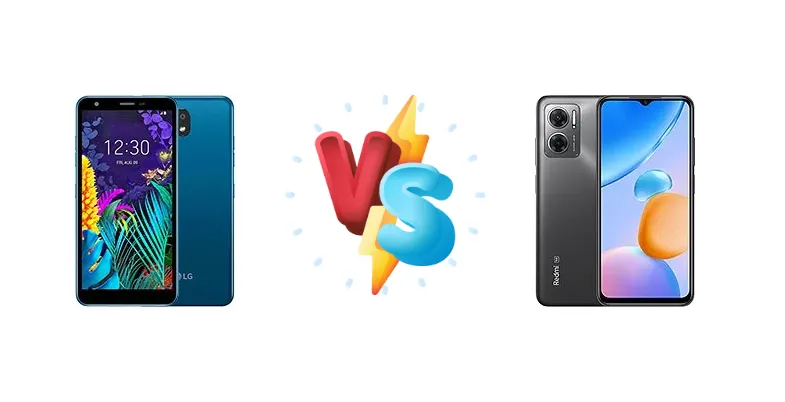
The budget smartphone market is fiercely competitive, offering incredible value for money. Today, we're pitting two contenders against each other: the LG K30 (2019), a reliable older model, and the Xiaomi Redmi 10 5G, a more modern 5G-enabled device. Let's see which one comes out on top.
🏆 Quick Verdict
The Xiaomi Redmi 10 5G is the clear winner. Its significantly more powerful chipset, 5G connectivity, and improved camera capabilities outweigh the LG K30's affordability. While the K30 offers a familiar experience, the Redmi 10 5G provides a substantial upgrade for a reasonable price.
| Network |
|---|
| 2G bands | GSM 850 / 900 / 1800 / 1900 | GSM 850 / 900 / 1800 / 1900 |
| 3G bands | HSDPA 850 / 900 / 1900 / 2100 | HSDPA 850 / 900 / 1700(AWS) / 1900 / 2100 |
| 4G bands | 1, 3, 7, 8, 20, 38 | 1, 2, 3, 4, 5, 7, 8, 20, 28, 38, 40, 41 |
| 5G bands | - | 1, 3, 5, 7, 8, 20, 28, 38, 40, 41, 77, 78 SA/NSA |
| Speed | HSPA 42.2/5.76 Mbps, LTE Cat4 150/50 Mbps | HSPA, LTE, 5G |
| Technology | GSM / HSPA / LTE | GSM / HSPA / LTE / 5G |
| Launch |
|---|
| Announced | 2019, August. Released 2019, September | 2022, March 29 |
| Status | Discontinued | Available. Released 2022, September 23 |
| Body |
|---|
| Build | Glass front, plastic back, plastic frame | - |
| Dimensions | 146.9 x 71.5 x 8.5 mm (5.78 x 2.81 x 0.33 in) | 164 x 76.1 x 8.9 mm (6.46 x 3.00 x 0.35 in) |
| SIM | · Nano-SIM· Nano-SIM + Nano-SIM | Nano-SIM + Nano-SIM |
| Weight | 148 g (5.22 oz) | 200 g (7.05 oz) |
| | MIL-STD-810G compliant*
*does not guarantee ruggedness or use in extreme conditions | - |
| Display |
|---|
| Protection | - | Corning Gorilla Glass 3 |
| Resolution | 720 x 1440 pixels, 18:9 ratio (~295 ppi density) | 1080 x 2408 pixels, 20:9 ratio (~401 ppi density) |
| Size | 5.45 inches, 76.7 cm2 (~73.0% screen-to-body ratio) | 6.58 inches, 104.3 cm2 (~83.6% screen-to-body ratio) |
| Type | IPS LCD | IPS LCD, 90Hz |
| Platform |
|---|
| CPU | Quad-core 1.4 GHz Cortex-A53 | Octa-core (2x2.2 GHz Cortex-A76 & 6x2.0 GHz Cortex-A55) |
| Chipset | Qualcomm MSM8917 Snapdragon 425 (28 nm) | Mediatek Dimensity 700 (7 nm) |
| GPU | Adreno 308 | Mali-G57 MC2 |
| OS | Android 9.0 (Pie) | Android 12, MIUI 13 |
| Memory |
|---|
| Card slot | microSDHC (uses shared SIM slot) | microSDXC (dedicated slot) |
| Internal | 16GB 2GB RAM | 64GB 4GB RAM, 128GB 4GB RAM, 128GB 6GB RAM |
| | eMMC 5.1 | UFS 2.2 |
| Main Camera |
|---|
| Dual | - | 50 MP, f/1.8, (wide), PDAF
Auxiliary lens |
| Features | LED flash, panorama, HDR | LED flash, HDR, panorama |
| Single | 8 MP, f/2.0, 27mm (wide), 1/4.0", 1.12µm, AF | 5 MP, f/2.2 |
| Video | 1080p@30fps | 1080p@30fps |
| Selfie camera |
|---|
| Features | LED flash | HDR |
| Single | 5 MP, f/2.2, 24mm (wide), 1/5.0", 1.12µm | 5 MP, f/2.2 |
| Video | - | 1080p@30fps |
| Sound |
|---|
| 3.5mm jack | Yes | Yes |
| 35mm jack | Yes | Yes |
| Loudspeaker | Yes | Yes |
| | - | 24-bit/192kHz audio |
| Comms |
|---|
| Bluetooth | 5.0, A2DP, LE | 5.1, A2DP, LE |
| Infrared port | - | Yes |
| NFC | Yes (market/region dependent) | Yes (market/region dependent) |
| Positioning | GPS | GPS, GLONASS, BDS, GALILEO |
| Radio | No | FM radio |
| USB | microUSB 2.0 | USB Type-C 2.0, OTG |
| WLAN | Wi-Fi 802.11 b/g/n | Wi-Fi 802.11 a/b/g/n/ac, dual-band, Wi-Fi Direct |
| Features |
|---|
| Sensors | Accelerometer, proximity | Fingerprint (side-mounted), accelerometer, proximity, compass |
| Battery |
|---|
| Charging | - | 18W wired |
| Talk time | Up to 10 h (3G) | - |
| Type | Li-Ion 3000 mAh, non-removable | Li-Po 5000 mAh |
| Misc |
|---|
| Colors | New Aurora Black, New Moroccan Blue | Graphite Gray, Chrome Silver, Aurora Green |
| Models | LM-X320EMW, LMX320EMW, LMX320ZMW, LM-X320ZMW | 22041219G, 22041219NY |
| Price | About 140 EUR | About 100 EUR |
| SAR | - | 1.09 W/kg (head) 1.09 W/kg (body) |
| SAR EU | - | 0.60 W/kg (head) 0.99 W/kg (body) |
LG K30 (2019)
- Affordable
- Simple and easy to use
- Decent battery life
- Outdated chipset
- Slow performance
- Basic camera
- No 5G
Xiaomi Redmi 10 5G
- Fast performance (Dimensity 700)
- 5G connectivity
- Improved camera
- Modern design
- 18W fast charging
- Software can be a bit cluttered
- May lack some premium features
Display Comparison
The Redmi 10 5G boasts a larger 6.59-inch display compared to the K30's 6.5-inch screen. While both offer HD+ resolution, the Redmi 10 5G's newer panel likely provides better color accuracy and brightness. The K30's display is adequate but lacks the vibrancy of the Redmi 10 5G.
Camera Comparison
The Redmi 10 5G generally offers a superior camera experience. While specific megapixel counts may be similar, the newer sensor and image processing algorithms on the Redmi 10 5G result in better image quality, especially in low light. The K30's camera is functional but lacks detail and dynamic range.
Performance
This is where the Redmi 10 5G truly shines. The Dimensity 700 chipset is significantly faster than the Snapdragon 425. Expect smoother multitasking, faster app loading times, and better gaming performance on the Redmi 10 5G. The K30 can handle basic tasks, but struggles with demanding applications.
Battery Life
Both phones offer decent battery life, typically lasting a full day with moderate use. The Redmi 10 5G's more efficient chipset and 18W fast charging give it a slight edge in overall battery performance and charging speed.
Buying Guide
Who should buy the LG K30 (2019)? Users seeking a basic, affordable phone for calls, texts, and light browsing, and who don't need 5G. Who should buy the Xiaomi Redmi 10 5G? Anyone wanting a faster phone with 5G connectivity, a better camera, and a more modern Android experience, all while staying within a budget.
Frequently Asked Questions
❓ Is the LG K30 (2019) still worth buying?
Only if you're on a very tight budget and only need basic smartphone functionality. Otherwise, the Redmi 10 5G offers significantly better value.
❓ Does the Redmi 10 5G support 5G in all regions?
5G support depends on your carrier and region. Check compatibility before purchasing.