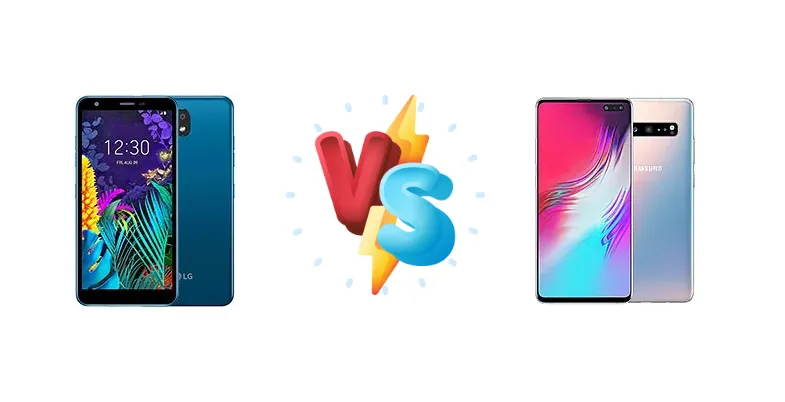
The LG K30 (2019) represents a segment of the market focused on affordability and essential functionality, while the Samsung Galaxy S10 5G was a flagship pushing the boundaries of connectivity and performance. Comparing these two isn't about finding a direct competitor, but understanding the trade-offs between a basic smartphone experience and a premium, future-proofed device. This comparison will dissect the core differences to help you determine which aligns with your needs.
🏆 Quick Verdict
For the average user prioritizing value, the LG K30 (2019) offers a functional smartphone experience at a significantly lower price. However, the Samsung Galaxy S10 5G is the clear winner for those demanding 5G connectivity, superior performance, and advanced features like wireless charging, justifying its higher cost.
| Network |
|---|
| 2G bands | GSM 850 / 900 / 1800 / 1900 | GSM 850 / 900 / 1800 / 1900 |
| 3G bands | HSDPA 850 / 900 / 1900 / 2100 | HSDPA 850 / 900 / 1900 / 2100 - USA |
| 4G bands | 1, 3, 7, 8, 20, 38 | 1, 2, 3, 4, 5, 7, 8, 12, 13, 17, 18, 19, 20, 25, 26, 28, 32, 38, 39, 40, 41, 66 - Global |
| 5G bands | - | 78 NSA/Sub6 |
| Speed | HSPA 42.2/5.76 Mbps, LTE Cat4 150/50 Mbps | HSPA 42.2/5.76 Mbps, LTE (7CA) Cat20 2000/150 Mbps, 5G (2+ Gbps DL) |
| Technology | GSM / HSPA / LTE | GSM / CDMA / HSPA / EVDO / LTE / 5G |
| | - | 1, 2, 3, 4, 5, 7, 8, 12, 13, 17, 20, 24, 25, 26, 28, 38, 39, 40, 41, 66 - China |
| Launch |
|---|
| Announced | 2019, August. Released 2019, September | 2019, February. Released 2019, April |
| Status | Discontinued | Discontinued |
| Body |
|---|
| Build | Glass front, plastic back, plastic frame | Glass front (Gorilla Glass 6), glass back (Gorilla Glass 6), aluminum frame |
| Dimensions | 146.9 x 71.5 x 8.5 mm (5.78 x 2.81 x 0.33 in) | 162.6 x 77.1 x 7.9 mm (6.40 x 3.04 x 0.31 in) |
| SIM | · Nano-SIM· Nano-SIM + Nano-SIM | · Nano-SIM· Nano-SIM + Nano-SIM |
| Weight | 148 g (5.22 oz) | 198 g (6.98 oz) |
| | MIL-STD-810G compliant*
*does not guarantee ruggedness or use in extreme conditions | IP68 dust/water resistant (up to 1.5m for 30 min) |
| Display |
|---|
| Protection | - | Corning Gorilla Glass 6 |
| Resolution | 720 x 1440 pixels, 18:9 ratio (~295 ppi density) | 1440 x 3040 pixels, 19:9 ratio (~502 ppi density) |
| Size | 5.45 inches, 76.7 cm2 (~73.0% screen-to-body ratio) | 6.7 inches, 112.0 cm2 (~89.4% screen-to-body ratio) |
| Type | IPS LCD | Dynamic AMOLED, HDR10+ |
| | - | Always-on display |
| Platform |
|---|
| CPU | Quad-core 1.4 GHz Cortex-A53 | Octa-core (2x2.73 GHz Mongoose M4 & 2x2.31 GHz Cortex-A75 & 4x1.95 GHz Cortex-A55) - GlobalOcta-core (1x2.84 GHz Kryo 485 & 3x2.42 GHz Kryo 485 & 4x1.78 GHz Kryo 485) - USA |
| Chipset | Qualcomm MSM8917 Snapdragon 425 (28 nm) | Exynos 9820 (8 nm) - GlobalQualcomm SM8150 Snapdragon 855 (7 nm) - USA |
| GPU | Adreno 308 | Mali-G76 MP12 - GlobalAdreno 640 - USA |
| OS | Android 9.0 (Pie) | Android 9.0 (Pie), upgradable to Android 12, One UI 4.1 |
| Memory |
|---|
| Card slot | microSDHC (uses shared SIM slot) | No |
| Internal | 16GB 2GB RAM | 128GB 8GB RAM, 256GB 8GB RAM, 512GB 8GB RAM |
| | eMMC 5.1 | UFS 2.1 |
| Main Camera |
|---|
| Features | LED flash, panorama, HDR | LED flash, auto-HDR, panorama |
| Single | 8 MP, f/2.0, 27mm (wide), 1/4.0", 1.12µm, AF | - |
| Triple | - | 12 MP, f/1.5-2.4, 26mm (wide), 1/2.55", 1.4µm, dual pixel PDAF, OIS
12 MP, f/2.4, 52mm (telephoto), 1/3.6", 1.0µm, AF, OIS, 2x optical zoom
16 MP, f/2.2, 12mm (ultrawide), 1/3.1", 1.0µm, Super Steady video
0.3 MP, TOF 3D, (depth) |
| Video | 1080p@30fps | 4K@60fps (no EIS), 4K@30fps, 1080p@30/60/240fps, 720p@960fps, HDR10+, stereo sound rec., gyro-EIS & OIS |
| Selfie camera |
|---|
| Features | LED flash | HDR |
| Single | 5 MP, f/2.2, 24mm (wide), 1/5.0", 1.12µm | 10 MP, f/1.9, 26mm (wide), 1/3", 1.22µm, dual pixel PDAF
TOF 3D, (depth sensor) |
| Video | - | 4K@30/60fps, 1080p@30fps |
| Sound |
|---|
| 3.5mm jack | Yes | Yes |
| 35mm jack | Yes | Yes |
| Loudspeaker | Yes | Yes, with stereo speakers |
| | - | 32-bit/384kHz audio
Tuned by AKG |
| Comms |
|---|
| Bluetooth | 5.0, A2DP, LE | 5.0, A2DP, LE, aptX |
| NFC | Yes (market/region dependent) | Yes |
| Positioning | GPS | GPS, GLONASS, BDS, GALILEO |
| Radio | No | FM radio (USA & Canada only) |
| USB | microUSB 2.0 | USB Type-C 3.1, OTG, DisplayPort |
| WLAN | Wi-Fi 802.11 b/g/n | Wi-Fi 802.11 a/b/g/n/ac/6, dual-band, Wi-Fi Direct |
| Features |
|---|
| Sensors | Accelerometer, proximity | Fingerprint (under display, ultrasonic), accelerometer, gyro, proximity, compass, barometer |
| | - | ANT+
Bixby natural language commands and dictation
Samsung DeX (desktop experience support)
Samsung Pay (Visa, MasterCard certified) |
| Battery |
|---|
| Charging | - | 25W wired, PD3.0
15W wireless (Qi)
4.5W reverse wireless |
| Talk time | Up to 10 h (3G) | - |
| Type | Li-Ion 3000 mAh, non-removable | Li-Ion 4500 mAh, non-removable |
| Misc |
|---|
| Colors | New Aurora Black, New Moroccan Blue | Crown Silver, Majestic Black, Royal Gold |
| Models | LM-X320EMW, LMX320EMW, LMX320ZMW, LM-X320ZMW | SM-G977U, SM-G977N, SM-G977B, SM-G9770, SM-G977P, SM-G977T |
| Price | About 140 EUR | About 380 EUR |
| SAR | - | 0.46 W/kg (head) 1.59 W/kg (body) |
| SAR EU | - | 0.26 W/kg (head) 1.55 W/kg (body) |
LG K30 (2019)
- Significantly lower price
- Simple and easy-to-use interface
- Functional for basic tasks
- Poor performance for demanding apps
- Limited camera capabilities
- No 5G connectivity
Samsung Galaxy S10 5G
- Fast 5G connectivity
- Powerful processor for gaming and multitasking
- Advanced camera system with OIS
- High price point
- Battery life can be impacted by 5G usage
- Larger and heavier than the LG K30
Display Comparison
While display specifications for the LG K30 are not provided, it's reasonable to assume a standard LCD panel. The Samsung Galaxy S10 5G, however, boasts a Dynamic AMOLED display, offering superior color accuracy and contrast. The S10 5G's panel technology, combined with its higher resolution, delivers a significantly more immersive viewing experience. The S10 5G also benefits from a higher peak brightness, making it more usable in direct sunlight.
Camera Comparison
Details on the LG K30's camera are limited, but budget phones often prioritize megapixel count over sensor size and image quality. The Samsung Galaxy S10 5G, while not boasting the highest megapixel counts of later flagships, features a more sophisticated camera system with larger sensors and optical image stabilization (OIS). The S10 5G's image processing capabilities, powered by its powerful chipset, result in better dynamic range, detail, and low-light performance. The inclusion of OIS is a significant advantage for capturing stable videos and sharper photos in challenging conditions.
Performance
The Qualcomm MSM8917 Snapdragon 425 in the LG K30, built on a 28nm process, is a low-end chipset designed for basic tasks. Its quad-core Cortex-A53 CPU is sufficient for simple apps but will struggle with multitasking or demanding games. In contrast, the Samsung Galaxy S10 5G utilizes either the Exynos 9820 (global) or Snapdragon 855 (USA), both fabricated on 8nm and 7nm processes respectively. These chipsets feature octa-core architectures with high-performance Cortex-A75 and Kryo 485 cores, delivering significantly faster processing speeds and smoother performance. The S10 5G's superior chipset and likely faster LPDDR4X RAM translate to a far more responsive and capable user experience.
Battery Life
Battery capacity for the LG K30 is not specified, but given its budget nature, it's likely a smaller capacity. The Samsung Galaxy S10 5G features a 4500 mAh battery and supports 25W wired charging with Power Delivery 3.0, allowing for a relatively quick 0-100% charge. It also includes 15W wireless charging and 4.5W reverse wireless charging, features absent on the LG K30. While the S10 5G's 5G connectivity can impact battery life, the faster charging speeds and wireless charging options provide greater convenience and flexibility.
Buying Guide
Buy the LG K30 (2019) if you need a reliable, basic smartphone for calls, texts, and light app usage, and your budget is a primary concern. Buy the Samsung Galaxy S10 5G if you prioritize 5G speeds, a powerful processor for demanding tasks like gaming and video editing, and features like wireless charging and a more advanced camera system.
Frequently Asked Questions
❓ Does the Exynos 9820 in the Galaxy S10 5G suffer from overheating issues during prolonged gaming?
While the Exynos 9820 was known to run warmer than the Snapdragon 855, the Galaxy S10 5G's vapor chamber cooling system effectively mitigates overheating during typical gaming sessions. Some throttling may occur during extremely demanding games played for extended periods, but it's generally well-managed.
❓ Is the 5G connectivity on the Galaxy S10 5G worth the extra cost if 5G coverage is limited in my area?
If 5G coverage is sparse, the immediate benefit of the S10 5G's 5G capabilities is limited. However, purchasing a 5G phone future-proofs your device for when 5G infrastructure expands. The S10 5G also offers excellent 4G LTE performance, making it a capable device even without 5G access.
❓ How does the Snapdragon 425 in the LG K30 handle common social media apps like Facebook and Instagram?
The Snapdragon 425 can handle basic social media apps like Facebook and Instagram without significant issues. However, expect slower loading times and occasional lag when scrolling through image-heavy feeds or using features like Stories. Multitasking between social media apps and other applications will likely result in noticeable performance slowdowns.