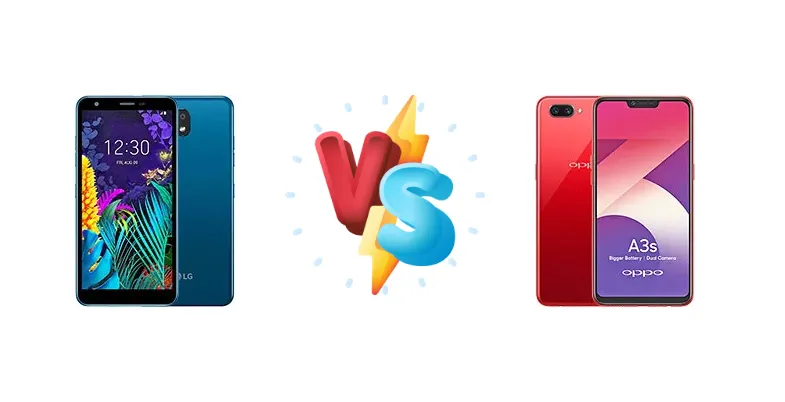
The LG K30 (2019) and Oppo A3s represent a segment of the market focused on affordability. Both devices aim to deliver a functional smartphone experience without breaking the bank, but they achieve this with different approaches to processing power and charging capabilities. This comparison dissects the core differences between the Qualcomm Snapdragon 425 powering the LG K30 and the Snapdragon 450 in the Oppo A3s, revealing which phone offers the better value.
🏆 Quick Verdict
For the average user prioritizing responsiveness and faster charging, the Oppo A3s is the clear winner. Its Snapdragon 450, with its octa-core configuration and 14nm process, provides a noticeable performance uplift over the LG K30’s quad-core Snapdragon 425. The 20W charging further enhances the A3s’ usability.
| Network |
|---|
| 2G bands | GSM 850 / 900 / 1800 / 1900 | GSM 850 / 900 / 1800 / 1900 |
| 3G bands | HSDPA 850 / 900 / 1900 / 2100 | HSDPA 850 / 900 / 2100 |
| 4G bands | 1, 3, 7, 8, 20, 38 | 1, 3, 5, 8, 38, 40, 41 |
| Speed | HSPA 42.2/5.76 Mbps, LTE Cat4 150/50 Mbps | HSPA 42.2/5.76 Mbps, LTE (2CA) Cat6 300/50 Mbps |
| Technology | GSM / HSPA / LTE | GSM / HSPA / LTE |
| Launch |
|---|
| Announced | 2019, August. Released 2019, September | 2018, July 13. Released 2018, July |
| Status | Discontinued | Discontinued |
| Body |
|---|
| Build | Glass front, plastic back, plastic frame | Glass front (Gorilla Glass 3), plastic back, plastic frame |
| Dimensions | 146.9 x 71.5 x 8.5 mm (5.78 x 2.81 x 0.33 in) | 156.2 x 75.6 x 8.2 mm (6.15 x 2.98 x 0.32 in) |
| SIM | · Nano-SIM· Nano-SIM + Nano-SIM | Nano-SIM + Nano-SIM |
| Weight | 148 g (5.22 oz) | 168 g (5.93 oz) |
| | MIL-STD-810G compliant*
*does not guarantee ruggedness or use in extreme conditions | - |
| Display |
|---|
| Protection | - | Corning Gorilla Glass 3 |
| Resolution | 720 x 1440 pixels, 18:9 ratio (~295 ppi density) | 720 x 1520 pixels, 19:9 ratio (~271 ppi density) |
| Size | 5.45 inches, 76.7 cm2 (~73.0% screen-to-body ratio) | 6.2 inches, 95.9 cm2 (~81.2% screen-to-body ratio) |
| Type | IPS LCD | IPS LCD |
| Platform |
|---|
| CPU | Quad-core 1.4 GHz Cortex-A53 | Octa-core 1.8 GHz Cortex-A53 |
| Chipset | Qualcomm MSM8917 Snapdragon 425 (28 nm) | Qualcomm SDM450 Snapdragon 450 (14 nm) |
| GPU | Adreno 308 | Adreno 506 |
| OS | Android 9.0 (Pie) | Android 8.1 (Oreo), ColorOS 5.1 |
| Memory |
|---|
| Card slot | microSDHC (uses shared SIM slot) | microSDXC (dedicated slot) |
| Internal | 16GB 2GB RAM | 16GB 2GB RAM, 32GB 3GB RAM, 64GB 4GB RAM |
| | eMMC 5.1 | eMMC 5.1 |
| Main Camera |
|---|
| Dual | - | 13 MP, f/2.2, AF
Auxiliary lens |
| Features | LED flash, panorama, HDR | LED flash, HDR, panorama |
| Single | 8 MP, f/2.0, 27mm (wide), 1/4.0", 1.12µm, AF | - |
| Video | 1080p@30fps | 1080p@30fps |
| Selfie camera |
|---|
| Features | LED flash | - |
| Single | 5 MP, f/2.2, 24mm (wide), 1/5.0", 1.12µm | 8 MP, f/2.2 |
| Video | - | 1080p@30fps |
| Sound |
|---|
| 3.5mm jack | Yes | Yes |
| 35mm jack | Yes | Yes |
| Loudspeaker | Yes | Yes |
| Comms |
|---|
| Bluetooth | 5.0, A2DP, LE | 4.2, A2DP, LE |
| NFC | Yes (market/region dependent) | No |
| Positioning | GPS | GPS |
| Radio | No | FM radio |
| USB | microUSB 2.0 | microUSB 2.0, OTG |
| WLAN | Wi-Fi 802.11 b/g/n | Wi-Fi 802.11 b/g/n, Wi-Fi Direct |
| Features |
|---|
| Sensors | Accelerometer, proximity | Accelerometer, gyro, proximity, compass |
| Battery |
|---|
| Charging | - | 20W wired |
| Talk time | Up to 10 h (3G) | - |
| Type | Li-Ion 3000 mAh, non-removable | Li-Ion 4230 mAh, non-removable |
| Misc |
|---|
| Colors | New Aurora Black, New Moroccan Blue | Red, Dark Purple |
| Models | LM-X320EMW, LMX320EMW, LMX320ZMW, LM-X320ZMW | CPH1803, CPH1853, CPH1805 |
| Price | About 140 EUR | About 11000 INR |
LG K30 (2019)
- Potential for longer software support from LG.
- May be available at a slightly lower price point.
- Simple and straightforward user experience.
- Significantly slower processor.
- Less efficient chipset (28nm).
- Likely slower charging speeds.
Oppo A3s
- Faster and more responsive processor (Snapdragon 450).
- More efficient chipset (14nm).
- 20W fast charging support.
- Potentially shorter software update lifespan.
- May be slightly more expensive than the LG K30.
Display Comparison
Neither LG nor Oppo provided display specifications beyond size in their marketing materials. Given the price point, both likely utilize IPS LCD panels. However, the difference in processing power suggests the Oppo A3s may be able to handle slightly more complex display rendering. The lack of high refresh rates or advanced panel technologies like LTPO is expected in this segment, meaning both phones will offer a standard visual experience.
Camera Comparison
Detailed camera specifications are scarce for both devices. It’s safe to assume both feature basic camera setups geared towards casual photography. Without sensor size or aperture information, a direct comparison is difficult. However, the improved processing power of the Snapdragon 450 in the Oppo A3s could potentially lead to slightly better image processing, particularly in low-light conditions. The LG K30’s weaker processor may struggle with complex image algorithms, resulting in softer images and slower processing times. The prevalence of 2MP auxiliary sensors on both devices suggests limited utility beyond marketing claims.
Performance
The core difference lies in the chipsets. The Oppo A3s’ Snapdragon 450, built on a 14nm process, features an octa-core Cortex-A53 CPU clocked at 1.8 GHz. This contrasts sharply with the LG K30’s Snapdragon 425, fabricated on a larger 28nm node and equipped with only four Cortex-A53 cores running at 1.4 GHz. The 14nm process of the SDM450 is significantly more efficient, leading to better thermal management and sustained performance. The octa-core configuration provides a substantial advantage in multitasking and handling more demanding applications. While both use Cortex-A53 cores, the sheer number and higher clock speed of the A3s’ processor translate to a smoother, more responsive user experience.
Battery Life
Battery capacity is not specified for either device. However, the Oppo A3s boasts 20W wired charging, a significant advantage over the likely slower charging speeds of the LG K30. The more efficient Snapdragon 450 in the A3s also contributes to better battery life, as it consumes less power during operation. While a larger battery capacity in the K30 might partially offset this, the faster charging of the A3s provides a more convenient user experience, allowing for quicker top-ups throughout the day.
Buying Guide
Buy the LG K30 (2019) if you prioritize a potentially longer software support lifecycle from LG, and your usage is limited to basic tasks like calls, texts, and light social media. Buy the Oppo A3s if you prefer a more responsive user experience, faster app loading times, and the convenience of quicker charging, even if it means potentially shorter software updates.
Frequently Asked Questions
❓ Will the Oppo A3s handle popular games like PUBG Mobile smoothly?
While the Snapdragon 450 isn't a gaming powerhouse, it's capable of running PUBG Mobile at lower settings. Expect frame rate drops during intense action, but it's playable. The LG K30's Snapdragon 425 will struggle significantly more, likely requiring the lowest possible settings and still experiencing noticeable lag.
❓ How much faster is the charging on the Oppo A3s compared to the LG K30?
The Oppo A3s’ 20W charging is a substantial upgrade. While the LG K30’s charging speed isn’t officially specified, it’s likely limited to 5W or 10W. This means the A3s can potentially charge from 0-100% in around 90-120 minutes, while the K30 could take upwards of 3-4 hours.
❓ Is the difference in processor cores noticeable in everyday use?
Yes, the difference between the quad-core Snapdragon 425 and the octa-core Snapdragon 450 is quite noticeable. The A3s will feel snappier when opening apps, switching between tasks, and browsing the web. The K30 may exhibit lag and slowdowns with even moderate multitasking.