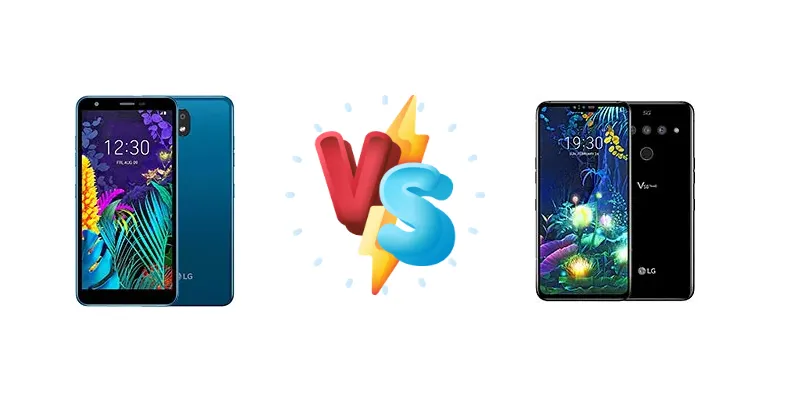
The LG V50 ThinQ 5G and LG K30 represent opposite ends of LG’s 2019 smartphone lineup. The K30 aimed for affordability, while the V50 was a flagship contender boasting 5G connectivity and high-end specs. This comparison dissects the key differences to determine which device best suits your needs and budget.
🏆 Quick Verdict
For most users, the LG V50 ThinQ 5G is the superior choice. Its Snapdragon 855 chipset delivers significantly faster performance, a brighter and higher contrast display, and 5G capabilities. While the K30 offers a lower price point, the V50’s overall experience justifies the investment for power users and those wanting future-proof connectivity.
| Network |
|---|
| 2G bands | GSM 850 / 900 / 1800 / 1900 | GSM 850 / 900 / 1800 / 1900 |
| 3G bands | HSDPA 850 / 900 / 1900 / 2100 | HSDPA 850 / 900 / 1700(AWS) / 1900 / 2100 - USA |
| 4G bands | 1, 3, 7, 8, 20, 38 | 1, 2, 3, 4, 5, 7, 8, 12, 13, 17, 20, 25, 26, 28, 40, 41, 46, 66, 71 - USA |
| 5G bands | - | 41, 260, 261 NSA |
| Speed | HSPA 42.2/5.76 Mbps, LTE Cat4 150/50 Mbps | HSPA 42.2/5.76 Mbps, LTE (6CA) Cat18 1200/75 Mbps, 5G (2+ Gbps DL) |
| Technology | GSM / HSPA / LTE | GSM / CDMA / HSPA / EVDO / LTE / 5G |
| | - | CDMA2000 1xEV-DO |
| Launch |
|---|
| Announced | 2019, August. Released 2019, September | 2019, February 24. Released 2019, April 19 |
| Status | Discontinued | Discontinued |
| Body |
|---|
| Build | Glass front, plastic back, plastic frame | Glass front (Gorilla Glass 5), glass back (Gorilla Glass 6), aluminum frame |
| Dimensions | 146.9 x 71.5 x 8.5 mm (5.78 x 2.81 x 0.33 in) | 159.2 x 76.1 x 8.3 mm (6.27 x 3.00 x 0.33 in) |
| SIM | · Nano-SIM· Nano-SIM + Nano-SIM | · Nano-SIM· Nano-SIM + Nano-SIM |
| Weight | 148 g (5.22 oz) | 183 g (6.46 oz) |
| | MIL-STD-810G compliant*
*does not guarantee ruggedness or use in extreme conditions | IP68 dust/water resistant (up to 1.5m for 30 min)
MIL-STD-810G compliant*
*does not guarantee ruggedness or use in extreme conditions |
| Display |
|---|
| Protection | - | Corning Gorilla Glass 5 |
| Resolution | 720 x 1440 pixels, 18:9 ratio (~295 ppi density) | 1440 x 3120 pixels, 19.5:9 ratio (~538 ppi density) |
| Size | 5.45 inches, 76.7 cm2 (~73.0% screen-to-body ratio) | 6.4 inches, 100.2 cm2 (~82.7% screen-to-body ratio) |
| Type | IPS LCD | P-OLED, HDR10 |
| | - | Always-on display |
| Platform |
|---|
| CPU | Quad-core 1.4 GHz Cortex-A53 | Octa-core (1x2.84 GHz Kryo 485 & 3x2.42 GHz Kryo 485 & 4x1.78 GHz Kryo 485) |
| Chipset | Qualcomm MSM8917 Snapdragon 425 (28 nm) | Qualcomm SM8150 Snapdragon 855 (7 nm) |
| GPU | Adreno 308 | Adreno 640 |
| OS | Android 9.0 (Pie) | Android 9.0 (Pie), upgradable to Android 11 |
| Memory |
|---|
| Card slot | microSDHC (uses shared SIM slot) | microSDXC (dedicated slot) |
| Internal | 16GB 2GB RAM | 128GB 6GB RAM |
| | eMMC 5.1 | UFS 2.1 |
| Main Camera |
|---|
| Features | LED flash, panorama, HDR | LED flash, HDR, panorama |
| Single | 8 MP, f/2.0, 27mm (wide), 1/4.0", 1.12µm, AF | - |
| Triple | - | 12 MP, 27mm (wide), f/1.5, 1/2.55", 1.4µm, dual pixel PDAF, 3-axis OIS
12 MP, 52mm (telephoto), f/2.4, 1/3.4", 1.0µm, 2x optical zoom, PDAF, OIS
16 MP, 16mm (ultrawide), f/1.9, 1/3.1", 1.0µm, no AF |
| Video | 1080p@30fps | 4K@30/60fps, 1080p@30/60/240fps, 24-bit/192kHz stereo sound rec., HDR10 video, gyro-EIS |
| Selfie camera |
|---|
| Dual | - | 8 MP, f/1.9, 26mm (wide), 1/4.0", 1.12µm
5 MP, 21mm (wide), f/2.2, 1/5.0", 1.12µm |
| Features | LED flash | HDR |
| Single | 5 MP, f/2.2, 24mm (wide), 1/5.0", 1.12µm | - |
| Video | - | 1080p@60fps |
| Sound |
|---|
| 3.5mm jack | Yes | Yes |
| 35mm jack | Yes | Yes |
| Loudspeaker | Yes | Yes, with stereo speakers |
| | - | 32-bit/192kHz audio
24-bit/192kHz audio recording
Tuned with Meridian Audio |
| Comms |
|---|
| Bluetooth | 5.0, A2DP, LE | 5.0, A2DP, LE, aptX HD |
| NFC | Yes (market/region dependent) | Yes |
| Positioning | GPS | GPS, GLONASS, GALILEO |
| Radio | No | FM radio |
| USB | microUSB 2.0 | USB Type-C 3.1 |
| WLAN | Wi-Fi 802.11 b/g/n | Wi-Fi 802.11 a/b/g/n/ac, dual-band, Wi-Fi Direct, DLNA |
| Features |
|---|
| Sensors | Accelerometer, proximity | Fingerprint (rear-mounted), accelerometer, gyro, proximity, compass, barometer |
| Battery |
|---|
| Charging | - | 18W wired, PD2.0, QC3, 50% in 36 min
10W wireless (Qi) |
| Talk time | Up to 10 h (3G) | - |
| Type | Li-Ion 3000 mAh, non-removable | Li-Po 4000 mAh, non-removable |
| Misc |
|---|
| Colors | New Aurora Black, New Moroccan Blue | New Aurora Black |
| Models | LM-X320EMW, LMX320EMW, LMX320ZMW, LM-X320ZMW | LM-V500, LM-V500N, LM-V500EM, LM-V500XM, LM-V450PM, LM-V450 |
| Price | About 140 EUR | About 550 EUR |
| Tests |
|---|
| Audio quality | - |
Noise -92.5dB / Crosstalk -92.6dB |
| Battery life | - |
Endurance rating 96h
|
| Camera | - |
Photo / Video |
| Display | - |
Contrast ratio: 194000:1 (nominal) |
| Loudspeaker | - |
-25.2 LUFS (Very good)
|
| Performance | - |
AnTuTu: 343758 (v7), 421934 (v8)
GeekBench: 10928 (v4.4), 2672 (v5.1)
GFXBench: 22fps (ES 3.1 onscreen) |
LG K30 (2019)
- Significantly lower price point
- Acceptable battery life for basic use
- Simple and easy-to-use interface
- Weak processor struggles with demanding apps
- Low display brightness and contrast
- Limited camera capabilities
LG V50 ThinQ 5G
- Flagship-level performance with Snapdragon 855
- Bright and high-contrast display
- Fast charging and wireless charging support
- 5G connectivity for faster data speeds
- Higher price tag
- May be difficult to find new
- Larger size and weight compared to the K30
Display Comparison
The LG V50 ThinQ 5G boasts a significantly more impressive display, achieving a measured peak brightness of 533 nits. This is crucial for outdoor visibility, a weakness likely present in the K30 given its budget positioning. Furthermore, the V50’s contrast ratio of 194000:1 (nominal) indicates deeper blacks and more vibrant colors compared to what would be expected from the K30’s likely IPS LCD panel. While panel type isn't specified for the K30, the V50’s superior specs translate to a far more immersive viewing experience.
Camera Comparison
Both phones feature photo and video capabilities, but the specifics are limited. The V50, as a flagship, likely incorporates a more advanced camera system with larger sensors and optical image stabilization (OIS) – features absent or limited in the K30. While both can capture images, the V50’s superior processing power and potentially larger sensor size will result in better low-light performance, dynamic range, and overall image quality. The K30’s camera is likely geared towards basic snapshots.
Performance
The performance gap between these devices is substantial. The LG V50 ThinQ 5G’s Qualcomm SM8150 Snapdragon 855, built on a 7nm process, is a flagship-level chipset with an octa-core CPU configuration (1x2.84 GHz Kryo 485, 3x2.42 GHz Kryo 485, 4x1.78 GHz Kryo 485). This contrasts sharply with the LG K30’s Qualcomm MSM8917 Snapdragon 425, a quad-core 1.4 GHz Cortex-A53 processor fabricated on a larger 28nm node. The 7nm process of the Snapdragon 855 offers significantly improved power efficiency and thermal performance, allowing for sustained high performance during demanding tasks like gaming and video editing, something the K30 would struggle with.
Battery Life
Both devices share an endurance rating of 96 hours, suggesting similar real-world battery life despite the V50’s more powerful components. This is likely due to the Snapdragon 855’s improved power efficiency. However, the V50 offers significantly faster charging capabilities with 18W wired charging (PD2.0, QC3) reaching 50% in 36 minutes, and 10W wireless charging (Qi). The K30’s charging speed is likely considerably slower, making the V50 more convenient for users who need to quickly top up their battery.
Buying Guide
Buy the LG K30 (2019) if you need a basic, reliable smartphone for essential tasks like calls, texts, and light social media use, and your budget is extremely limited. Buy the LG V50 ThinQ 5G if you prioritize performance for gaming and multitasking, demand a vibrant display, and want access to 5G networks for faster data speeds, even if it means a higher upfront cost.
Frequently Asked Questions
❓ Is the LG V50 ThinQ 5G still worth buying in 2024, considering 5G network availability?
Yes, if you live in an area with robust 5G coverage, the V50 can still provide significantly faster data speeds than 4G. However, consider that newer phones offer more advanced 5G technologies and longer software support lifecycles. The V50’s value lies in its discounted price for a capable 5G device.
❓ Will the LG K30 (2019) receive further software updates?
It is highly unlikely. LG has exited the smartphone market, and software support for older devices like the K30 has likely ended. Users should expect limited or no future updates, potentially impacting security and app compatibility over time.
❓ Can the LG V50 ThinQ 5G handle demanding games like PUBG Mobile or Call of Duty Mobile?
Yes, the Snapdragon 855 in the V50 is capable of running demanding games like PUBG Mobile and Call of Duty Mobile at high settings. However, sustained performance may be affected by thermal throttling, especially during extended gaming sessions. Expect playable frame rates, but not necessarily consistently maxed-out settings.
❓ What type of charging cable does the LG V50 ThinQ 5G use?
The LG V50 ThinQ 5G uses a USB-C charging cable. It supports USB Power Delivery 2.0 (PD2.0) and Quick Charge 3.0 (QC3) for faster wired charging.