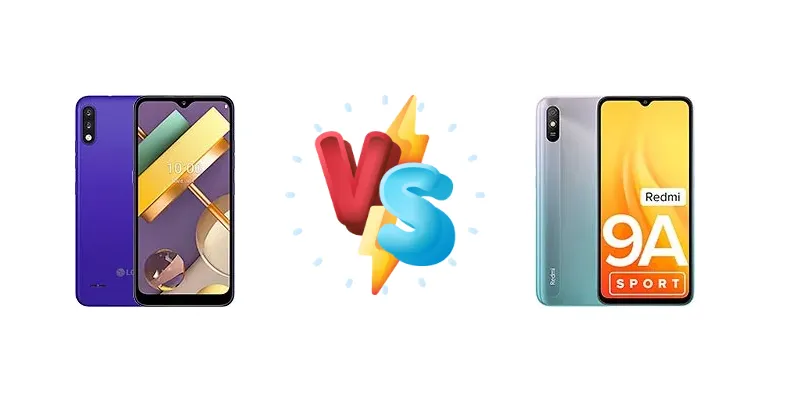
The LG K22 and Xiaomi Redmi 9A Sport represent the extreme end of the smartphone price spectrum. Both aim to deliver essential functionality at a minimal cost, but they take different approaches to achieving this. This comparison dissects their core components to determine which device offers the best value for users prioritizing affordability.
🏆 Quick Verdict
For the average user, the Xiaomi Redmi 9A Sport emerges as the better choice. Its Mediatek Helio G25 chipset, featuring an octa-core CPU, provides a significantly more responsive experience than the LG K22’s quad-core Snapdragon 215, making it better suited for multitasking and light gaming.
| Network |
|---|
| 2G bands | GSM 850 / 900 / 1800 / 1900 | GSM 850 / 900 / 1800 / 1900 |
| 3G bands | HSDPA 850 / 900 / 1900 / 2100 - International | HSDPA 850 / 900 / 2100 |
| 4G bands | 1, 3, 5, 7, 8, 20, 28, 38, 40 - International | 1, 3, 5, 8, 40, 41 |
| Speed | HSPA 42.2/5.76 Mbps, LTE Cat4 150/50 Mbps | HSPA, LTE |
| Technology | GSM / HSPA / LTE | GSM / HSPA / LTE |
| | 1, 3, 5, 7, 8, 20, 28, 40 - Brazil | - |
| Launch |
|---|
| Announced | 2020, September 12. Released 2020, September 12 | 2021, September 28 |
| Status | Discontinued | Available. Released 2021, September 28 |
| Body |
|---|
| Build | Glass front, plastic frame, plastic back | - |
| Dimensions | 155.7 x 75.4 x 8.4 mm (6.13 x 2.97 x 0.33 in) | 164.9 x 77.1 x 9 mm (6.49 x 3.04 x 0.35 in) |
| SIM | Nano-SIM + Nano-SIM | Nano-SIM + Nano-SIM |
| Weight | 169.5 g (6.00 oz) | 194 g (6.84 oz) |
| | MIL-STD-810G compliant*
*does not guarantee ruggedness or use in extreme conditions | Water-repellent coating |
| Display |
|---|
| Resolution | 720 x 1520 pixels, 19:9 ratio (~271 ppi density) | 720 x 1600 pixels, 20:9 ratio (~269 ppi density) |
| Size | 6.2 inches, 95.9 cm2 (~81.7% screen-to-body ratio) | 6.53 inches, 102.9 cm2 (~81.0% screen-to-body ratio) |
| Type | IPS LCD, 400 nits (typ) | IPS LCD, 400 nits (typ) |
| Platform |
|---|
| CPU | Quad-core 1.3 GHz Cortex-A53 | Octa-core (4x2.0 GHz Cortex-A53 & 4x1.5 GHz Cortex-A53) |
| Chipset | Qualcomm QM215 Snapdragon 215 (28 nm) | Mediatek MT6762G Helio G25 (12 nm) |
| GPU | Adreno 308 | PowerVR GE8320 |
| OS | Android 10 | Android 10, MIUI 12 |
| Memory |
|---|
| Card slot | microSDXC | microSDXC (dedicated slot) |
| Internal | 32GB 2GB RAM, 64GB 3GB RAM | 32GB 2GB RAM, 32GB 3GB RAM |
| | eMMC 5.1 | eMMC 5.1 |
| Main Camera |
|---|
| Dual | 13 MP, 27mm (wide), 1/3.1", 1.12µm, PDAF
2 MP (macro) | - |
| Features | LED flash, HDR | LED flash, HDR |
| Single | - | 13 MP, f/2.2, 28mm (wide), 1.0µm, PDAF |
| Video | 1080p@30fps | 1080p@30/60fps |
| Selfie camera |
|---|
| Features | - | HDR |
| Single | 5 MP, f/2.2, 24mm (wide), 1/5.0", 1.12µm | 5 MP, f/2.2, (wide), 1.12µm |
| Video | 1080p@30fps | 1080p@30fps |
| Sound |
|---|
| 3.5mm jack | Yes | Yes |
| 35mm jack | Yes | Yes |
| Loudspeaker | Yes | Yes |
| Comms |
|---|
| Bluetooth | 5.0, A2DP, LE | 5.0, A2DP, LE |
| NFC | No | No |
| Positioning | GPS, GLONASS | GPS, GLONASS, BDS |
| Radio | FM radio (market/operator dependent) | FM radio |
| USB | microUSB 2.0, OTG | microUSB 2.0, OTG |
| WLAN | Wi-Fi 802.11 b/g/n, Wi-Fi Direct | Wi-Fi 802.11 a/b/g/n, Wi-Fi Direct |
| Features |
|---|
| Sensors | Accelerometer, proximity, compass | Accelerometer, proximity |
| Battery |
|---|
| Charging | - | 10W wired |
| Type | Li-Po 3000 mAh | Li-Po 5000 mAh |
| Misc |
|---|
| Colors | Titan, Blue | Carbon Black, Coral Green, Metallic Blue |
| Models | LMK200Z, LMK200E, LMK200B, LM-K200 | - |
| Price | About 140 EUR | About 100 EUR |
LG K22
- Potentially longer standby time due to less powerful processor.
- LG brand recognition (for users loyal to the brand).
- Simpler user experience for those unfamiliar with smartphones.
- Significantly slower performance compared to the Redmi 9A Sport.
- Outdated Snapdragon 215 chipset.
- Likely limited software updates.
Xiaomi Redmi 9A Sport
- More powerful Mediatek Helio G25 processor.
- Octa-core CPU for improved multitasking.
- 10W wired charging for predictable recharge times.
- May have slightly shorter battery life under heavy load.
- Xiaomi’s MIUI software can be resource-intensive.
- Build quality may be less premium than some competitors.
Display Comparison
Neither device boasts a standout display. Both likely utilize LCD panels, typical for this price point. However, detailed display specs (resolution, brightness) are unavailable. The Redmi 9A Sport’s advantage lies in its potential for slightly better color reproduction due to Mediatek’s image signal processing capabilities, though this is speculative without direct testing. Bezels are expected to be substantial on both devices, reflecting their budget nature.
Camera Comparison
Camera performance is likely to be similar, and generally poor, on both devices. Without sensor size or aperture information, it’s difficult to make definitive claims. Both phones likely feature basic camera modules focused on capturing acceptable images in good lighting conditions. The Redmi 9A Sport *may* benefit from Mediatek’s image processing algorithms, but this is unlikely to be a substantial improvement. Expect limited low-light performance and a lack of advanced features on both.
Performance
The performance gap is the most significant differentiator. The Xiaomi Redmi 9A Sport’s Mediatek Helio G25, built on a 12nm process, is a clear upgrade over the LG K22’s Qualcomm Snapdragon 215 (28nm). The Helio G25’s octa-core configuration (4x2.0 GHz Cortex-A53 & 4x1.5 GHz Cortex-A53) provides more processing power and allows for better multitasking compared to the K22’s quad-core 1.3 GHz Cortex-A53. The 12nm process also contributes to improved power efficiency, potentially leading to longer battery life under load. While neither chipset is designed for demanding games, the Redmi 9A Sport will handle simpler titles with greater fluidity.
Battery Life
Battery capacity is not specified for either device. However, the Redmi 9A Sport’s 10W wired charging is a notable feature, allowing for a predictable, albeit slow, recharge rate. The Snapdragon 215 in the LG K22, being less power-hungry, *could* offer comparable battery life despite a potentially smaller capacity, but the Helio G25’s efficiency gains at 12nm may offset this. Real-world usage will determine the actual battery endurance of each device.
Buying Guide
Buy the LG K22 if you absolutely need a phone from the LG brand and are primarily focused on basic communication – calls and texts – with minimal app usage. Buy the Xiaomi Redmi 9A Sport if you prioritize a smoother user experience, even for simple tasks, and anticipate using more apps or engaging in occasional light gaming. The Redmi 9A Sport’s more powerful processor offers a tangible benefit for everyday usability.
Frequently Asked Questions
❓ Will the Redmi 9A Sport struggle with popular apps like WhatsApp and Facebook?
While the Helio G25 isn't a powerhouse, it's sufficient for running essential apps like WhatsApp and Facebook smoothly. You might experience some slowdown with multiple apps open simultaneously, but for typical social media usage, it should be adequate.
❓ Is the Snapdragon 215 in the LG K22 sufficient for basic web browsing?
The Snapdragon 215 can handle basic web browsing, but expect slower page loading times and potential lag when navigating complex websites. It's best suited for simple tasks and light usage.
❓ Can I play games on the Redmi 9A Sport?
The Redmi 9A Sport can handle less demanding 2D games and older 3D titles at lower settings. Don't expect to play graphically intensive games like PUBG Mobile or Call of Duty Mobile smoothly.
❓ How long will the battery last on either phone with moderate use?
Without specific battery capacity details, it's hard to say definitively. However, with moderate use (calls, texts, some social media), both phones should likely last a full day. The Redmi 9A Sport's 10W charging will be useful for topping up overnight.