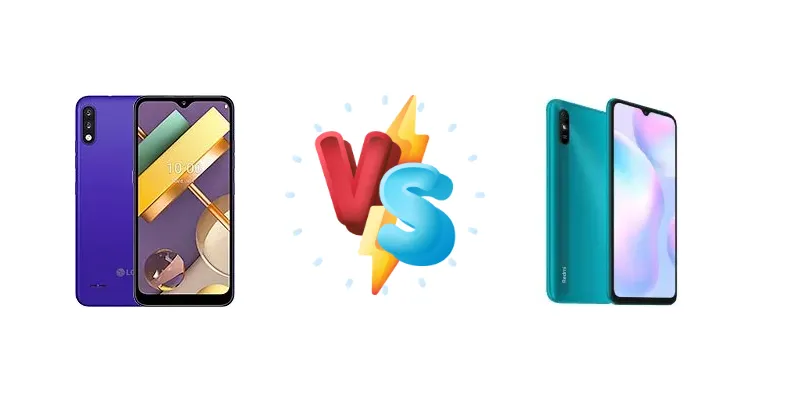
The LG K22 and Xiaomi Redmi 9A represent the absolute bottom end of the smartphone market, catering to users prioritizing affordability above all else. Both devices aim to deliver basic smartphone functionality at the lowest possible price point, but significant differences in their underlying hardware dictate vastly different user experiences. This comparison dissects those differences to determine which phone offers the best value.
🏆 Quick Verdict
For the average user, the Xiaomi Redmi 9A emerges as the better choice. Its Mediatek Helio G25 chipset, featuring an octa-core CPU built on a more efficient 12nm process, provides a noticeable performance advantage over the LG K22’s aging Snapdragon 215. While neither phone excels, the Redmi 9A offers a smoother, more responsive experience for everyday tasks.
| Network |
|---|
| 2G bands | GSM 850 / 900 / 1800 / 1900 | GSM 850 / 900 / 1800 / 1900 |
| 3G bands | HSDPA 850 / 900 / 1900 / 2100 - International | HSDPA 850 / 900 / 1700(AWS) / 1900 / 2100 - International |
| 4G bands | 1, 3, 5, 7, 8, 20, 28, 38, 40 - International | 1, 2, 3, 4, 5, 7, 8, 20, 28, 38, 40, 41 - International |
| Speed | HSPA 42.2/5.76 Mbps, LTE Cat4 150/50 Mbps | HSPA, LTE |
| Technology | GSM / HSPA / LTE | GSM / HSPA / LTE |
| | 1, 3, 5, 7, 8, 20, 28, 40 - Brazil | 1, 3, 5, 8, 40, 41 - India |
| Launch |
|---|
| Announced | 2020, September 12. Released 2020, September 12 | 2020, June 30. Released 2020, July 07 |
| Status | Discontinued | Discontinued |
| Body |
|---|
| Build | Glass front, plastic frame, plastic back | - |
| Dimensions | 155.7 x 75.4 x 8.4 mm (6.13 x 2.97 x 0.33 in) | 164.9 x 77.1 x 9 mm (6.49 x 3.04 x 0.35 in) |
| SIM | Nano-SIM + Nano-SIM | Nano-SIM + Nano-SIM |
| Weight | 169.5 g (6.00 oz) | 196 g (6.91 oz) |
| | MIL-STD-810G compliant*
*does not guarantee ruggedness or use in extreme conditions | - |
| Display |
|---|
| Resolution | 720 x 1520 pixels, 19:9 ratio (~271 ppi density) | 720 x 1600 pixels, 20:9 ratio (~269 ppi density) |
| Size | 6.2 inches, 95.9 cm2 (~81.7% screen-to-body ratio) | 6.53 inches, 102.9 cm2 (~81.0% screen-to-body ratio) |
| Type | IPS LCD, 400 nits (typ) | IPS LCD, 400 nits (typ) |
| Platform |
|---|
| CPU | Quad-core 1.3 GHz Cortex-A53 | Octa-core (4x2.0 GHz Cortex-A53 & 4x1.5 GHz Cortex-A53) |
| Chipset | Qualcomm QM215 Snapdragon 215 (28 nm) | Mediatek MT6762G Helio G25 (12 nm) |
| GPU | Adreno 308 | PowerVR GE8320 |
| OS | Android 10 | Android 10, upgradable to Android 11, MIUI 12 |
| Memory |
|---|
| Card slot | microSDXC | microSDXC (dedicated slot) |
| Internal | 32GB 2GB RAM, 64GB 3GB RAM | 32GB 2GB RAM, 32GB 3GB RAM, 64GB 4GB RAM, 128GB 4GB RAM, 128GB 6GB RAM |
| | eMMC 5.1 | eMMC 5.1 |
| Main Camera |
|---|
| Dual | 13 MP, 27mm (wide), 1/3.1", 1.12µm, PDAF
2 MP (macro) | - |
| Features | LED flash, HDR | LED flash, HDR |
| Single | - | 13 MP, f/2.2, 28mm (wide), 1.0µm, PDAF |
| Video | 1080p@30fps | 1080p@30/60fps |
| Selfie camera |
|---|
| Features | - | HDR |
| Single | 5 MP, f/2.2, 24mm (wide), 1/5.0", 1.12µm | 5 MP, f/2.2, (wide), 1.12µm |
| Video | 1080p@30fps | 1080p@30fps |
| Sound |
|---|
| 3.5mm jack | Yes | Yes |
| 35mm jack | Yes | Yes |
| Loudspeaker | Yes | Yes |
| Comms |
|---|
| Bluetooth | 5.0, A2DP, LE | 5.0, A2DP, LE |
| NFC | No | No |
| Positioning | GPS, GLONASS | GPS, GLONASS, BDS |
| Radio | FM radio (market/operator dependent) | FM radio |
| USB | microUSB 2.0, OTG | microUSB 2.0, OTG |
| WLAN | Wi-Fi 802.11 b/g/n, Wi-Fi Direct | Wi-Fi 802.11 b/g/n, Wi-Fi Direct |
| Features |
|---|
| Sensors | Accelerometer, proximity, compass | Accelerometer, proximity |
| Battery |
|---|
| Charging | - | 10W wired |
| Type | Li-Po 3000 mAh | Li-Po 5000 mAh |
| Misc |
|---|
| Colors | Titan, Blue | Carbon Gray (Midnight Black), Sky Blue (Sea Blue), Ocean Green (Nature Green) |
| Models | LMK200Z, LMK200E, LMK200B, LM-K200 | M2006C3LG, M2006C3LI, M2006C3LC, M2004C3L |
| Price | About 140 EUR | € 64.30 / $ 56.50 / £ 95.56 |
| SAR | - | 0.90 W/kg (head) 0.65 W/kg (body) |
| SAR EU | - | 0.40 W/kg (head) 1.19 W/kg (body) |
LG K22
- Potentially lower price point
- May have specific carrier compatibility
- Simple, straightforward Android experience
- Significantly slower performance
- Less efficient chipset (28nm)
- Likely slower charging
Xiaomi Redmi 9A
- Faster and more responsive performance
- More efficient chipset (12nm)
- 10W wired charging included
- May be slightly more expensive
- Basic camera capabilities
- Still an entry-level device
Display Comparison
Neither the LG K22 nor the Xiaomi Redmi 9A boast impressive displays. Specifics regarding panel type (IPS vs TFT) and resolution are not provided, but both are likely to feature low-resolution panels. The key difference lies in the processing power driving them. The Redmi 9A’s more capable chipset can render UI elements and apps more smoothly, even if the panel itself isn’t high-end. Expect similar color accuracy and viewing angles on both devices, limited by their budget nature.
Camera Comparison
Camera performance on both devices will be limited. Without specific sensor details, it’s safe to assume both feature basic sensors capable of capturing acceptable photos in good lighting conditions. The Redmi 9A likely benefits from slightly better image processing capabilities due to its more powerful chipset. The presence of a 10W charger on the Redmi 9A suggests a focus on usability, which may extend to slightly improved camera software features. Expect both phones to struggle in low-light scenarios.
Performance
The performance gap is the most significant differentiator. The Xiaomi Redmi 9A’s Mediatek Helio G25, built on a 12nm process, features an octa-core CPU (4x2.0 GHz Cortex-A53 & 4x1.5 GHz Cortex-A53) compared to the LG K22’s quad-core 1.3 GHz Cortex-A53 Snapdragon 215, fabricated on a less efficient 28nm node. This translates to a substantial advantage for the Redmi 9A in multitasking and app loading times. The 12nm process also contributes to better thermal efficiency, potentially reducing throttling during sustained use. While neither phone is a gaming powerhouse, the Redmi 9A will handle less demanding games with greater stability.
Battery Life
Battery capacity is not specified for either device. However, given their target market, both likely feature batteries in the 4000-5000 mAh range. The Redmi 9A’s inclusion of 10W wired charging is a notable advantage. While not fast charging by any means, it provides a more convenient charging experience than potentially slower, undocumented charging on the LG K22. The more efficient Helio G25 chipset in the Redmi 9A may also contribute to slightly longer battery life during typical usage.
Buying Guide
Buy the LG K22 if you absolutely need a phone with a specific carrier compatibility that the Redmi 9A lacks, or if you find it at a significantly lower price point. However, be prepared for a sluggish experience. Buy the Xiaomi Redmi 9A if you prioritize responsiveness and a slightly more modern chipset, even for basic tasks like browsing and social media. The Redmi 9A is the better option for anyone who wants a phone that doesn't feel completely outdated.
Frequently Asked Questions
❓ Will the Redmi 9A struggle with popular apps like Facebook and WhatsApp?
While the Redmi 9A isn't a powerhouse, its Helio G25 chipset is sufficient to run apps like Facebook and WhatsApp smoothly for most users. Expect some loading times, but the overall experience should be usable. The LG K22's Snapdragon 215 will likely exhibit more noticeable lag.
❓ Is the Redmi 9A suitable for playing mobile games?
The Redmi 9A can handle less demanding mobile games, but don't expect high frame rates or graphics settings. Games like PUBG Mobile will likely require significant compromises in graphics quality to achieve playable performance. The LG K22 will struggle even more with gaming.
❓ Does the LG K22 receive regular software updates?
Given LG's exit from the smartphone market, software update support for the K22 is highly uncertain. Users should expect limited or no future updates, potentially leaving the device vulnerable to security risks. The Redmi 9A, backed by Xiaomi, is more likely to receive occasional security patches.
❓ What type of charging port do both phones use?
Both the LG K22 and Xiaomi Redmi 9A utilize a Micro-USB port for charging and data transfer. This is standard for phones in this price range, but it's slower and less convenient than the USB-C port found on more modern devices.