
LG K22 vs. Samsung Galaxy S10+: A Tale of Two Androids
| Phones Images | |||||
|---|---|---|---|---|---|
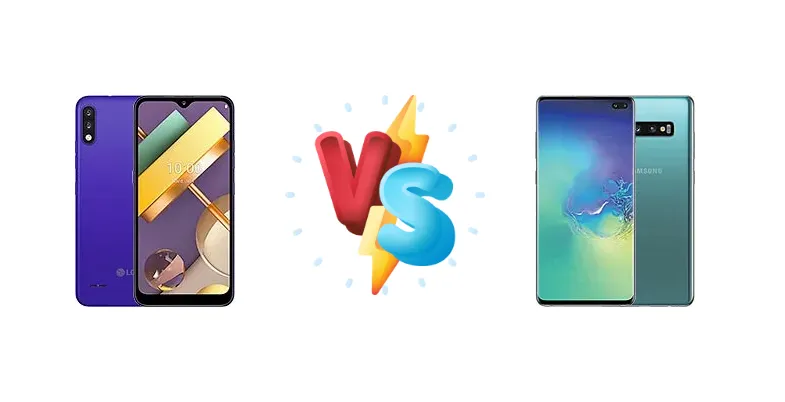
|
🏆 Quick Verdict
For the average user prioritizing affordability and basic functionality, the LG K22 is the clear winner. However, the Samsung Galaxy S10+ remains a compelling option for those who demand significantly better performance, a superior display, and features like wireless charging, despite its age.
| PHONES | ||
|---|---|---|
| Phone Names | LG K22 | Samsung Galaxy S10+ |
| Network | ||
|---|---|---|
| 2G bands | GSM 850 / 900 / 1800 / 1900 | GSM 850 / 900 / 1800 / 1900 - SIM 1 & SIM 2 (dual-SIM model only) |
| 3G bands | HSDPA 850 / 900 / 1900 / 2100 - International | HSDPA 850 / 900 / 1700(AWS) / 1900 / 2100 - Global, USA |
| 4G bands | 1, 3, 5, 7, 8, 20, 28, 38, 40 - International | 1, 2, 3, 4, 5, 7, 8, 12, 13, 17, 18, 19, 20, 25, 26, 28, 32, 38, 39, 40, 41, 66 - Global |
| Speed | HSPA 42.2/5.76 Mbps, LTE Cat4 150/50 Mbps | HSPA 42.2/5.76 Mbps, LTE-A (7CA) Cat20 2000/150 Mbps |
| Technology | GSM / HSPA / LTE | GSM / CDMA / HSPA / EVDO / LTE |
| 1, 3, 5, 7, 8, 20, 28, 40 - Brazil | - | |
| Launch | ||
|---|---|---|
| Announced | 2020, September 12. Released 2020, September 12 | 2019, February 20 |
| Status | Discontinued | Available. Released 2019, March 08 |
| Body | ||
|---|---|---|
| Build | Glass front, plastic frame, plastic back | Glass front (Gorilla Glass 6), glass back (Gorilla Glass 5), aluminum frameGlass front (Gorilla Glass 6), ceramic back, ceramic frame |
| Dimensions | 155.7 x 75.4 x 8.4 mm (6.13 x 2.97 x 0.33 in) | 157.6 x 74.1 x 7.8 mm (6.20 x 2.92 x 0.31 in) |
| SIM | Nano-SIM + Nano-SIM | Single SIM (Nano-SIM) or Hybrid Dual SIM (Nano-SIM, dual stand-by) |
| Weight | 169.5 g (6.00 oz) | 175 g / 198 g (ceramic) (6.17 oz) |
| MIL-STD-810G compliant* *does not guarantee ruggedness or use in extreme conditions | - | |
| Display | ||
|---|---|---|
| Protection | - | Corning Gorilla Glass 6 |
| Resolution | 720 x 1520 pixels, 19:9 ratio (~271 ppi density) | 1440 x 3040 pixels, 19:9 ratio (~522 ppi density) |
| Size | 6.2 inches, 95.9 cm2 (~81.7% screen-to-body ratio) | 6.4 inches, 103.8 cm2 (~88.9% screen-to-body ratio) |
| Type | IPS LCD, 400 nits (typ) | Dynamic AMOLED, HDR10+ |
| Platform | ||
|---|---|---|
| CPU | Quad-core 1.3 GHz Cortex-A53 | Octa-core (2x2.73 GHz Mongoose M4 & 2x2.31 GHz Cortex-A75 & 4x1.95 GHz Cortex-A55) - EMEA/LATAMOcta-core (1x2.84 GHz Kryo 485 & 3x2.42 GHz Kryo 485 & 4x1.78 GHz Kryo 485) - USA/China |
| Chipset | Qualcomm QM215 Snapdragon 215 (28 nm) | Exynos 9820 (8 nm) - EMEA/LATAMQualcomm SM8150 Snapdragon 855 (7 nm) - USA/China |
| GPU | Adreno 308 | Mali-G76 MP12 - EMEA/LATAMAdreno 640 - USA/China |
| OS | Android 10 | Android 9.0 (Pie), upgradable to Android 12, One UI 4.1 |
| Memory | ||
|---|---|---|
| Card slot | microSDXC | microSDXC (uses shared SIM slot) - dual SIM model only |
| Internal | 32GB 2GB RAM, 64GB 3GB RAM | 128GB 6GB RAM, 128GB 8GB RAM, 512GB 8GB RAM, 1TB 12GB RAM |
| eMMC 5.1 | - | |
| Main Camera | ||
|---|---|---|
| Dual | 13 MP, 27mm (wide), 1/3.1", 1.12µm, PDAF 2 MP (macro) | - |
| Features | LED flash, HDR | LED flash, auto-HDR, panorama |
| Triple | - | 12 MP, f/1.5-2.4, 26mm (wide), 1/2.55", 1.4µm, Dual Pixel PDAF, OIS 12 MP, f/2.4, 52mm (telephoto), 1/3.6", 1.0µm, AF, OIS, 2x optical zoom 16 MP, f/2.2, 12mm (ultrawide), 1/3.1", 1.0µm, Super Steady video |
| Video | 1080p@30fps | 4K@60fps (no EIS), 4K@30fps, 1080p@30/60/240fps, 720p@960fps, HDR10+, stereo sound rec., gyro-EIS & OIS |
| Selfie camera | ||
|---|---|---|
| Dual | - | 10 MP, f/1.9, 26mm (wide), 1/3", 1.22µm, Dual Pixel PDAF 8 MP, f/2.2, 22mm (wide), 1/4", 1.12µm, depth sensor |
| Features | - | Dual video call, Auto-HDR |
| Single | 5 MP, f/2.2, 24mm (wide), 1/5.0", 1.12µm | - |
| Video | 1080p@30fps | 4K@30/60fps, 1080p@30fps |
| Sound | ||
|---|---|---|
| 3.5mm jack | Yes | Yes |
| 35mm jack | Yes | - |
| Loudspeaker | Yes | Yes, with stereo speakers |
| Comms | ||
|---|---|---|
| Bluetooth | 5.0, A2DP, LE | 5.0, A2DP, LE, aptX |
| NFC | No | Yes |
| Positioning | GPS, GLONASS | GPS, GLONASS, BDS, GALILEO |
| Radio | FM radio (market/operator dependent) | FM radio (USA & Canada only) |
| USB | microUSB 2.0, OTG | USB Type-C 3.1 |
| WLAN | Wi-Fi 802.11 b/g/n, Wi-Fi Direct | Wi-Fi 802.11 a/b/g/n/ac/6, dual-band, Wi-Fi Direct |
| Features | ||
|---|---|---|
| Sensors | Accelerometer, proximity, compass | Fingerprint (under display, ultrasonic), accelerometer, gyro, proximity, compass, barometer, heart rate, SpO2 |
| Battery | ||
|---|---|---|
| Charging | - | 15W wired, PD2.0 15W wireless (Qi/PMA) 4.5W reverse wireless |
| Type | Li-Po 3000 mAh | Li-Ion 4100 mAh, non-removable |
| Misc | ||
|---|---|---|
| Colors | Titan, Blue | Prism White, Prism Black, Prism Green, Prism Blue, Canary Yellow, Flamingo Pink, Ceramic Black, Ceramic White, Cardinal Red, Smoke Blue |
| Models | LMK200Z, LMK200E, LMK200B, LM-K200 | SM-G975F, SM-G975U, SM-G975W, SM-G975U1, SM-G9750, SM-G975N, SM-G975X |
| Price | About 140 EUR | $ 199.00 / C$ 879.99 / £ 999.00 / € 299.00 / ₹ 39,940 |
| SAR | - | 1.06 W/kg (head) 1.03 W/kg (body) |
| SAR EU | - | 0.52 W/kg (head) 1.58 W/kg (body) |
| Tests | ||
|---|---|---|
| Audio quality | - | Noise -93.0dB / Crosstalk -94.3dB |
| Battery life | - | Endurance rating 91h |
| Camera | - | Photo / Video |
| Display | - | Contrast ratio: Infinite (nominal), 4.514 (sunlight) |
| Loudspeaker | - | -24.7 LUFS (Very good) |
| Performance | - | AnTuTu: 333736 (v7), 399901 (v8) GeekBench: 10387 (v4.4), 2190 (v5.1) GFXBench: 23fps (ES 3.1 onscreen) |
LG K22
- Extremely affordable price
- Long battery life (91h endurance)
- Simple and easy-to-use interface
- Very limited performance
- Basic camera quality
- Outdated chipset
Samsung Galaxy S10+
- Powerful processor (Exynos 9820/Snapdragon 855)
- High-quality display with vibrant colors
- Versatile camera system with OIS
- Higher price point
- Battery life not as exceptional as K22
- Older device, software updates may be limited
Display Comparison
The Samsung Galaxy S10+ boasts a significantly more advanced display experience. While the LG K22’s display specifications are not provided, it’s reasonable to assume a basic LCD panel. The S10+ features an 'Infinite' contrast ratio (nominal 4.514 in sunlight), indicating a vibrant and readable screen even outdoors. The S10+'s higher resolution and likely higher peak brightness (compared to the K22) translate to sharper images and better visibility. The S10+ also benefits from Samsung’s display expertise, offering superior color accuracy and viewing angles.
Camera Comparison
The Samsung Galaxy S10+ offers a far more capable camera system. While both phones feature photo/video capabilities, the S10+ likely includes features like Optical Image Stabilization (OIS) and a larger main sensor, resulting in better low-light performance and sharper images. The LG K22’s camera is likely focused on providing acceptable results in good lighting conditions, but will fall short in challenging scenarios. The presence of a 2MP macro camera on the K22 is unlikely to provide significant benefit due to its low resolution and limited image quality.
Performance
The performance gap between these devices is substantial. The LG K22’s Qualcomm Snapdragon 215 (28nm) with a quad-core 1.3 GHz Cortex-A53 CPU is designed for basic tasks. In contrast, the Samsung Galaxy S10+ utilizes either the Exynos 9820 (8nm) or the Snapdragon 855 (7nm), both octa-core processors with significantly more powerful CPU cores (Mongoose M4 and Cortex-A75/Kryo 485). The smaller fabrication process (8nm/7nm vs 28nm) of the S10+’s chipsets results in greater efficiency and less heat generation, allowing for sustained performance. The S10+ will handle demanding apps, multitasking, and gaming with ease, while the K22 will struggle with anything beyond basic operations.
Battery Life
The LG K22 achieves an impressive endurance rating of 91 hours, suggesting excellent battery life for its class. However, the Samsung Galaxy S10+ offers more versatile charging options with 15W wired charging (PD2.0), 15W wireless charging (Qi/PMA), and even 4.5W reverse wireless charging. While the K22 likely has a smaller battery capacity, the Snapdragon 215’s low power consumption contributes to its long endurance. The S10+'s faster charging speeds allow for quicker top-ups, and the reverse wireless charging is a convenient feature for charging accessories.
Buying Guide
Buy the LG K22 if you need a functional, inexpensive smartphone for calls, texts, and light social media use. Its primary strength is its low price point. Buy the Samsung Galaxy S10+ if you prioritize a smoother user experience, better photography, faster charging, and a more premium build quality, and are willing to spend more for these features. The S10+ is ideal for media consumption and moderate gaming.