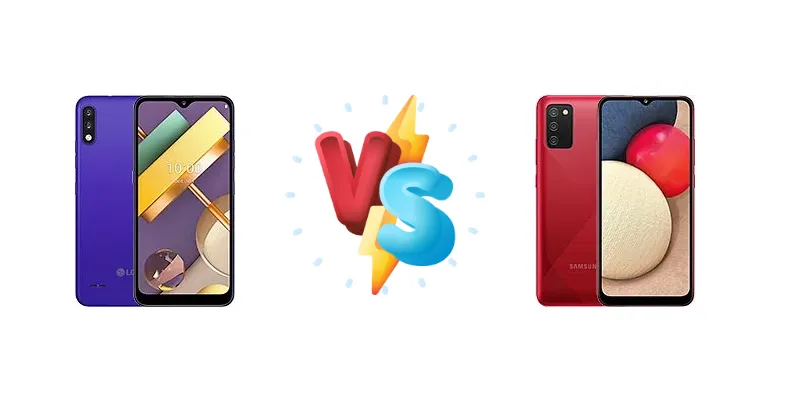
The LG K22 and Samsung Galaxy A02s represent the absolute bottom end of the smartphone market, catering to users prioritizing affordability above all else. Both devices aim to deliver basic smartphone functionality at the lowest possible price point, but significant differences in their underlying hardware dictate which phone offers the better experience.
🏆 Quick Verdict
For most users, the Samsung Galaxy A02s is the superior choice. Its Snapdragon 450 chipset, built on a more efficient 14nm process, provides a noticeable performance advantage over the LG K22’s Snapdragon 215. While both offer similar battery endurance, the A02s’ brighter display and faster charging add to its overall value.
| Network |
|---|
| 2G bands | GSM 850 / 900 / 1800 / 1900 | GSM 850 / 900 / 1800 / 1900 |
| 3G bands | HSDPA 850 / 900 / 1900 / 2100 - International | HSDPA 850 / 900 / 2100 |
| 4G bands | 1, 3, 5, 7, 8, 20, 28, 38, 40 - International | 1, 3, 5, 7, 8, 20, 28, 38, 40, 41 |
| Speed | HSPA 42.2/5.76 Mbps, LTE Cat4 150/50 Mbps | HSPA 42.2/5.76 Mbps, LTE Cat4 150/50 Mbps |
| Technology | GSM / HSPA / LTE | GSM / HSPA / LTE |
| | 1, 3, 5, 7, 8, 20, 28, 40 - Brazil | - |
| Launch |
|---|
| Announced | 2020, September 12. Released 2020, September 12 | 2020, November 24. Released 2021, January 04 |
| Status | Discontinued | Discontinued |
| Body |
|---|
| Build | Glass front, plastic frame, plastic back | Glass front, plastic back, plastic frame |
| Dimensions | 155.7 x 75.4 x 8.4 mm (6.13 x 2.97 x 0.33 in) | 164.2 x 75.9 x 9.1 mm (6.46 x 2.99 x 0.36 in) |
| SIM | Nano-SIM + Nano-SIM | · Nano-SIM· Nano-SIM + Nano-SIM |
| Weight | 169.5 g (6.00 oz) | 196 g (6.91 oz) |
| | MIL-STD-810G compliant*
*does not guarantee ruggedness or use in extreme conditions | - |
| Display |
|---|
| Protection | - | Scratch-resistant glass |
| Resolution | 720 x 1520 pixels, 19:9 ratio (~271 ppi density) | 720 x 1600 pixels, 20:9 ratio (~270 ppi density) |
| Size | 6.2 inches, 95.9 cm2 (~81.7% screen-to-body ratio) | 6.5 inches, 102.0 cm2 (~81.8% screen-to-body ratio) |
| Type | IPS LCD, 400 nits (typ) | PLS LCD |
| Platform |
|---|
| CPU | Quad-core 1.3 GHz Cortex-A53 | Octa-core 1.8 GHz Cortex-A53 |
| Chipset | Qualcomm QM215 Snapdragon 215 (28 nm) | Qualcomm SDM450 Snapdragon 450 (14 nm) |
| GPU | Adreno 308 | Adreno 506 |
| OS | Android 10 | Android 10, upgradable to Android 12, One UI 4.1 |
| Memory |
|---|
| Card slot | microSDXC | microSDXC (dedicated slot) |
| Internal | 32GB 2GB RAM, 64GB 3GB RAM | 16GB 1GB RAM, 32GB 2GB RAM, 32GB 3GB RAM, 32GB 4GB RAM, 64GB 3GB RAM, 64GB 4GB RAM |
| | eMMC 5.1 | eMMC 5.1 |
| Main Camera |
|---|
| Dual | 13 MP, 27mm (wide), 1/3.1", 1.12µm, PDAF
2 MP (macro) | - |
| Features | LED flash, HDR | LED flash |
| Single | - | 3.15 MP |
| Triple | - | 13 MP, f/2.2, (wide), AF
2 MP (macro)
Auxiliary lens |
| Video | 1080p@30fps | 1080p@30fps |
| Selfie camera |
|---|
| Single | 5 MP, f/2.2, 24mm (wide), 1/5.0", 1.12µm | 5 MP, f/2.2 |
| Video | 1080p@30fps | - |
| Sound |
|---|
| 3.5mm jack | Yes | Yes |
| 35mm jack | Yes | Yes |
| Loudspeaker | Yes | Yes |
| Comms |
|---|
| Bluetooth | 5.0, A2DP, LE | 4.2, A2DP |
| NFC | No | No |
| Positioning | GPS, GLONASS | GPS, GLONASS, GALILEO, BDS |
| Radio | FM radio (market/operator dependent) | Unspecified |
| USB | microUSB 2.0, OTG | USB Type-C 2.0 |
| WLAN | Wi-Fi 802.11 b/g/n, Wi-Fi Direct | Wi-Fi 802.11 b/g/n, Wi-Fi Direct |
| Features |
|---|
| Sensors | Accelerometer, proximity, compass | Accelerometer, proximity |
| Battery |
|---|
| Charging | - | 15W wired |
| Stand-by | - | Up to 530 h (2G) / Up to 530 h (3G) |
| Talk time | - | Up to 6 h 12 min (2G) / Up to 6 h 18 min (3G) |
| Type | Li-Po 3000 mAh | Li-Po 5000 mAh |
| Misc |
|---|
| Colors | Titan, Blue | Black, White, Red, Blue |
| Models | LMK200Z, LMK200E, LMK200B, LM-K200 | SM-A025F, SM-A025F/DS, SM-A025G, SM-A025G/DS, SM-A025M, SM-A025M/DS, SM-A025U, SM-A025V, SM-A025A, SM-A025U1, SM-A025AZ, SM-S124DL |
| Price | About 140 EUR | About 110 EUR |
| SAR | - | 1.15 W/kg (head) 0.79 W/kg (body) |
| SAR EU | - | 0.40 W/kg (head) 1.37 W/kg (body) |
| Tests |
|---|
| Audio quality | - |
Noise -81.4dB / Crosstalk -80.5dB |
| Battery life | - |
Endurance rating 114h
|
| Camera | - |
Photo / Video |
| Display | - |
Contrast ratio: 1765:1 (nominal) |
| Loudspeaker | - |
-29.8 LUFS (Average)
|
| Performance | - |
AnTuTu: 90811 (v8)
GeekBench: 495 (v5.1)
GFXBench: 6.1fps (ES 3.1 onscreen) |
LG K22
- Potentially lower price point
- Basic smartphone functionality
- Acceptable battery life
- Significantly slower processor
- Less efficient chipset (28nm)
- Likely lower display brightness
Samsung Galaxy A02s
- Faster and more efficient processor
- Brighter display for better visibility
- Faster 15W charging
- May be slightly more expensive
- Still an entry-level device with limitations
- Camera quality likely remains basic
Display Comparison
The Samsung Galaxy A02s boasts a measurable 406 nits of maximum brightness, a significant advantage over the LG K22 (brightness data unavailable). Both displays share a 1765:1 contrast ratio, suggesting similar color reproduction capabilities. However, the A02s’ higher peak brightness translates to better visibility outdoors and in brightly lit environments. While neither display is expected to offer exceptional color accuracy, the A02s’ superior brightness makes it the more practical choice for everyday use.
Camera Comparison
Both phones feature basic photo and video capabilities, but detailed camera specifications are limited. Given the price point, image quality is unlikely to be a strong suit for either device. The absence of specific sensor details makes a direct comparison difficult, but it’s safe to assume both rely on entry-level sensors. Users should temper expectations and view the cameras as suitable for casual snapshots rather than serious photography. The presence of a camera is more for marketing than actual quality.
Performance
The core difference between these two phones lies in their chipsets. The Samsung Galaxy A02s utilizes the Qualcomm Snapdragon 450, an octa-core processor built on a 14nm process. This contrasts sharply with the LG K22’s Snapdragon 215, a quad-core chip fabricated on a less efficient 28nm node. The 14nm process allows the Snapdragon 450 to deliver more performance per watt, resulting in a smoother user experience and better thermal management. The A02s’ eight Cortex-A53 cores, clocked at 1.8 GHz, will outperform the K22’s four Cortex-A53 cores running at 1.3 GHz in virtually all scenarios, from app loading times to web browsing.
Battery Life
Both the LG K22 and Samsung Galaxy A02s achieve an endurance rating of 114 hours, indicating comparable battery life under similar usage conditions. However, the Galaxy A02s supports 15W wired charging, a significant advantage over the LG K22 (charging speed data unavailable). This faster charging capability allows the A02s to replenish its battery more quickly, minimizing downtime and providing greater convenience.
Buying Guide
Buy the LG K22 if you absolutely need the lowest possible upfront cost and are willing to tolerate significantly slower performance for basic tasks like messaging and calls. Buy the Samsung Galaxy A02s if you prioritize a smoother user experience, even with light multitasking, and appreciate a slightly brighter and more usable display. The A02s is the better all-rounder for the vast majority of users.
Frequently Asked Questions
❓ Will the Snapdragon 450 in the A02s handle basic social media apps like Facebook and WhatsApp smoothly?
Yes, the Snapdragon 450 is sufficiently capable of running basic social media applications without significant lag. While it won't offer a flagship-level experience, it provides a noticeably smoother experience than the Snapdragon 215 in the K22, especially when multitasking between apps.
❓ Is the 15W charging on the A02s a significant improvement over the K22, assuming the K22 has standard 5W charging?
Yes, 15W charging is a substantial improvement. While a precise charging time for the K22 is unavailable, 15W charging on the A02s will significantly reduce the time it takes to fully charge the device, offering greater convenience for users who rely on their phone throughout the day.
❓ Given the low price point, should I expect frequent software updates on either device?
No. Both the LG K22 and Samsung Galaxy A02s are entry-level devices and are unlikely to receive frequent or long-term software updates. Expect minimal security patches and potentially no major Android version upgrades.