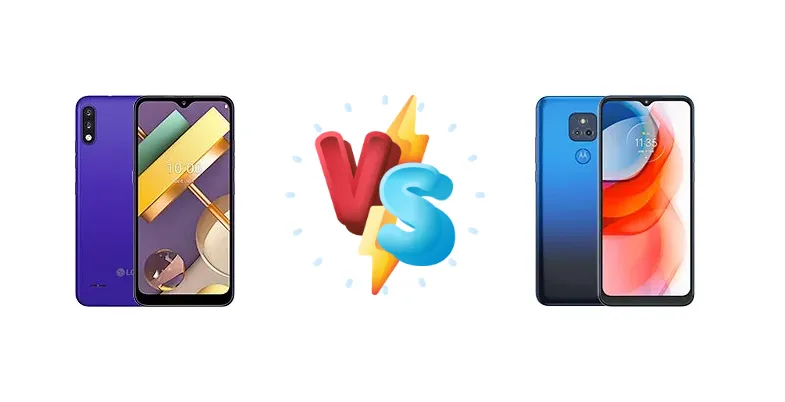
The LG K22 and Motorola Moto G Play (2021) represent the lower end of the Android smartphone market, targeting users prioritizing affordability. However, a significant gap exists in their internal hardware, particularly in the chipset. This comparison dissects those differences to determine which phone delivers the best experience for the price.
🏆 Quick Verdict
For most users, the Motorola Moto G Play (2021) is the superior choice. Its Snapdragon 460 chipset, built on an 11nm process, provides a substantial performance uplift over the LG K22’s aging Snapdragon 215. While both phones offer basic functionality, the Moto G Play handles multitasking and app loading with noticeably greater speed.
| Network |
|---|
| 2G bands | GSM 850 / 900 / 1800 / 1900 | GSM 850 / 900 / 1800 / 1900 |
| 3G bands | HSDPA 850 / 900 / 1900 / 2100 - International | HSDPA 850 / 900 / 1700(AWS) / 1900 / 2100 |
| 4G bands | 1, 3, 5, 7, 8, 20, 28, 38, 40 - International | 1, 2, 3, 4, 5, 7, 8, 12, 13, 17, 25, 26, 38, 41, 66, 71 |
| Speed | HSPA 42.2/5.76 Mbps, LTE Cat4 150/50 Mbps | HSPA, LTE |
| Technology | GSM / HSPA / LTE | GSM / CDMA / HSPA / LTE |
| | 1, 3, 5, 7, 8, 20, 28, 40 - Brazil | 2, 4, 5, 12, 14, 30, 66 |
| Launch |
|---|
| Announced | 2020, September 12. Released 2020, September 12 | 2021, January 08 |
| Status | Discontinued | Available. Released 2021, January 14 |
| Body |
|---|
| Build | Glass front, plastic frame, plastic back | Plastic frame, plastic back |
| Dimensions | 155.7 x 75.4 x 8.4 mm (6.13 x 2.97 x 0.33 in) | 166.6 x 76 x 9.4 mm (6.56 x 2.99 x 0.37 in) |
| SIM | Nano-SIM + Nano-SIM | Nano-SIM |
| Weight | 169.5 g (6.00 oz) | 204 g (7.20 oz) |
| | MIL-STD-810G compliant*
*does not guarantee ruggedness or use in extreme conditions | Water-repellent coating |
| Display |
|---|
| Resolution | 720 x 1520 pixels, 19:9 ratio (~271 ppi density) | 720 x 1600 pixels, 20:9 ratio (~270 ppi density) |
| Size | 6.2 inches, 95.9 cm2 (~81.7% screen-to-body ratio) | 6.5 inches, 102.0 cm2 (~80.6% screen-to-body ratio) |
| Type | IPS LCD, 400 nits (typ) | IPS LCD |
| Platform |
|---|
| CPU | Quad-core 1.3 GHz Cortex-A53 | Octa-core (4x1.8 GHz Kryo 240 & 4x1.6 GHz Kryo 240) |
| Chipset | Qualcomm QM215 Snapdragon 215 (28 nm) | Qualcomm SM4250 Snapdragon 460 (11 nm) |
| GPU | Adreno 308 | Adreno 610 |
| OS | Android 10 | Android 10 |
| Memory |
|---|
| Card slot | microSDXC | microSDXC (dedicated slot) |
| Internal | 32GB 2GB RAM, 64GB 3GB RAM | 32GB 3GB RAM |
| | eMMC 5.1 | eMMC 5.1 |
| Main Camera |
|---|
| Dual | 13 MP, 27mm (wide), 1/3.1", 1.12µm, PDAF
2 MP (macro) | 13 MP, f/2.0, (wide), 1/3.1", 1.12µm, PDAF
Auxiliary lens |
| Features | LED flash, HDR | LED flash, HDR, panorama |
| Video | 1080p@30fps | 1080p@30/60fps |
| Selfie camera |
|---|
| Features | - | HDR |
| Single | 5 MP, f/2.2, 24mm (wide), 1/5.0", 1.12µm | 5 MP, f/2.2, (wide), 1.12µm |
| Video | 1080p@30fps | 1080p@30fps |
| Sound |
|---|
| 3.5mm jack | Yes | Yes |
| 35mm jack | Yes | Yes |
| Loudspeaker | Yes | Yes |
| Comms |
|---|
| Bluetooth | 5.0, A2DP, LE | 5.0, A2DP, LE |
| NFC | No | No |
| Positioning | GPS, GLONASS | GPS, GLONASS, GALILEO |
| Radio | FM radio (market/operator dependent) | Unspecified |
| USB | microUSB 2.0, OTG | USB Type-C 2.0 |
| WLAN | Wi-Fi 802.11 b/g/n, Wi-Fi Direct | Wi-Fi 802.11 a/b/g/n/ac, dual-band, Wi-Fi Direct |
| Features |
|---|
| Sensors | Accelerometer, proximity, compass | Fingerprint (rear-mounted), accelerometer, proximity |
| Battery |
|---|
| Charging | - | 10W wired |
| Type | Li-Po 3000 mAh | Li-Po 5000 mAh |
| Misc |
|---|
| Colors | Titan, Blue | Misty Blue |
| Models | LMK200Z, LMK200E, LMK200B, LM-K200 | XT2093-3, XT2093-7, XT2093-DL, XT2093DL |
| Price | About 140 EUR | About 60 EUR |
LG K22
- Potentially lower price point
- Basic functionality for calls and texts
- Simple user interface
- Significantly slower performance
- Outdated chipset
- Limited multitasking capabilities
Motorola Moto G Play (2021)
- Faster Snapdragon 460 processor
- More efficient 11nm process
- 10W wired charging support
- Better multitasking performance
- Still a budget device with limitations
- 720p display resolution
- Camera performance is average
Display Comparison
Neither device boasts a standout display. Specifications are unavailable for the LG K22’s panel, but given its market positioning, it’s likely a 720p LCD. The Moto G Play (2021) also features a 720p LCD. The key difference isn’t display quality, but the processing power needed to drive it smoothly – a task the Snapdragon 460 handles more effectively. Expect similar color accuracy and viewing angles on both, but the Moto G Play will likely exhibit fewer stutters during scrolling and animations.
Camera Comparison
Both phones are unlikely to impress in the camera department. Details on the LG K22’s camera are scarce, but budget phones often prioritize megapixel count over sensor size and image processing. The Moto G Play (2021) features a 13MP main camera, which is a reasonable specification for its price point. However, the Snapdragon 460’s image signal processor (ISP) is more capable than the one found in the Snapdragon 215, resulting in better dynamic range and noise reduction. Expect similar limitations in low-light conditions on both devices.
Performance
The performance disparity is the defining factor in this comparison. The LG K22’s Snapdragon 215, fabricated on a 28nm process, features a quad-core Cortex-A53 CPU clocked at 1.3 GHz. This is a very basic processor designed for minimal tasks. Conversely, the Moto G Play (2021) utilizes the Snapdragon 460, built on a more efficient 11nm process, with an octa-core configuration (4x1.8 GHz Kryo 240 & 4x1.6 GHz Kryo 240). This translates to significantly faster app launch times, smoother multitasking, and a more responsive user experience. The Snapdragon 460’s architecture allows for better sustained performance under load, making it the clear winner for even moderate usage.
Battery Life
Battery life will depend heavily on usage patterns. While specific mAh ratings are unavailable for the LG K22, it’s reasonable to assume a capacity similar to the Moto G Play (2021)’s 5000 mAh battery. However, the Snapdragon 460’s 11nm process is more power-efficient than the Snapdragon 215’s 28nm process. The Moto G Play (2021) also supports 10W wired charging, which, while slow, is a feature absent from the LG K22’s specifications. This combination of efficiency and charging support gives the Moto G Play a slight edge in real-world battery endurance.
Buying Guide
Buy the LG K22 if your primary need is a very basic, extremely affordable phone for essential communication – calls and texts – and you prioritize minimal cost above all else. Buy the Motorola Moto G Play (2021) if you want a phone capable of handling light social media, streaming video, and occasional gaming without frustrating lag, even if it means spending a little more.
Frequently Asked Questions
❓ Will the Motorola Moto G Play (2021) struggle with popular apps like Facebook or YouTube?
While not a powerhouse, the Snapdragon 460 in the Moto G Play (2021) is capable of running Facebook and YouTube without significant issues. Expect some loading times and occasional stuttering, but it’s a far more usable experience than the LG K22’s Snapdragon 215 would provide. Video playback at 720p should be smooth.
❓ Is the LG K22 a good option for a first smartphone for a senior citizen?
The LG K22 could be considered for a senior citizen who only needs basic calling and texting functionality. Its simplicity might be appealing. However, the slow performance could be frustrating even for simple tasks. The Moto G Play (2021) offers a more responsive experience that might be preferable, even with a slightly steeper learning curve.
❓ Can either of these phones handle basic mobile games?
The Motorola Moto G Play (2021) can handle very basic mobile games like Candy Crush or simple puzzle games. However, more demanding titles will likely be unplayable due to the limited processing power. The LG K22’s Snapdragon 215 is even less capable of handling any form of gaming.