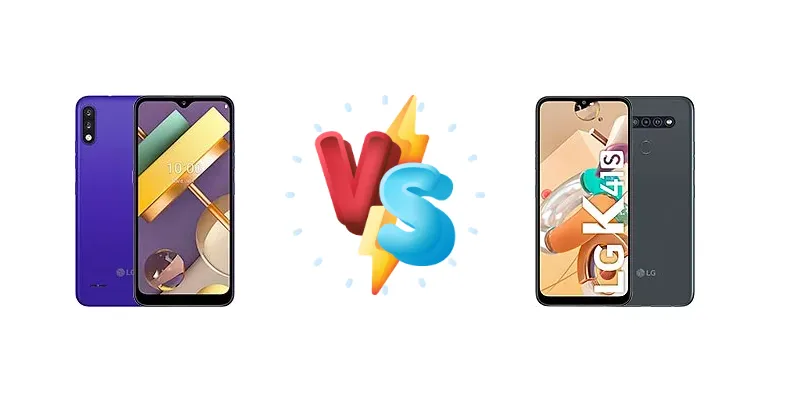
The LG K22 and K41S represent LG's attempts to capture the ultra-budget smartphone market. While both devices aim for affordability, they diverge significantly in their core hardware, particularly the chipset. This comparison dissects those differences to determine which phone delivers the best value for users prioritizing performance versus efficiency.
🏆 Quick Verdict
For most users, the LG K41S is the superior choice. Its Mediatek Helio P22 chipset, built on a 12nm process, offers a substantial performance advantage over the K22’s Snapdragon 215, making it better suited for multitasking and moderately demanding apps. While the K22 may offer slightly better battery life due to its less powerful processor, the K41S’s performance gains outweigh this trade-off.
| Network |
|---|
| 2G bands | GSM 850 / 900 / 1800 / 1900 | GSM 850 / 900 / 1800 / 1900 |
| 3G bands | HSDPA 850 / 900 / 1900 / 2100 - International | HSDPA 850 / 900 / 1900 / 2100 |
| 4G bands | 1, 3, 5, 7, 8, 20, 28, 38, 40 - International | 1, 3, 7, 8, 20, 38 |
| Speed | HSPA 42.2/5.76 Mbps, LTE Cat4 150/50 Mbps | HSPA 42.2/5.76 Mbps, LTE Cat4 150/50 Mbps |
| Technology | GSM / HSPA / LTE | GSM / HSPA / LTE |
| | 1, 3, 5, 7, 8, 20, 28, 40 - Brazil | - |
| Launch |
|---|
| Announced | 2020, September 12. Released 2020, September 12 | 2020, February 18. Released 2020, April 27 |
| Status | Discontinued | Discontinued |
| Body |
|---|
| Build | Glass front, plastic frame, plastic back | - |
| Dimensions | 155.7 x 75.4 x 8.4 mm (6.13 x 2.97 x 0.33 in) | 165.8 x 76.5 x 8.3 mm (6.53 x 3.01 x 0.33 in) |
| SIM | Nano-SIM + Nano-SIM | · Nano-SIM· Nano-SIM + Nano-SIM |
| Weight | 169.5 g (6.00 oz) | 191.7 g (6.77 oz) |
| | MIL-STD-810G compliant*
*does not guarantee ruggedness or use in extreme conditions | MIL-STD-810G compliant*
*does not guarantee ruggedness or use in extreme conditions |
| Display |
|---|
| Protection | - | Scratch-resistant glass |
| Resolution | 720 x 1520 pixels, 19:9 ratio (~271 ppi density) | 720 x 1600 pixels, 20:9 ratio (~268 ppi density) |
| Size | 6.2 inches, 95.9 cm2 (~81.7% screen-to-body ratio) | 6.55 inches, 103.6 cm2 (~81.7% screen-to-body ratio) |
| Type | IPS LCD, 400 nits (typ) | IPS LCD |
| Platform |
|---|
| CPU | Quad-core 1.3 GHz Cortex-A53 | Octa-core 2.0 GHz Cortex-A53 |
| Chipset | Qualcomm QM215 Snapdragon 215 (28 nm) | Mediatek MT6762 Helio P22 (12 nm) |
| GPU | Adreno 308 | PowerVR GE8320 |
| OS | Android 10 | Android 9.0 (Pie) |
| Memory |
|---|
| Card slot | microSDXC | microSDXC (dedicated slot) |
| Internal | 32GB 2GB RAM, 64GB 3GB RAM | 32GB 3GB RAM |
| | eMMC 5.1 | eMMC 5.1 |
| Main Camera |
|---|
| Dual | 13 MP, 27mm (wide), 1/3.1", 1.12µm, PDAF
2 MP (macro) | - |
| Features | LED flash, HDR | LED flash, panorama, HDR |
| Quad | - | 13 MP, f/2.0, 28mm (wide), PDAF
5 MP, f/2.2, 115˚, (ultrawide)
2 MP (macro)
Auxiliary lens |
| Video | 1080p@30fps | 1080p@30fps |
| Selfie camera |
|---|
| Single | 5 MP, f/2.2, 24mm (wide), 1/5.0", 1.12µm | 8 MP |
| Video | 1080p@30fps | 1080p@30fps |
| Sound |
|---|
| 3.5mm jack | Yes | Yes |
| 35mm jack | Yes | Yes |
| Loudspeaker | Yes | Yes |
| Comms |
|---|
| Bluetooth | 5.0, A2DP, LE | 5.0, A2DP, LE |
| NFC | No | Yes |
| Positioning | GPS, GLONASS | GPS |
| Radio | FM radio (market/operator dependent) | No |
| USB | microUSB 2.0, OTG | USB Type-C 2.0, OTG |
| WLAN | Wi-Fi 802.11 b/g/n, Wi-Fi Direct | Wi-Fi 802.11 b/g/n, Wi-Fi Direct, DLNA |
| Features |
|---|
| Sensors | Accelerometer, proximity, compass | Fingerprint (rear-mounted), accelerometer, proximity, compass |
| Battery |
|---|
| Type | Li-Po 3000 mAh | Li-Po 4000 mAh |
| Misc |
|---|
| Colors | Titan, Blue | Titanium, Black, White |
| Models | LMK200Z, LMK200E, LMK200B, LM-K200 | LMK410EMW, LM-K410EMW, LM-K410 |
| Price | About 140 EUR | About 220 EUR |
LG K22
- Potentially longer battery life with minimal use
- Simpler processor may result in less software bloat
- Lower price point (likely)
- Significantly slower performance
- Struggles with multitasking
- Poor gaming performance
LG K41S
- Faster and more responsive performance
- Better multitasking capabilities
- Improved image processing
- More suitable for gaming
- Potentially shorter battery life under heavy use
- May run slightly warmer
- Likely a higher price point
Display Comparison
Neither LG provides detailed display specifications beyond resolution. However, given the price point, both likely utilize IPS LCD panels. The K41S’s more powerful chipset *could* support a slightly higher refresh rate, though this is unconfirmed. The real difference lies in the processing power available to drive the display; the K41S will likely exhibit smoother animations and faster response times. Bezels are expected to be substantial on both devices, typical of this market segment.
Camera Comparison
Without detailed camera sensor information, a direct comparison is difficult. However, it’s safe to assume both phones feature basic camera setups geared towards casual photography. The K41S’s more powerful ISP (Image Signal Processor) within the Helio P22 chipset will likely result in better image processing, particularly in low-light conditions. Any differences in sensor size or lens aperture would further accentuate this advantage. The presence of a dedicated ISP on the K41S allows for more sophisticated image algorithms, potentially improving dynamic range and noise reduction. The often-included 2MP macro lenses on both devices are largely marketing fluff and offer minimal practical benefit.
Performance
The core difference between these phones is the chipset. The LG K41S boasts a Mediatek Helio P22, an octa-core processor built on a 12nm process, clocked at 2.0 GHz. This contrasts sharply with the LG K22’s Qualcomm Snapdragon 215, a quad-core processor fabricated on a larger 28nm node and running at 1.3 GHz. The 12nm process of the Helio P22 is significantly more efficient, allowing for higher clock speeds without excessive heat generation. The octa-core configuration further enhances multitasking capabilities. The K41S will demonstrably outperform the K22 in almost all CPU-bound tasks, offering a smoother user experience and faster app loading times.
Battery Life
Battery capacity is not specified in the provided data. However, the Snapdragon 215 in the K22, being less power-hungry, will likely contribute to longer battery life *under light usage*. The K41S’s Helio P22, while more efficient per clock cycle, draws more power overall due to its higher performance. The difference in battery life will be most noticeable during sustained use, such as video streaming or gaming, where the K41S will deplete its battery faster. Charging wattage is also unknown, but likely slow on both devices.
Buying Guide
Buy the LG K22 if you absolutely need the longest possible battery life for extremely light usage – primarily calls, texts, and occasional light browsing. It’s a good option for a first smartphone for someone with minimal needs. Buy the LG K41S if you want a more responsive experience for social media, streaming video, and basic gaming. The K41S is the better choice for anyone who doesn’t want to constantly fight with a sluggish interface.
Frequently Asked Questions
❓ Will the LG K41S struggle with popular apps like Facebook or Instagram?
While the Helio P22 isn't a powerhouse, it's capable of running apps like Facebook and Instagram smoothly. You might experience occasional slowdowns with multiple apps open simultaneously, but for typical social media usage, the K41S should provide an acceptable experience. The K22 would likely struggle more noticeably with these apps.
❓ Is the LG K41S suitable for playing mobile games like PUBG Mobile or Call of Duty Mobile?
The LG K41S can *run* PUBG Mobile and Call of Duty Mobile, but don't expect a high-fidelity gaming experience. You'll likely need to play at the lowest graphics settings and may still encounter frame rate drops. The Snapdragon 215 in the K22 is even less capable and would provide a significantly worse gaming experience.
❓ How much faster is the LG K41S in real-world use compared to the LG K22?
The K41S will feel noticeably faster in almost all tasks. App loading times will be quicker, web browsing will be smoother, and multitasking will be less frustrating. The difference isn't night and day, but it's substantial enough to make the K41S a more enjoyable phone to use daily.