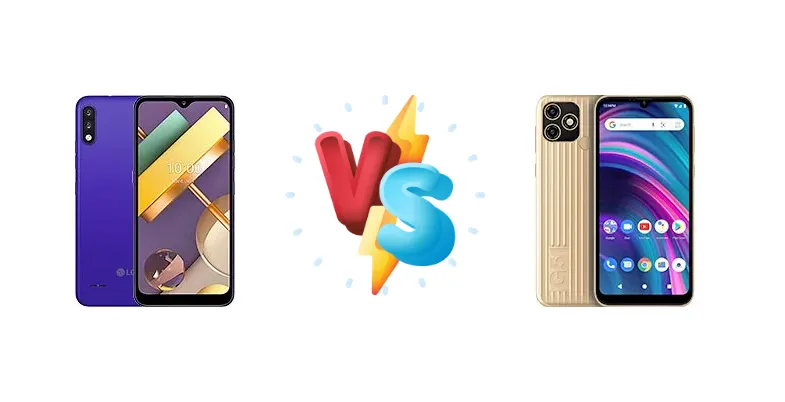
The sub-$150 smartphone market is fiercely competitive, demanding compromises. Both the LG K22 and BLU G51 aim to deliver a functional Android experience at an incredibly low price point. However, they achieve this with significantly different chipsets, leading to distinct performance characteristics. This comparison dissects those differences to determine which phone offers the best value for the money.
🏆 Quick Verdict
For the average user prioritizing responsiveness and a slightly smoother experience, the BLU G51 emerges as the better choice. Its Mediatek Helio A22, built on a more efficient 12nm process, offers a noticeable performance advantage over the LG K22’s older Snapdragon 215, despite both utilizing Cortex-A53 cores. While neither phone excels, the G51 provides a more usable daily driver.
| Network |
|---|
| 2G bands | GSM 850 / 900 / 1800 / 1900 | GSM 850 / 900 / 1800 / 1900 |
| 3G bands | HSDPA 850 / 900 / 1900 / 2100 - International | HSDPA 850 / 900 / 1700(AWS) / 1900 / 2100 |
| 4G bands | 1, 3, 5, 7, 8, 20, 28, 38, 40 - International | 2, 3, 4, 5, 7, 12, 17, 28, 66 |
| Speed | HSPA 42.2/5.76 Mbps, LTE Cat4 150/50 Mbps | HSPA, LTE |
| Technology | GSM / HSPA / LTE | GSM / HSPA / LTE |
| | 1, 3, 5, 7, 8, 20, 28, 40 - Brazil | - |
| Launch |
|---|
| Announced | 2020, September 12. Released 2020, September 12 | 2022, June 03 |
| Status | Discontinued | Available. Released 2022, June 03 |
| Body |
|---|
| Build | Glass front, plastic frame, plastic back | - |
| Dimensions | 155.7 x 75.4 x 8.4 mm (6.13 x 2.97 x 0.33 in) | 155.3 x 73.5 x 9.5 mm (6.11 x 2.89 x 0.37 in) |
| SIM | Nano-SIM + Nano-SIM | Nano-SIM + Nano-SIM |
| Weight | 169.5 g (6.00 oz) | 166 g (5.86 oz) |
| | MIL-STD-810G compliant*
*does not guarantee ruggedness or use in extreme conditions | - |
| Display |
|---|
| Resolution | 720 x 1520 pixels, 19:9 ratio (~271 ppi density) | 720 x 1520 pixels, 19:9 ratio (~276 ppi density) |
| Size | 6.2 inches, 95.9 cm2 (~81.7% screen-to-body ratio) | 6.1 inches, 92.9 cm2 (~81.4% screen-to-body ratio) |
| Type | IPS LCD, 400 nits (typ) | IPS LCD |
| Platform |
|---|
| CPU | Quad-core 1.3 GHz Cortex-A53 | Quad-core 2.0 GHz Cortex-A53 |
| Chipset | Qualcomm QM215 Snapdragon 215 (28 nm) | Mediatek MT6761 Helio A22 (12 nm) |
| GPU | Adreno 308 | PowerVR GE8320 |
| OS | Android 10 | Android 11 (Go edition) |
| Memory |
|---|
| Card slot | microSDXC | microSDXC |
| Internal | 32GB 2GB RAM, 64GB 3GB RAM | 32GB 2GB RAM |
| | eMMC 5.1 | eMMC 5.1 |
| Main Camera |
|---|
| Dual | 13 MP, 27mm (wide), 1/3.1", 1.12µm, PDAF
2 MP (macro) | 8 MP
Auxiliary lens |
| Features | LED flash, HDR | LED flash, HDR, panorama |
| Single | - | 8 MP |
| Video | 1080p@30fps | 1080p@30fps |
| Selfie camera |
|---|
| Single | 5 MP, f/2.2, 24mm (wide), 1/5.0", 1.12µm | 8 MP |
| Video | 1080p@30fps | 720p@30fps |
| Sound |
|---|
| 3.5mm jack | Yes | Yes |
| 35mm jack | Yes | Yes |
| Loudspeaker | Yes | Yes |
| Comms |
|---|
| Bluetooth | 5.0, A2DP, LE | 4.2, A2DP, LE |
| NFC | No | No |
| Positioning | GPS, GLONASS | GPS |
| Radio | FM radio (market/operator dependent) | FM radio |
| USB | microUSB 2.0, OTG | microUSB 2.0 |
| WLAN | Wi-Fi 802.11 b/g/n, Wi-Fi Direct | Wi-Fi 802.11 a/b/g/n, Wi-Fi Direct |
| Features |
|---|
| Sensors | Accelerometer, proximity, compass | Fingerprint (rear-mounted), accelerometer, proximity |
| Battery |
|---|
| Type | Li-Po 3000 mAh | Li-Po 3000 mAh |
| Misc |
|---|
| Colors | Titan, Blue | Black, Blue, Green, Silver, Gold |
| Models | LMK200Z, LMK200E, LMK200B, LM-K200 | - |
| Price | About 140 EUR | - |
LG K22
- LG Brand Recognition
- Potentially simpler user interface
- May be more readily available in some regions
- Older, less efficient Snapdragon 215 chipset
- Lower performance compared to the BLU G51
- Likely slower app loading times
BLU G51
- More modern and efficient Mediatek Helio A22 chipset
- Better performance for multitasking and light gaming
- Potentially longer battery life
- Less established brand reputation
- Software updates may be less frequent
- Build quality may be slightly lower
Display Comparison
Neither LG nor BLU provide detailed display specifications for these models. Given their price point, we can assume both utilize LCD panels with modest resolutions (likely 720p+). The lack of information prevents a detailed comparison of brightness, color accuracy, or viewing angles. However, the focus here is on processing power, not display fidelity. Expect both displays to be adequate for basic use but unremarkable.
Camera Comparison
Both phones likely feature basic camera setups, and detailed specifications are scarce. It’s safe to assume both will include a primary camera and potentially a secondary depth sensor. Given the price bracket, image quality will be heavily reliant on software processing and lighting conditions. Without knowing sensor sizes or apertures, it’s difficult to declare a clear winner. However, the slightly better processing power of the Helio A22 in the BLU G51 *could* translate to marginally faster image processing times, but don't expect flagship-level results from either.
Performance
The core difference lies in the chipsets. The BLU G51’s Mediatek Helio A22, fabricated on a 12nm process, represents a significant architectural improvement over the LG K22’s Qualcomm Snapdragon 215 (28nm). While both CPUs feature quad-core Cortex-A53 cores clocked at 2.0 GHz (G51) and 1.3 GHz (K22), the smaller node size of the Helio A22 translates to better power efficiency and, crucially, higher sustained performance. The Snapdragon 215, being an older design, will likely exhibit more throttling under load. This means the G51 will maintain a more consistent frame rate during app switching and light gaming. The G51’s higher clock speed further contributes to this advantage.
Battery Life
Again, specific battery capacities are not provided. However, the more efficient 12nm Helio A22 in the BLU G51 will likely result in better battery life compared to the LG K22’s Snapdragon 215. The 28nm process of the Snapdragon 215 is inherently less power-efficient. While the K22 might have a slightly larger battery, the G51’s chipset will draw less power during typical usage, leading to longer screen-on time. Charging speeds are also likely to be similar – slow, given the budget nature of both devices.
Buying Guide
Buy the LG K22 if you absolutely need the LG brand ecosystem and are primarily using the phone for very basic tasks like calls, texts, and light messaging. Its simplicity might appeal to those less comfortable with technology. Buy the BLU G51 if you prioritize a more responsive user interface, slightly better multitasking capabilities, and a more modern chipset architecture, even if it means sacrificing brand recognition.
Frequently Asked Questions
❓ Will the BLU G51 be able to run popular social media apps like Facebook and Instagram smoothly?
Yes, the Mediatek Helio A22 in the BLU G51 is sufficiently capable of running most popular social media applications without significant lag. While it won't offer a fluid experience like a flagship device, it should provide a usable experience for browsing feeds and posting updates.
❓ Is the LG K22 a good choice for someone who primarily uses their phone for making calls and sending texts?
The LG K22 is a viable option for basic communication. Its Snapdragon 215 chipset is adequate for handling calls and texts, and the LG brand may appeal to those seeking a familiar interface. However, even for these basic tasks, the BLU G51 offers a more responsive experience.
❓ Can I play games on the BLU G51?
The BLU G51 can handle *very* light gaming, such as simple puzzle games or older titles. However, demanding 3D games will likely experience significant frame rate drops and lag due to the Helio A22's limited graphical capabilities. It's not a gaming phone by any stretch.
❓ How long will the battery last on the LG K22 with moderate use?
With moderate use (calls, texts, occasional web browsing), the LG K22 will likely last a full day on a single charge. However, the older Snapdragon 215 chipset is less power-efficient, so battery life will be shorter compared to the BLU G51.