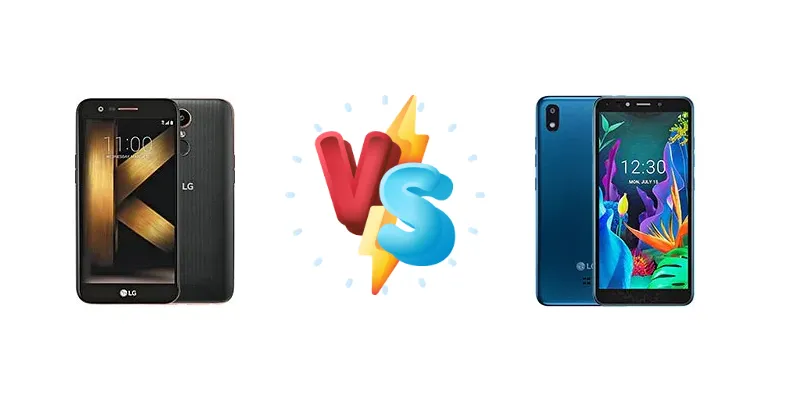
The LG K20 Plus and LG K20 (2019) were both budget-friendly options aiming to deliver essential smartphone features. While they share a similar target audience, subtle differences in their hardware could impact your daily experience. This comprehensive comparison will help you determine which phone is the better choice for your needs.
🏆 Quick Verdict
The LG K20 (2019) edges out the K20 Plus thanks to its slightly faster processor and potentially improved software support. Both offer decent value, but the 2019 model's marginal performance boost makes it the preferred pick for most users seeking a reliable budget device.
| Network |
|---|
| 2G bands | GSM 850 / 900 / 1800 / 1900 | GSM 850 / 900 / 1800 / 1900 |
| 3G bands | HSDPA 850 / 1700(AWS) / 1900 - T-Mobile & MetroPCS | HSDPA 850 / 900 / 1900 / 2100 |
| 4G bands | 2, 4, 5, 12 - T-Mobile & MetroPCS | 1, 3, 7, 8, 20, 38 |
| Speed | HSPA 42.2/5.76 Mbps, LTE (2CA) Cat6 300/50 Mbps, EV-DO Rev.A 3.1 Mbps | HSPA 42.2/5.76 Mbps, LTE Cat4 150/50 Mbps |
| Technology | GSM / CDMA / HSPA / EVDO / LTE | GSM / HSPA / LTE |
| | 2, 4, 5, 13 - Verizon | - |
| Launch |
|---|
| Announced | 2016, December. Released 2016, December | 2019, August. Released 2019, September |
| Status | Discontinued | Discontinued |
| Body |
|---|
| Build | - | Glass front, plastic back, plastic frame |
| Dimensions | 148.6 x 75.2 x 7.9 mm (5.85 x 2.96 x 0.31 in) | 148.6 x 71.9 x 8.3 mm (5.85 x 2.83 x 0.33 in) |
| SIM | Nano-SIM | Nano-SIM + Nano-SIM |
| Weight | 140 g (4.94 oz) | 152 g (5.36 oz) |
| | - | MIL-STD-810G compliant*
*does not guarantee ruggedness or use in extreme conditions |
| Display |
|---|
| Protection | Corning Gorilla Glass 3 (T-Mobile) | - |
| Resolution | 720 x 1280 pixels, 16:9 ratio (~277 ppi density) | 480 x 960 pixels, 18:9 ratio (~197 ppi density) |
| Size | 5.3 inches, 77.4 cm2 (~69.3% screen-to-body ratio) | 5.45 inches, 76.7 cm2 (~71.7% screen-to-body ratio) |
| Type | IPS LCD | IPS LCD |
| Platform |
|---|
| CPU | Quad-core 1.4 GHz Cortex-A53 | Quad-core 1.5 GHz Cortex-A53 |
| Chipset | Qualcomm MSM8917 Snapdragon 425 (28 nm) | Mediatek MT6739 (28 nm) |
| GPU | Adreno 308 | PowerVR GE8100 |
| OS | Android 7.0 (Nougat) | Android 9.0 Pie (Go edition) |
| Memory |
|---|
| Card slot | microSDXC (dedicated slot) | microSDHC (dedicated slot) |
| Internal | 16GB 2GB RAM, 32GB 2GB RAM | 16GB 1GB RAM |
| | eMMC 5.1 | eMMC 5.1 |
| Main Camera |
|---|
| Features | LED flash, HDR | LED flash, panorama, HDR |
| Single | 13 MP, f/2.2, 1/3.1", 1.12µm, AF | 8 MP, f/2.0, 27mm (wide), 1/4.0", 1.12µm, AF |
| Video | 1080p@30fps | 1080p@30fps |
| Selfie camera |
|---|
| Features | - | LED flash |
| Single | 5 MP, f/2.4, 1/5.0", 1.12µm | 5 MP, f/2.2, 24mm (wide), 1/5.0", 1.12µm |
| Video | 1080p@30fps | - |
| Sound |
|---|
| 3.5mm jack | Yes | Yes |
| 35mm jack | Yes | Yes |
| Loudspeaker | Yes | Yes |
| Comms |
|---|
| Bluetooth | 4.2, A2DP, LE | 5.0, A2DP, LE |
| NFC | No | No |
| Positioning | GPS, S-GPS | GPS |
| Radio | FM radio | No |
| USB | microUSB 2.0 | microUSB 2.0 |
| WLAN | Wi-Fi 802.11 a/b/g/n, Wi-Fi Direct | Wi-Fi 802.11 b/g/n |
| Features |
|---|
| Sensors | Fingerprint (rear-mounted), accelerometer, proximity, compass | Accelerometer, proximity |
| Battery |
|---|
| Stand-by | Up to 300 h | - |
| Talk time | Up to 31 h | - |
| Type | Li-Ion 2700 mAh, removable | Li-Ion 3000 mAh, non-removable |
| Misc |
|---|
| Colors | Black | New Aurora Black, New Moroccan Blue |
| Models | LGMP260, TP260, VS501, M255 | LM-X120EMW, LMX120EMW, LM-X120, LMX120BMW |
| Price | About 160 EUR | About 100 EUR |
LG K20 plus
- Potentially lower price
- Decent battery life
- Acceptable camera for basic use
- Slightly older chipset
- Potentially shorter software support
- Limited performance for demanding tasks
LG K20 (2019)
- Slightly faster processor
- Potentially longer software support
- Improved front camera
- May be slightly more expensive
- Still a budget phone with limitations
- Limited RAM
Display Comparison
Both phones feature a 5.3-inch IPS LCD display with a resolution of 720 x 1440 pixels (HD+). While the panels are similar in quality, color accuracy and brightness might vary slightly. Expect adequate viewing angles and decent outdoor visibility, but don't expect flagship-level display performance.
Camera Comparison
The LG K20 Plus typically features a 13MP main camera and a 5MP front camera. The LG K20 (2019) often includes a 13MP main camera and an 8MP front camera. Image quality is generally acceptable in good lighting conditions, but low-light performance is limited. The front camera on the 2019 model offers a slight improvement for selfies.
Performance
The LG K20 (2019) holds a slight advantage here. Its MediaTek MT6739 chipset with a 1.5 GHz Cortex-A53 quad-core CPU offers a small performance boost over the Qualcomm Snapdragon 425 (1.4 GHz Cortex-A53) in the K20 Plus. This translates to slightly smoother multitasking and app loading times. Both phones have 2GB or 3GB of RAM, which can be a bottleneck for demanding tasks.
Battery Life
Both phones are equipped with a 3000mAh battery. Battery life is generally sufficient for a full day of moderate use. However, the slightly more efficient MediaTek chipset in the LG K20 (2019) might provide marginally better battery endurance.
Buying Guide
The LG K20 Plus is a good option for users prioritizing a slightly lower price point and are comfortable with potentially older software. The LG K20 (2019) is ideal for those seeking a bit more performance and potentially longer software support, even within the budget category.
Frequently Asked Questions
❓ What is the difference in performance between the two phones?
The LG K20 (2019) has a slightly faster MediaTek MT6739 chipset compared to the Qualcomm Snapdragon 425 in the K20 Plus, resulting in marginally better performance.
❓ Which phone will receive software updates for longer?
The LG K20 (2019) is likely to receive software updates for a slightly longer period due to being a newer model, although both are budget devices and updates are limited.