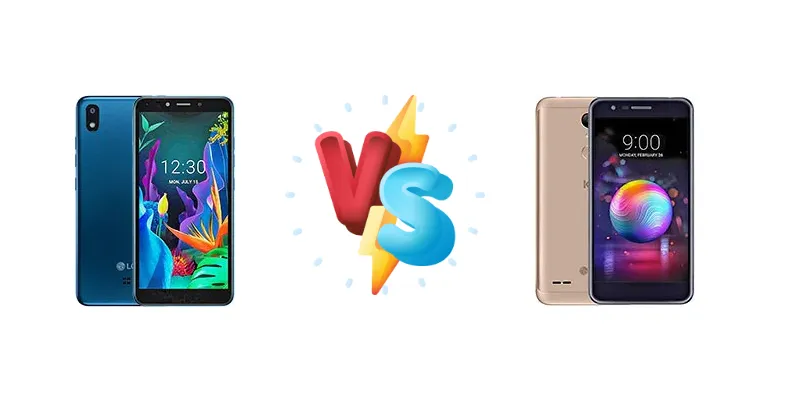
The LG K20 (2019) and LG K11 Plus represent LG’s attempts to capture the ultra-budget smartphone market. While both devices share a similar price point and target demographic, a key difference lies under the hood: the K11 Plus boasts an octa-core processor compared to the K20’s quad-core setup. This comparison will dissect the implications of this core difference, alongside other specifications, to determine which device offers the best value for users.
🏆 Quick Verdict
For the average user prioritizing multitasking and smoother app switching, the LG K11 Plus is the clear winner. Its Mediatek MT6750 chipset, with its eight cores, provides a noticeable performance boost over the K20’s MT6739, making it better suited for handling multiple applications simultaneously. However, the K20 remains a viable option for basic users.
| Network |
|---|
| 2G bands | GSM 850 / 900 / 1800 / 1900 | GSM 850 / 900 / 1800 / 1900 |
| 3G bands | HSDPA 850 / 900 / 1900 / 2100 | HSDPA 850 / 900 / 2100 - LMX410YC |
| 4G bands | 1, 3, 7, 8, 20, 38 | 1, 3, 5, 7, 8, 28, 38, 40 - LMX410YC |
| Speed | HSPA 42.2/5.76 Mbps, LTE Cat4 150/50 Mbps | HSPA 42.2/5.76 Mbps, LTE (2CA) Cat6 300/50 Mbps |
| Technology | GSM / HSPA / LTE | GSM / HSPA / LTE |
| | - | 1, 3, 7, 8, 20 - LMX410ZCW |
| Launch |
|---|
| Announced | 2019, August. Released 2019, September | 2018, July. Released 2018, July |
| Status | Discontinued | Discontinued |
| Body |
|---|
| Build | Glass front, plastic back, plastic frame | Glass front, aluminum back, plastic frame |
| Dimensions | 148.6 x 71.9 x 8.3 mm (5.85 x 2.83 x 0.33 in) | 148.7 x 75.3 x 8.7 mm (5.85 x 2.96 x 0.34 in) |
| SIM | Nano-SIM + Nano-SIM | · Nano-SIM· Nano-SIM + Nano-SIM |
| Weight | 152 g (5.36 oz) | 162 g (5.71 oz) |
| | MIL-STD-810G compliant*
*does not guarantee ruggedness or use in extreme conditions | MIL-STD-810G compliant*
*does not guarantee ruggedness or use in extreme conditions |
| Display |
|---|
| Resolution | 480 x 960 pixels, 18:9 ratio (~197 ppi density) | 720 x 1280 pixels, 16:9 ratio (~277 ppi density) |
| Size | 5.45 inches, 76.7 cm2 (~71.7% screen-to-body ratio) | 5.3 inches, 77.4 cm2 (~69.2% screen-to-body ratio) |
| Type | IPS LCD | IPS LCD |
| Platform |
|---|
| CPU | Quad-core 1.5 GHz Cortex-A53 | Octa-core (4x1.5 GHz Cortex-A53 & 4x1.0 GHz Cortex-A53) |
| Chipset | Mediatek MT6739 (28 nm) | Mediatek MT6750 (28 nm) |
| GPU | PowerVR GE8100 | Mali-T860MP2 |
| OS | Android 9.0 Pie (Go edition) | Android 7.1.2 (Nougat), upgradable to Android 8.1 (Oreo) |
| Memory |
|---|
| Card slot | microSDHC (dedicated slot) | microSDXC (dedicated slot) |
| Internal | 16GB 1GB RAM | 16GB 2GB RAM, 32GB 2GB RAM, 32GB 3GB RAM |
| | eMMC 5.1 | eMMC 5.1 |
| Main Camera |
|---|
| Features | LED flash, panorama, HDR | LED flash, HDR |
| Single | 8 MP, f/2.0, 27mm (wide), 1/4.0", 1.12µm, AF | 13 MP, f2.2, 26mm (wide), 1/3.1", PDAF - LG K11+
8 MP, f/2.2, 26mm (wide), 1/4.0", PDAF - LG K11α |
| Video | 1080p@30fps | 1080p@30fps |
| Selfie camera |
|---|
| Features | LED flash | - |
| Single | 5 MP, f/2.2, 24mm (wide), 1/5.0", 1.12µm | 5 MP, f/2.2, 18mm, 1/5.0", 1.12µm |
| Video | - | 720p@30fps |
| Sound |
|---|
| 3.5mm jack | Yes | Yes |
| 35mm jack | Yes | Yes |
| Loudspeaker | Yes | Yes |
| Comms |
|---|
| Bluetooth | 5.0, A2DP, LE | 4.2, A2DP, LE |
| NFC | No | Yes (market dependent) |
| Positioning | GPS | GPS, GLONASS |
| Radio | No | FM radio, RDS, recording |
| USB | microUSB 2.0 | microUSB 2.0 |
| WLAN | Wi-Fi 802.11 b/g/n | Wi-Fi 802.11 b/g/n, Wi-Fi Direct |
| Features |
|---|
| Sensors | Accelerometer, proximity | Fingerprint (rear-mounted), accelerometer, proximity, compass |
| Battery |
|---|
| Type | Li-Ion 3000 mAh, non-removable | Li-Ion 3000 mAh, non-removable |
| Misc |
|---|
| Colors | New Aurora Black, New Moroccan Blue | Moroccan Blue, Terra Gold, Black |
| Models | LM-X120EMW, LMX120EMW, LM-X120, LMX120BMW | LMX410, LMX410FC, LMX410YC, LMX410HC, LMX410EO, LMX410ZCW, LMX410BCW, LM-X410S |
| Price | About 100 EUR | About 140 EUR |
| SAR EU | - | 0.81 W/kg (head) |
LG K20 (2019)
- Potentially slightly better battery life under light use.
- Simpler user experience for basic tasks.
- Likely lower price point (depending on retailer).
- Significantly slower performance for multitasking.
- Struggles with demanding apps and games.
- Less responsive user interface.
LG K11 Plus
- Noticeably faster performance due to octa-core processor.
- Smoother multitasking and app switching.
- Better suited for moderate gaming.
- Potentially improved image processing.
- Potentially shorter battery life.
- May be slightly more expensive.
- Still limited by the 28nm process and low RAM (assumed).
Display Comparison
Neither LG provides detailed display specifications beyond resolution. Given their market segment, both likely utilize IPS LCD panels. The focus here isn't on display quality, but rather the impact of the chipset on UI responsiveness *within* the display. The K11 Plus’s more powerful processor will contribute to smoother scrolling and faster app loading times on the display, even if the panel itself is similar.
Camera Comparison
Without detailed camera specs, a direct comparison is difficult. Both phones likely feature similar low-end camera sensors. The chipset’s image signal processor (ISP) plays a role, and the MT6750 in the K11 Plus *should* offer slightly faster image processing and potentially better noise reduction. However, the real-world difference will likely be minimal, especially in good lighting conditions. Expect both to struggle in low-light scenarios.
Performance
The core difference lies in the chipsets. The LG K20 (2019) utilizes the Mediatek MT6739, a quad-core processor clocked at 1.5 GHz using Cortex-A53 cores. The LG K11 Plus steps up to the Mediatek MT6750, featuring an octa-core configuration – four cores at 1.5 GHz and four at 1.0 GHz, also Cortex-A53. This isn’t a generational leap in core architecture, but doubling the core count significantly improves multitasking capabilities. The K11 Plus will handle more apps in the background and switch between them more fluidly. While both are 28nm chips, the MT6750’s architecture is designed for better sustained performance under load, though thermal throttling will still be a factor in both devices.
Battery Life
Battery capacity isn’t specified, but given the target market, both likely house batteries in the 2500-3000 mAh range. The MT6750 in the K11 Plus, while more powerful, is also less power-efficient than the MT6739. Therefore, while the K11 Plus offers better performance, the K20 (2019) may achieve slightly longer battery life under light usage. Charging wattage is also unknown, but likely slow on both devices.
Buying Guide
Buy the LG K20 (2019) if you need a supremely basic smartphone for calls, texts, and light web browsing, and prioritize simplicity over performance. Buy the LG K11 Plus if you prefer a device capable of handling moderate multitasking, occasional gaming, and a slightly more responsive user experience, even if it means potentially sacrificing a small amount of battery life due to the more powerful processor.
Frequently Asked Questions
❓ Will the LG K11 Plus handle popular games like PUBG Mobile?
The LG K11 Plus can *run* PUBG Mobile, but don't expect a high-fidelity experience. The MT6750 will allow for playable frame rates at low to medium settings, but you'll likely encounter stuttering and lag, especially in intense firefights. It's suitable for casual gaming, but not competitive play.
❓ Is the difference in performance between the K20 and K11 Plus noticeable for everyday tasks like browsing and social media?
Yes, the difference is noticeable. While both phones can handle basic tasks, the K11 Plus’s octa-core processor results in snappier app loading times, smoother scrolling through social media feeds, and a more responsive overall user experience. The K20 may exhibit lag when switching between apps or loading complex web pages.
❓ How much RAM do these phones have, and will that impact performance?
RAM capacity isn't explicitly stated in the provided data. However, given their price point, both likely feature 2GB or 3GB of RAM. This limited RAM will exacerbate the performance differences between the two devices, as the K11 Plus’s processor will be better equipped to manage multiple apps within that limited memory.