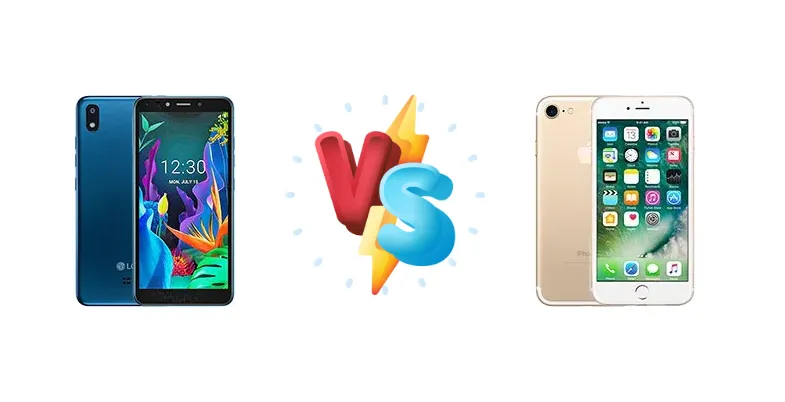
The Apple iPhone 7, despite its age, remains a popular choice in the used market due to Apple’s ecosystem and perceived longevity. The LG K20 (2019) represents a more modern, budget-focused Android option. This comparison dissects these two devices, focusing on where the iPhone 7’s older hardware holds up and where the K20’s newer design offers advantages.
🏆 Quick Verdict
For users prioritizing raw performance and a smoother user experience, the Apple iPhone 7 is the clear winner. Its A10 Fusion chip, built on a 16nm process, significantly outperforms the LG K20’s Mediatek MT6739. However, the K20 offers a more modern Android experience at a lower price point.
| Network |
|---|
| 2G bands | GSM 850 / 900 / 1800 / 1900 | GSM 850 / 900 / 1800 / 1900 - A1660, A1778 |
| 3G bands | HSDPA 850 / 900 / 1900 / 2100 | HSDPA 850 / 900 / 1700(AWS) / 1900 / 2100 - A1660, A1778 |
| 4G bands | 1, 3, 7, 8, 20, 38 | 1, 2, 3, 4, 5, 7, 8, 12, 13, 17, 18, 19, 20, 25, 26, 27, 28, 29, 30, 38, 39, 40, 41 - A1660, A1778 |
| Speed | HSPA 42.2/5.76 Mbps, LTE Cat4 150/50 Mbps | HSPA 42.2/5.76 Mbps, LTE (3CA) Cat9 450/50 Mbps, EV-DO Rev.A 3.1 Mbps |
| Technology | GSM / HSPA / LTE | GSM / CDMA / HSPA / EVDO / LTE |
| | - | CDMA2000 1xEV-DO & TD-SCDMA - A1660 |
| Launch |
|---|
| Announced | 2019, August. Released 2019, September | 2016, September 07. Released 2016, September 16 |
| Status | Discontinued | Discontinued |
| Body |
|---|
| Build | Glass front, plastic back, plastic frame | Glass front (Corning-made glass), aluminum back, aluminum frame |
| Dimensions | 148.6 x 71.9 x 8.3 mm (5.85 x 2.83 x 0.33 in) | 138.3 x 67.1 x 7.1 mm (5.44 x 2.64 x 0.28 in) |
| SIM | Nano-SIM + Nano-SIM | Nano-SIM |
| Weight | 152 g (5.36 oz) | 138 g (4.87 oz) |
| | MIL-STD-810G compliant*
*does not guarantee ruggedness or use in extreme conditions | IP67 dust/water resistant (up to 1m for 30 min)
Apple Pay (Visa, MasterCard, AMEX certified) |
| Display |
|---|
| Protection | - | Ion-strengthened glass |
| Resolution | 480 x 960 pixels, 18:9 ratio (~197 ppi density) | 750 x 1334 pixels, 16:9 ratio (~326 ppi density) |
| Size | 5.45 inches, 76.7 cm2 (~71.7% screen-to-body ratio) | 4.7 inches, 60.9 cm2 (~65.6% screen-to-body ratio) |
| Type | IPS LCD | Retina IPS LCD, 625 nits (typ) |
| | - | 3D Touch display & home button |
| Platform |
|---|
| CPU | Quad-core 1.5 GHz Cortex-A53 | Quad-core 2.34 GHz (2x Hurricane + 2x Zephyr) |
| Chipset | Mediatek MT6739 (28 nm) | Apple A10 Fusion (16 nm) |
| GPU | PowerVR GE8100 | PowerVR Series7XT Plus (six-core graphics) |
| OS | Android 9.0 Pie (Go edition) | iOS 10.0.1, upgradable to iOS 15.8.5 |
| Memory |
|---|
| Card slot | microSDHC (dedicated slot) | No |
| Internal | 16GB 1GB RAM | 32GB 2GB RAM, 128GB 2GB RAM, 256GB 2GB RAM |
| | eMMC 5.1 | NVMe |
| Main Camera |
|---|
| Features | LED flash, panorama, HDR | Quad-LED dual-tone flash, HDR |
| Single | 8 MP, f/2.0, 27mm (wide), 1/4.0", 1.12µm, AF | 12 MP, f/1.8, 28mm (wide), 1/3.0", PDAF, OIS |
| Video | 1080p@30fps | 4K@30fps, 1080p@30/60/120fps, 720p@240fps |
| Selfie camera |
|---|
| Features | LED flash | Face detection, HDR, panorama |
| Single | 5 MP, f/2.2, 24mm (wide), 1/5.0", 1.12µm | 7 MP, f/2.2, 32mm (standard) |
| Video | - | 1080p@30fps |
| Sound |
|---|
| 3.5mm jack | Yes | No |
| 35mm jack | Yes | No |
| Loudspeaker | Yes | Yes, with stereo speakers |
| Comms |
|---|
| Bluetooth | 5.0, A2DP, LE | 4.2, A2DP, LE |
| NFC | No | Yes |
| Positioning | GPS | GPS, GLONASS, GALILEO, QZSS |
| Radio | No | No |
| USB | microUSB 2.0 | Lightning, USB 2.0 |
| WLAN | Wi-Fi 802.11 b/g/n | Wi-Fi 802.11 a/b/g/n/ac, dual-band, hotspot |
| Features |
|---|
| Sensors | Accelerometer, proximity | Fingerprint (front-mounted), accelerometer, gyro, proximity, compass, barometer |
| Battery |
|---|
| Talk time | - | Up to 14 h (3G) |
| Type | Li-Ion 3000 mAh, non-removable | Li-Ion 1960 mAh, non-removable (7.45 Wh) |
| Misc |
|---|
| Colors | New Aurora Black, New Moroccan Blue | Jet Black, Black, Silver, Gold, Rose Gold, Red |
| Models | LM-X120EMW, LMX120EMW, LM-X120, LMX120BMW | A1660, A1778, A1779, A1780, A1853, A1866, iPhone9,1, iPhone9,3 |
| Price | About 100 EUR | About 180 EUR |
| SAR | - | 1.19 W/kg (head) 1.19 W/kg (body) |
| SAR EU | - | 1.38 W/kg (head) 1.34 W/kg (body) |
| Tests |
|---|
| Audio quality | - |
Noise -92.4dB / Crosstalk -80.9dB |
| Battery life | - |
Endurance rating 61h
|
| Camera | - |
Photo / Video |
| Display | - |
Contrast ratio: 1603:1 (nominal), 3.964 (sunlight) |
| Loudspeaker | - |
Voice 67dB / Noise 73dB / Ring 75dB
|
| Performance | - |
Basemark OS II 2.0: 3416 |
LG K20 (2019)
- More powerful processor (A10 Fusion)
- Superior camera image processing
- Access to Apple’s ecosystem
- Older design and smaller screen
- Aging battery health
- Limited storage options
Apple iPhone 7
- Larger screen size (likely)
- Expandable storage via microSD
- More modern Android OS
- Significantly slower processor (MT6739)
- Less refined camera performance
- Potentially slower software updates
Display Comparison
Both devices share a similar contrast ratio of 1603:1 (nominal) and 3.964 (sunlight), suggesting comparable outdoor visibility. However, the iPhone 7’s smaller 4.7-inch display likely offers a higher pixel density than the LG K20’s unspecified screen size, resulting in a sharper image. The K20 benefits from a more recent manufacturing date, potentially avoiding some of the display degradation common in older iPhone 7 units.
Camera Comparison
While both phones offer photo and video capabilities, the iPhone 7’s image signal processor (ISP) within the A10 Fusion provides superior image processing. Although sensor sizes aren’t specified, Apple’s computational photography algorithms consistently deliver better dynamic range and detail. The LG K20 likely relies more heavily on software enhancements to compensate for a potentially less capable sensor. The iPhone 7’s video recording capabilities are also expected to be superior, offering better stabilization and quality.
Performance
The Apple A10 Fusion, fabricated on a 16nm process, is the dominant force here. Its quad-core configuration (2x Hurricane + 2x Zephyr) running at 2.34 GHz delivers significantly more processing power than the LG K20’s Mediatek MT6739 (28nm) and its quad-core 1.5 GHz Cortex-A53 cores. This translates to faster app loading times, smoother multitasking, and a more responsive overall experience on the iPhone 7. The A10 Fusion’s architecture also provides a more capable GPU for gaming and graphics-intensive tasks. The K20’s MT6739 will struggle with demanding applications.
Battery Life
Interestingly, both devices share an endurance rating of 61 hours, despite the LG K20 likely having a larger battery capacity due to its larger size. This suggests the iPhone 7’s more efficient A10 Fusion chip and iOS optimization contribute to comparable battery life. However, the iPhone 7’s battery has aged significantly since its release, meaning real-world performance will likely be lower than the K20’s, especially if the iPhone 7’s battery hasn’t been replaced.
Buying Guide
Buy the LG K20 (2019) if you need a large-screen Android device with expandable storage and are comfortable with a slower processor and less refined software experience. Buy the Apple iPhone 7 if you prioritize a responsive user interface, a more capable camera, and access to Apple’s ecosystem, even if it means accepting an older design and potentially reduced battery health.
Frequently Asked Questions
❓ Is the Mediatek MT6739 in the LG K20 powerful enough for modern mobile games?
The Mediatek MT6739 is a budget chipset and will struggle with graphically demanding games. While it can handle simpler titles, expect low frame rates and reduced graphical settings in popular games like PUBG or Call of Duty Mobile. The iPhone 7’s A10 Fusion offers a much smoother gaming experience.
❓ How does the aging battery on the iPhone 7 affect its usability in 2024?
The iPhone 7’s battery has likely degraded significantly over time. Expect shorter battery life compared to a new device, potentially requiring a mid-day charge with moderate use. Apple offers battery replacement services, which can restore much of the original battery life, but this adds to the overall cost.
❓ Does the LG K20 support software updates and security patches?
The LG K20 (2019) is unlikely to receive major Android version updates at this point. Security patches may be infrequent or nonexistent, posing a potential security risk. The iPhone 7, while also no longer receiving major iOS updates, generally receives security updates for a longer period than Android devices in this price range.