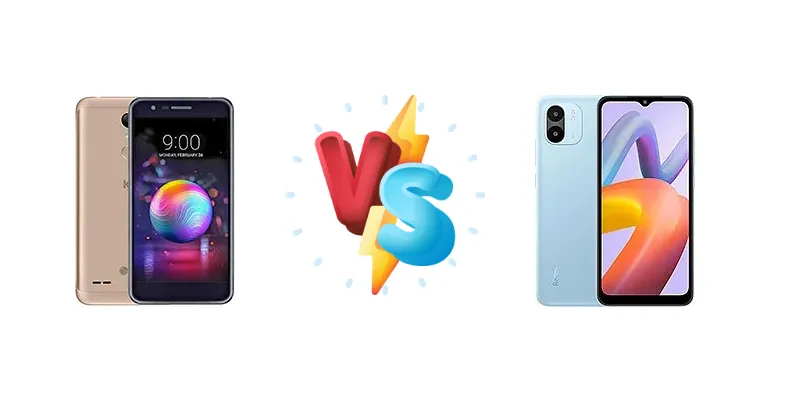
The LG K11 Plus and Xiaomi Redmi A2 represent two approaches to the ultra-budget smartphone market. The K11 Plus, utilizing an older but established Mediatek MT6750, aims for reliable performance. The Redmi A2, with its newer Mediatek Helio G36, attempts to offer a more modern experience, albeit within the same price bracket. This comparison dissects their key differences to determine which device delivers the best value.
🏆 Quick Verdict
For most users, the Xiaomi Redmi A2 emerges as the better choice. Its Helio G36 chipset, fabricated on a more efficient 12nm process, provides a noticeable performance uplift over the LG K11 Plus’s 28nm MT6750, and the inclusion of 10W charging is a practical advantage. While neither phone excels, the Redmi A2 offers a more contemporary experience.
| Network |
|---|
| 2G bands | GSM 850 / 900 / 1800 / 1900 | GSM 850 / 900 / 1800 / 1900 |
| 3G bands | HSDPA 850 / 900 / 2100 - LMX410YC | HSDPA 850 / 900 / 2100 |
| 4G bands | 1, 3, 5, 7, 8, 28, 38, 40 - LMX410YC | 1, 3, 5, 7, 8, 20, 28, 38, 40, 41 - International |
| Speed | HSPA 42.2/5.76 Mbps, LTE (2CA) Cat6 300/50 Mbps | HSPA, LTE |
| Technology | GSM / HSPA / LTE | GSM / HSPA / LTE |
| | 1, 3, 7, 8, 20 - LMX410ZCW | 1, 3, 5, 8, 40, 41 - India |
| Launch |
|---|
| Announced | 2018, July. Released 2018, July | 2023, March 24 |
| Status | Discontinued | Available. Released 2023, March 24 |
| Body |
|---|
| Build | Glass front, aluminum back, plastic frame | - |
| Dimensions | 148.7 x 75.3 x 8.7 mm (5.85 x 2.96 x 0.34 in) | 164.9 x 76.8 x 9.1 mm (6.49 x 3.02 x 0.36 in) |
| SIM | · Nano-SIM· Nano-SIM + Nano-SIM | Nano-SIM + Nano-SIM |
| Weight | 162 g (5.71 oz) | 192 g (6.77 oz) |
| | MIL-STD-810G compliant*
*does not guarantee ruggedness or use in extreme conditions | - |
| Display |
|---|
| Resolution | 720 x 1280 pixels, 16:9 ratio (~277 ppi density) | 720 x 1600 pixels, 20:9 ratio (~269 ppi density) |
| Size | 5.3 inches, 77.4 cm2 (~69.2% screen-to-body ratio) | 6.52 inches, 102.6 cm2 (~81.0% screen-to-body ratio) |
| Type | IPS LCD | IPS LCD, 400 nits (typ) |
| Platform |
|---|
| CPU | Octa-core (4x1.5 GHz Cortex-A53 & 4x1.0 GHz Cortex-A53) | Octa-core (4x2.2 GHz Cortex-A53 & 4x1.7 GHz Cortex-A53) |
| Chipset | Mediatek MT6750 (28 nm) | Mediatek Helio G36 (12 nm) |
| GPU | Mali-T860MP2 | PowerVR GE8320 |
| OS | Android 7.1.2 (Nougat), upgradable to Android 8.1 (Oreo) | Android 12 or 13 (Go edition), MIUI |
| Memory |
|---|
| Card slot | microSDXC (dedicated slot) | microSDXC (dedicated slot) |
| Internal | 16GB 2GB RAM, 32GB 2GB RAM, 32GB 3GB RAM | 32GB 2GB RAM, 32GB 3GB RAM, 64GB 2GB RAM, 64GB 3GB RAM, 64GB 4GB RAM |
| | eMMC 5.1 | eMMC 5.1 |
| Main Camera |
|---|
| Dual | - | 8 MP, f/2.0, (wide)
0.08 MP (depth) |
| Features | LED flash, HDR | Dual-LED flash, HDR |
| Single | 13 MP, f2.2, 26mm (wide), 1/3.1", PDAF - LG K11+
8 MP, f/2.2, 26mm (wide), 1/4.0", PDAF - LG K11α | 8 MP, f/2.0, (wide)
Auxiliary lens |
| Video | 1080p@30fps | 1080p@30fps |
| Selfie camera |
|---|
| Single | 5 MP, f/2.2, 18mm, 1/5.0", 1.12µm | 5 MP, f/2.2 |
| Video | 720p@30fps | 1080p@30fps |
| Sound |
|---|
| 3.5mm jack | Yes | Yes |
| 35mm jack | Yes | Yes |
| Loudspeaker | Yes | Yes |
| Comms |
|---|
| Bluetooth | 4.2, A2DP, LE | 5.0, A2DP, LE |
| NFC | Yes (market dependent) | No |
| Positioning | GPS, GLONASS | GPS, GLONASS, GALILEO, BDS |
| Radio | FM radio, RDS, recording | FM radio |
| USB | microUSB 2.0 | microUSB 2.0 |
| WLAN | Wi-Fi 802.11 b/g/n, Wi-Fi Direct | Wi-Fi 802.11 a/b/g/n |
| Features |
|---|
| Sensors | Fingerprint (rear-mounted), accelerometer, proximity, compass | Accelerometer |
| Battery |
|---|
| Charging | - | 10W wired |
| Type | Li-Ion 3000 mAh, non-removable | Li-Po 5000 mAh |
| Misc |
|---|
| Colors | Moroccan Blue, Terra Gold, Black | Aqua Blue, Classic Black, Sea Green |
| Models | LMX410, LMX410FC, LMX410YC, LMX410HC, LMX410EO, LMX410ZCW, LMX410BCW, LM-X410S | 23028RN4DG, 23026RN54G |
| Price | About 140 EUR | € 59.00 / £ 54.95 |
| SAR | - | 1.10 W/kg (head) 1.01 W/kg (body) |
| SAR EU | 0.81 W/kg (head) | 0.90 W/kg (head) 1.00 W/kg (body) |
LG K11 Plus
- Potentially longer software support (LG's history)
- Established chipset (MT6750) – known quantities
- May be available at a lower price point
- Older, less efficient 28nm chipset
- Likely lacks fast charging
- Slower CPU clock speeds
Xiaomi Redmi A2
- More modern and efficient 12nm Helio G36 chipset
- Faster CPU clock speeds
- Includes 10W wired charging
- Xiaomi's software can be ad-supported
- Potentially shorter software support lifecycle
- May not be significantly cheaper than the K11 Plus
Display Comparison
Neither LG nor Xiaomi provide display specifications beyond resolution. However, given the price point, both likely utilize IPS LCD panels. The key difference lies under the hood: the Redmi A2 benefits from the more modern chipset’s image signal processor, potentially leading to slightly better color reproduction. The K11 Plus, with its older chipset, may exhibit less accurate color calibration. Bezels are expected to be substantial on both devices, reflecting their budget nature.
Camera Comparison
Without detailed camera specs, a direct comparison is difficult. However, both phones likely feature basic camera setups geared towards casual photography. The Redmi A2’s newer ISP within the Helio G36 chipset *could* offer slightly improved image processing, potentially resulting in better dynamic range and noise reduction. Given the market segment, expect limited low-light performance from both devices. Any additional sensors (likely 2MP macro/depth) on either phone will offer minimal practical benefit.
Performance
The core distinction here is the chipset. The Xiaomi Redmi A2’s Mediatek Helio G36 (12nm) is a clear upgrade over the LG K11 Plus’s Mediatek MT6750 (28nm). The 12nm process allows for greater transistor density and improved power efficiency, translating to better sustained performance and less heat generation. While both CPUs feature an octa-core configuration with Cortex-A53 cores, the Redmi A2’s cores are clocked higher (4x2.2 GHz vs 4x1.5 GHz), resulting in faster processing speeds. This difference will be most noticeable in multitasking and app launch times. The K11 Plus will likely struggle with demanding applications.
Battery Life
Battery capacity isn’t specified for either device, but both likely house batteries in the 3000-4000 mAh range. The Redmi A2 gains a significant advantage with its 10W wired charging support. The LG K11 Plus likely lacks fast charging capabilities, meaning significantly longer charge times. While battery life will depend on usage patterns, the Helio G36’s improved power efficiency in the Redmi A2 could translate to slightly longer runtimes on a single charge.
Buying Guide
Buy the LG K11 Plus if you prioritize a known quantity and potentially longer software support from LG (though this is diminishing). It's a reasonable option if you find it heavily discounted. Buy the Xiaomi Redmi A2 if you prefer a slightly more responsive user experience, faster app loading times, and the convenience of even basic wired charging support. It’s the better pick for first-time smartphone users or those needing a reliable secondary device.
Frequently Asked Questions
❓ Will the Xiaomi Redmi A2 handle popular social media apps like Facebook and Instagram smoothly?
Yes, the Helio G36 chipset in the Redmi A2 is sufficiently capable of running social media apps without significant lag. While it won't offer a flagship-level experience, it provides a usable and responsive experience for everyday tasks like browsing and social networking.
❓ Is the LG K11 Plus a good option for playing mobile games?
The LG K11 Plus is not ideal for gaming. The older MT6750 chipset and limited GPU power will struggle with most modern mobile games, even at low settings. Expect significant frame rate drops and potential overheating. The Redmi A2, while still not a gaming powerhouse, will offer a slightly better experience.
❓ Does the Xiaomi Redmi A2 support over-the-air (OTA) software updates?
Yes, the Xiaomi Redmi A2 supports OTA updates. However, Xiaomi's update schedule for budget devices can be inconsistent. Expect to receive security patches and potentially Android version updates, but the frequency and duration of support are not guaranteed.
❓ What type of charging port does the LG K11 Plus use?
Given its age and market segment, the LG K11 Plus likely uses a Micro-USB port for charging and data transfer. This is slower and less convenient than the USB-C port found on the Xiaomi Redmi A2.