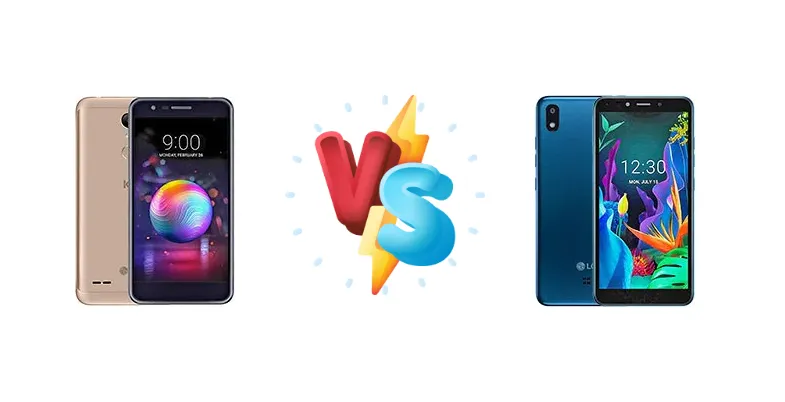
The LG K11 Plus and LG K20 (2019) represent LG’s attempts to capture the ultra-budget smartphone market. Both devices utilize Mediatek chipsets, but a key difference in their processing power dictates which phone is better suited for users prioritizing responsiveness and multitasking. This comparison dissects the architectural nuances of the MT6750 and MT6739 to reveal the real-world impact on performance.
🏆 Quick Verdict
For the average user needing a basic smartphone for calls, texts, and light social media, the LG K11 Plus emerges as the better choice. Its Mediatek MT6750 chipset, featuring an octa-core CPU, provides a noticeable performance advantage over the quad-core MT6739 in the K20 (2019), translating to smoother operation and better multitasking capabilities.
| Network |
|---|
| 2G bands | GSM 850 / 900 / 1800 / 1900 | GSM 850 / 900 / 1800 / 1900 |
| 3G bands | HSDPA 850 / 900 / 2100 - LMX410YC | HSDPA 850 / 900 / 1900 / 2100 |
| 4G bands | 1, 3, 5, 7, 8, 28, 38, 40 - LMX410YC | 1, 3, 7, 8, 20, 38 |
| Speed | HSPA 42.2/5.76 Mbps, LTE (2CA) Cat6 300/50 Mbps | HSPA 42.2/5.76 Mbps, LTE Cat4 150/50 Mbps |
| Technology | GSM / HSPA / LTE | GSM / HSPA / LTE |
| | 1, 3, 7, 8, 20 - LMX410ZCW | - |
| Launch |
|---|
| Announced | 2018, July. Released 2018, July | 2019, August. Released 2019, September |
| Status | Discontinued | Discontinued |
| Body |
|---|
| Build | Glass front, aluminum back, plastic frame | Glass front, plastic back, plastic frame |
| Dimensions | 148.7 x 75.3 x 8.7 mm (5.85 x 2.96 x 0.34 in) | 148.6 x 71.9 x 8.3 mm (5.85 x 2.83 x 0.33 in) |
| SIM | · Nano-SIM· Nano-SIM + Nano-SIM | Nano-SIM + Nano-SIM |
| Weight | 162 g (5.71 oz) | 152 g (5.36 oz) |
| | MIL-STD-810G compliant*
*does not guarantee ruggedness or use in extreme conditions | MIL-STD-810G compliant*
*does not guarantee ruggedness or use in extreme conditions |
| Display |
|---|
| Resolution | 720 x 1280 pixels, 16:9 ratio (~277 ppi density) | 480 x 960 pixels, 18:9 ratio (~197 ppi density) |
| Size | 5.3 inches, 77.4 cm2 (~69.2% screen-to-body ratio) | 5.45 inches, 76.7 cm2 (~71.7% screen-to-body ratio) |
| Type | IPS LCD | IPS LCD |
| Platform |
|---|
| CPU | Octa-core (4x1.5 GHz Cortex-A53 & 4x1.0 GHz Cortex-A53) | Quad-core 1.5 GHz Cortex-A53 |
| Chipset | Mediatek MT6750 (28 nm) | Mediatek MT6739 (28 nm) |
| GPU | Mali-T860MP2 | PowerVR GE8100 |
| OS | Android 7.1.2 (Nougat), upgradable to Android 8.1 (Oreo) | Android 9.0 Pie (Go edition) |
| Memory |
|---|
| Card slot | microSDXC (dedicated slot) | microSDHC (dedicated slot) |
| Internal | 16GB 2GB RAM, 32GB 2GB RAM, 32GB 3GB RAM | 16GB 1GB RAM |
| | eMMC 5.1 | eMMC 5.1 |
| Main Camera |
|---|
| Features | LED flash, HDR | LED flash, panorama, HDR |
| Single | 13 MP, f2.2, 26mm (wide), 1/3.1", PDAF - LG K11+
8 MP, f/2.2, 26mm (wide), 1/4.0", PDAF - LG K11α | 8 MP, f/2.0, 27mm (wide), 1/4.0", 1.12µm, AF |
| Video | 1080p@30fps | 1080p@30fps |
| Selfie camera |
|---|
| Features | - | LED flash |
| Single | 5 MP, f/2.2, 18mm, 1/5.0", 1.12µm | 5 MP, f/2.2, 24mm (wide), 1/5.0", 1.12µm |
| Video | 720p@30fps | - |
| Sound |
|---|
| 3.5mm jack | Yes | Yes |
| 35mm jack | Yes | Yes |
| Loudspeaker | Yes | Yes |
| Comms |
|---|
| Bluetooth | 4.2, A2DP, LE | 5.0, A2DP, LE |
| NFC | Yes (market dependent) | No |
| Positioning | GPS, GLONASS | GPS |
| Radio | FM radio, RDS, recording | No |
| USB | microUSB 2.0 | microUSB 2.0 |
| WLAN | Wi-Fi 802.11 b/g/n, Wi-Fi Direct | Wi-Fi 802.11 b/g/n |
| Features |
|---|
| Sensors | Fingerprint (rear-mounted), accelerometer, proximity, compass | Accelerometer, proximity |
| Battery |
|---|
| Type | Li-Ion 3000 mAh, non-removable | Li-Ion 3000 mAh, non-removable |
| Misc |
|---|
| Colors | Moroccan Blue, Terra Gold, Black | New Aurora Black, New Moroccan Blue |
| Models | LMX410, LMX410FC, LMX410YC, LMX410HC, LMX410EO, LMX410ZCW, LMX410BCW, LM-X410S | LM-X120EMW, LMX120EMW, LM-X120, LMX120BMW |
| Price | About 140 EUR | About 100 EUR |
| SAR EU | 0.81 W/kg (head) | - |
LG K11 Plus
- Octa-core processor offers superior performance.
- More responsive multitasking experience.
- Potentially better image processing speeds.
- May consume slightly more power under heavy load.
- Likely priced slightly higher than the K20 (2019).
LG K20 (2019)
- Lower price point.
- Potentially longer standby time.
- Sufficient for basic smartphone tasks.
- Quad-core processor struggles with multitasking.
- Slower app loading times.
- Less responsive user experience.
Display Comparison
Neither device is expected to boast a high-end display. Given their market segment, both likely utilize IPS LCD panels. Without specific data on brightness or resolution, it’s safe to assume both offer adequate, but not exceptional, viewing experiences. The focus here is on the chipset, as display quality is unlikely to be a differentiating factor.
Camera Comparison
Without detailed camera specifications, a direct comparison is difficult. However, given the price point, both phones likely feature basic camera setups. It’s probable that the K11 Plus’s more powerful chipset could offer slightly faster image processing speeds, but the image quality will largely depend on the sensor and lens used – data not provided. The inclusion of a 2MP macro lens on either device is unlikely to significantly impact the overall camera experience.
Performance
The core difference lies in the CPU configuration. The LG K11 Plus’s Mediatek MT6750 features an octa-core processor comprised of four Cortex-A53 cores clocked at 1.5 GHz and four at 1.0 GHz. This big.LITTLE architecture allows for efficient power management – the faster cores handle demanding tasks while the slower cores conserve battery during lighter use. Conversely, the LG K20 (2019) utilizes the Mediatek MT6739, a quad-core processor with four Cortex-A53 cores clocked at 1.5 GHz. While both chipsets are built on a 28nm process, the K11 Plus’s eight cores provide significantly more processing power, resulting in faster app loading times and smoother multitasking. The K20 (2019) will likely struggle with more than a few apps open simultaneously.
Battery Life
Battery capacity is not specified for either device. However, the MT6750 in the K11 Plus, while more powerful, is also more efficient due to its big.LITTLE architecture. This could translate to comparable, or even slightly better, battery life despite the increased processing load. Charging wattage is also unknown, making it difficult to assess 0-100% charging times. The K20 (2019)'s less demanding chipset *could* result in longer standby times, but active usage will likely drain the battery faster due to the processor being constantly stressed.
Buying Guide
Buy the LG K11 Plus if you need a phone capable of handling more than just the most basic tasks, such as running multiple apps simultaneously or playing less demanding games. The octa-core processor offers a tangible improvement in responsiveness. Buy the LG K20 (2019) if your primary needs are limited to calls, texts, and occasional light browsing, and you are prioritizing the absolute lowest possible price point. It's a functional device for minimal smartphone usage.
Frequently Asked Questions
❓ Will the LG K20 (2019) struggle with popular social media apps like Facebook and Instagram?
While the K20 (2019) can run these apps, the quad-core MT6739 processor may result in noticeable lag when scrolling through feeds or loading images, especially with multiple apps open. The K11 Plus, with its octa-core processor, will provide a smoother and more responsive experience.
❓ Is the LG K11 Plus a good choice for playing mobile games?
The LG K11 Plus is suitable for casual mobile gaming, but don't expect high frame rates or smooth performance in graphically demanding titles. The MT6750 chipset is capable of running less intensive games, but it will likely struggle with newer, more complex games. The K20 (2019) will perform even worse in gaming scenarios.
❓ Does either phone support VoLTE or Wi-Fi calling?
Without specific carrier and regional information, it's impossible to definitively say. However, given the target market, it's likely that support for these features will vary. Checking with your carrier is crucial before purchasing either device to ensure compatibility with your network.